

Shield lichen
Parmelia fertilis Müll.Arg.
Edibility
Edibility unknown — do not eat
Never eat a wild mushroom based on this site or any app.
Lookalikes
No lookalikes are recorded for this species yet. That does not mean there are none. Many mushrooms look alike, so never rely on appearance alone.
Season
When this species has been recorded, by month, from open-licensed US and Canada observations. It shows when people report it, not a guarantee it is fruiting.
The highlighted bar is the current month.
View season data as a table
| Month | Records |
|---|---|
| January | 0 |
| February | 0 |
| March | 0 |
| April | 0 |
| May | 2 |
| June | 5 |
| July | 5 |
| August | 2 |
| September | 6 |
| October | 0 |
| November | 0 |
| December | 0 |
Where it is found
States and provinces with the most records. Check the foraging rules for the place you plan to visit.
- New Brunswick 12 records · Foraging rules
- Quebec 2 records · Foraging rules
- New Hampshire 2 records · Foraging rules
- Nova Scotia 1 records · Foraging rules
- Maine 1 records · Foraging rules
- Vermont 1 records · Foraging rules
- Prince Edward Island 1 records · Foraging rules
About
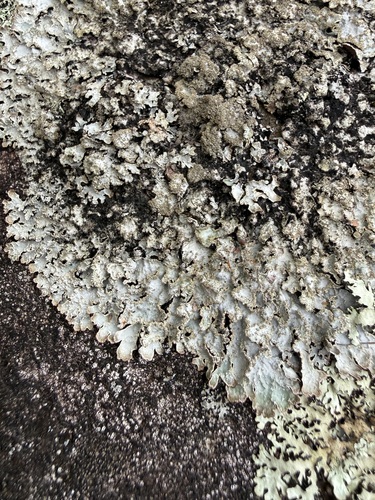
Parmelia fertilis is a species of corticolous (bark-dwelling) foliose lichen in the family Parmeliaceae. Originally described from Siberian collections in 1887, this lichen has a broad temperate distribution across the Northern Hemisphere, occurring in Asia from the Himalayas to Japan and Taiwan, in Siberia, and in maritime regions of eastern Canada. In North America it was recognised only late in the 20th century and has since been confirmed from Maine, where it was first reported for the United States. The species forms pale greenish to whitish-grey rosette-shaped growths 6–12 cm across on tree bark, characterized by lobes with conspicuous pale pores that sometimes merge into a white network near the tips. It is closely related to Parmelia sulcata but can be distinguished by its smaller asexual spores and denser root-like structures on the undersurface, and it readily produces fruiting bodies.
From Wikipedia, CC BY-SA 4.0. Read the original article.
Recent finds
No community finds tagged with this species yet. Log a find.
More in the genus Parmelia
-
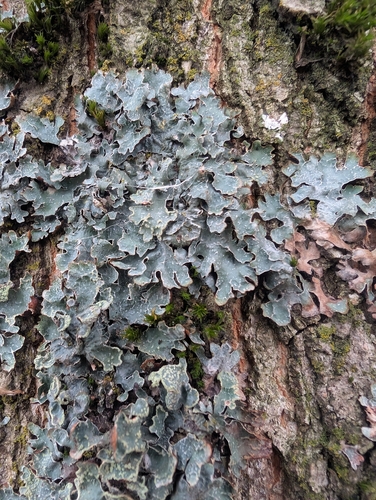
Netted Shield Lichen
Parmelia sulcata
Edibility unknown — do not eat -
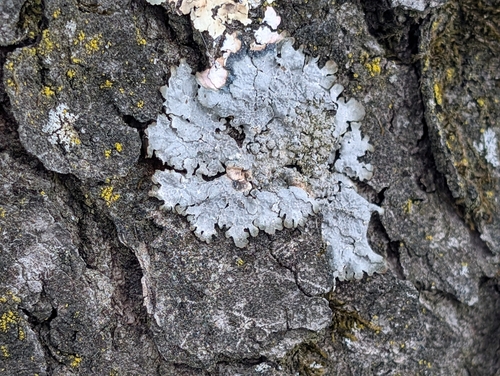
Bottle Brush Shield Lichen
Parmelia squarrosa
Edibility unknown — do not eat -
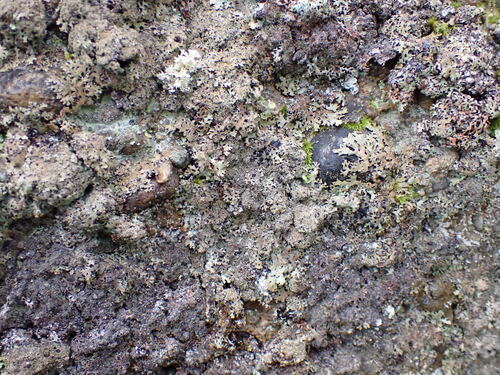
Salted Shield Lichen
Parmelia saxatilis
Edibility unknown — do not eat -
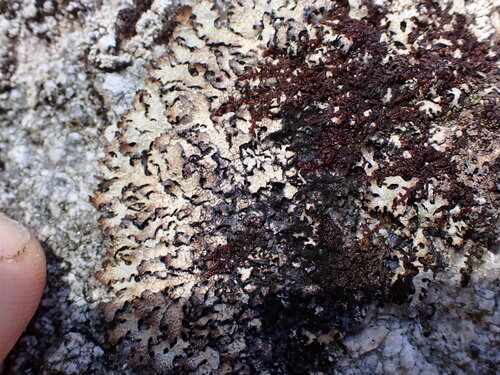
Smoky Crottle
Parmelia omphalodes
Edibility unknown — do not eat -

Western Shield Lichen
Parmelia hygrophila
Edibility unknown — do not eat -
Pea-green Shield Lichen
Parmelia fraudans
Edibility unknown — do not eat - No photo yet
Parmelia rigida
Edibility unknown — do not eat - No photo yet
Appalachian Shield Lichen
Parmelia neodiscordans
Edibility unknown — do not eat
Never eat a wild mushroom based on this site or any app. See safety basics and the disclaimer.