

Netted Shield Lichen
Parmelia sulcata Taylor
Also called: Hammered Shield Lichen, shield lichen, cracked-shield lichen, furrowed shield lichen, powdered crottle, powdered shield
Edibility
Edibility unknown — do not eat
Never eat a wild mushroom based on this site or any app.
Photos
-
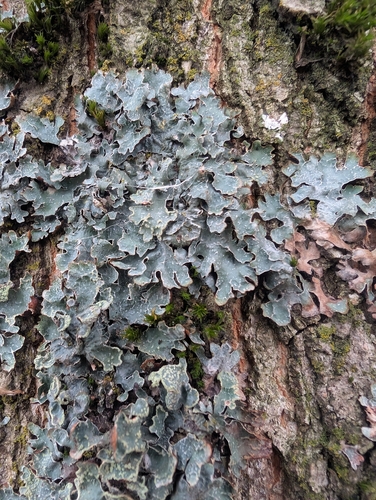
Photo: Simone Littledale. CC-BY. Source (inaturalist) -
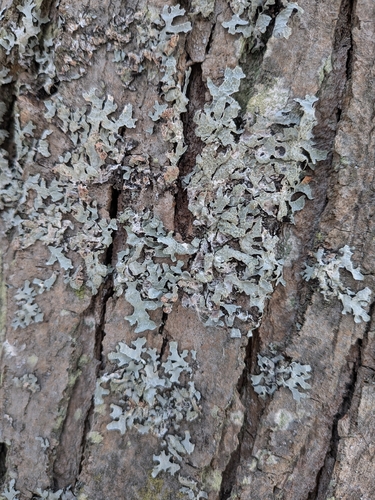
Photo: Ivan Wiljanen. CC-BY. Source (inaturalist) -
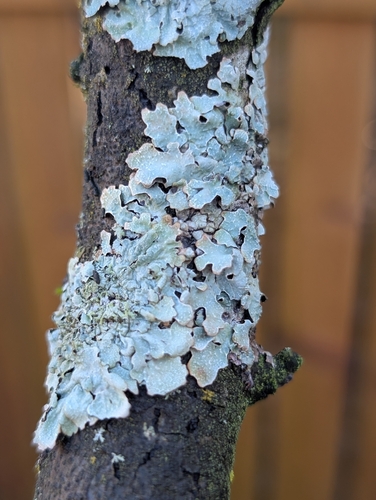
Photo: Matt B. CC0. Source (inaturalist) -
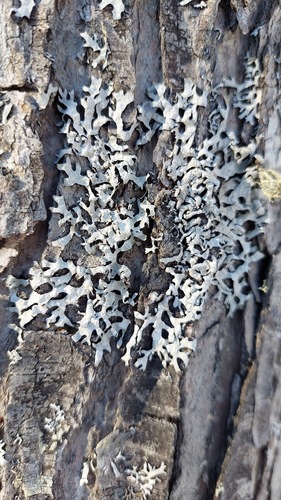
Photo: Étienne Lacroix-Carignan. CC0. Source (inaturalist)
Lookalikes
No lookalikes are recorded for this species yet. That does not mean there are none. Many mushrooms look alike, so never rely on appearance alone.
Season
When this species has been recorded, by month, from open-licensed US and Canada observations. It shows when people report it, not a guarantee it is fruiting.
The highlighted bar is the current month.
View season data as a table
| Month | Records |
|---|---|
| January | 232 |
| February | 230 |
| March | 341 |
| April | 446 |
| May | 653 |
| June | 1,176 |
| July | 1,976 |
| August | 1,483 |
| September | 701 |
| October | 465 |
| November | 220 |
| December | 175 |
Where it is found
States and provinces with the most records. Check the foraging rules for the place you plan to visit.
- British Columbia 1,179 records · Foraging rules
- Minnesota 739 records · Foraging rules
- Michigan 715 records · Foraging rules
- Ontario 672 records · Foraging rules
- Alaska 454 records · Foraging rules
- Quebec 287 records · Foraging rules
- Wisconsin 282 records · Foraging rules
- New York 275 records · Foraging rules
- Washington 268 records · Foraging rules
- Pennsylvania 267 records · Foraging rules
- Massachusetts 236 records · Foraging rules
- Maine 217 records · Foraging rules
- Oregon 210 records · Foraging rules
- Alberta 181 records · Foraging rules
- California 156 records · Foraging rules
Show 36 more
- New Jersey130 records
- North Dakota128 records
- Colorado124 records
- North Carolina122 records
- West Virginia121 records
- South Dakota117 records
- Manitoba117 records
- New Hampshire112 records
- Connecticut106 records
- Virginia101 records
- Northwest Territories96 records
- Ohio83 records
- Vermont79 records
- Nunavut75 records
- Newfoundland and Labrador70 records
- Maryland57 records
- Yukon53 records
- Nova Scotia53 records
- New Mexico51 records
- New Brunswick49 records
- Montana45 records
- Wyoming41 records
- Idaho35 records
- Arizona24 records
- Tennessee24 records
- Iowa21 records
- Illinois16 records
- Nebraska16 records
- Indiana15 records
- Saskatchewan12 records
- Prince Edward Island10 records
- Rhode Island10 records
- Delaware3 records
- Georgia3 records
- Florida1 records
- Kentucky1 records
About
Parmelia sulcata, commonly known as the hammered shield lichen or cracked-shield lichen, is a foliose lichen in the family Parmeliaceae. First described by Thomas Taylor in 1836, it is one of the most prevalent lichen species globally, known for its resilience to pollution and cosmopolitan distribution across temperate and cold regions of both hemispheres. P. sulcata forms a circular thallus up to 10 cm (4 in) in diameter, with a glaucous white to grey upper surface and a black lower surface, featuring broadly lobed structures with both marginal and laminal soralia and a distinctive reticulate pattern of pseudocyphellae. Taxonomically, Parmelia sulcata has a complex history. Molecular phylogenetics studies have revealed significant genetic variability within what was traditionally considered a single species, identifying a complex of cryptic species, including Parmelia encryptata and P. barrenoae, and demonstrate the necessity of molecular data for accurate species identification. P. sulcata maintains a highly specific symbiotic relationship with green algae of the genus Trebouxia, particularly species within Trebouxia clade I, as its photobiont partner. Ecologically, Parmelia sulcata grows on various substrates, including bark, wood, and rocks. It accumulates pollutants such as heavy metals and radionuclides, reflecting air quality and contamination levels, making it a useful bioindicator in pollution studies across Europe, North America, and other regions. Beyond its ecological importance, P. sulcata has been used in traditional medicine and as a source of natural dyes.
From Wikipedia, CC BY-SA 4.0. Read the original article.
More in the genus Parmelia


Never eat a wild mushroom based on this site or any app. See safety basics and the disclaimer.