

Bottle Brush Shield Lichen
Parmelia squarrosa Hale
Also called: Bottlebrush Shield Lichen, shield lichen
Edibility
Edibility unknown — do not eat
Never eat a wild mushroom based on this site or any app.
Photos
-
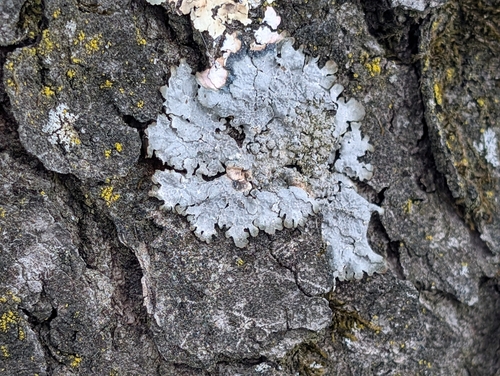
Photo: Connor Sites-Bowen. CC-BY. Source (inaturalist) -
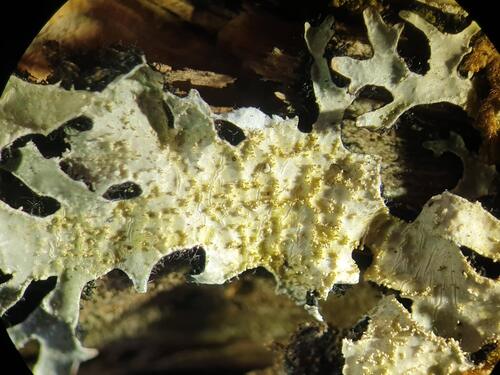
Photo: Étienne Lacroix-Carignan. CC0. Source (inaturalist) -
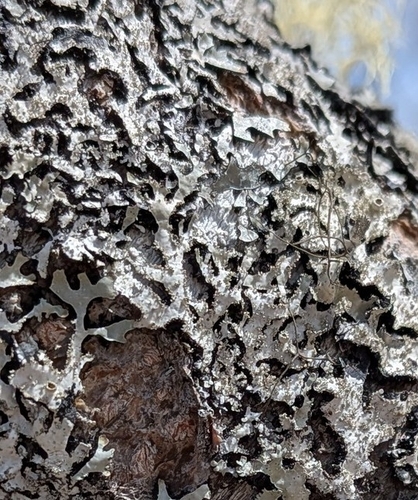
Photo: alicia penney. CC-BY. Source (inaturalist) -
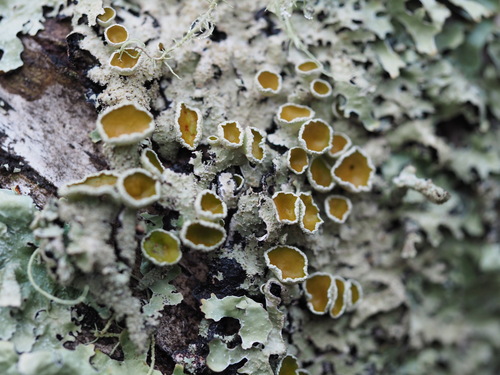
Photo: T. CC-BY. Source (inaturalist)
Lookalikes
No lookalikes are recorded for this species yet. That does not mean there are none. Many mushrooms look alike, so never rely on appearance alone.
Season
When this species has been recorded, by month, from open-licensed US and Canada observations. It shows when people report it, not a guarantee it is fruiting.
The highlighted bar is the current month.
View season data as a table
| Month | Records |
|---|---|
| January | 56 |
| February | 52 |
| March | 97 |
| April | 218 |
| May | 278 |
| June | 374 |
| July | 850 |
| August | 461 |
| September | 315 |
| October | 215 |
| November | 55 |
| December | 78 |
Where it is found
States and provinces with the most records. Check the foraging rules for the place you plan to visit.
- Minnesota 319 records · Foraging rules
- Michigan 273 records · Foraging rules
- North Carolina 271 records · Foraging rules
- Virginia 204 records · Foraging rules
- Maine 187 records · Foraging rules
- Tennessee 163 records · Foraging rules
- Quebec 158 records · Foraging rules
- New York 150 records · Foraging rules
- Pennsylvania 149 records · Foraging rules
- Wisconsin 137 records · Foraging rules
- West Virginia 134 records · Foraging rules
- Ontario 124 records · Foraging rules
- Nova Scotia 94 records · Foraging rules
- New Brunswick 92 records · Foraging rules
- Massachusetts 92 records · Foraging rules
Show 28 more
- New Jersey89 records
- Alaska69 records
- British Columbia63 records
- Georgia57 records
- Newfoundland and Labrador47 records
- Kentucky36 records
- Vermont25 records
- Connecticut25 records
- Alabama24 records
- Maryland23 records
- Oregon19 records
- Prince Edward Island18 records
- New Hampshire17 records
- Ohio17 records
- Arkansas8 records
- South Carolina8 records
- California7 records
- Northwest Territories5 records
- Indiana5 records
- Nunavut3 records
- Rhode Island3 records
- Washington3 records
- Manitoba3 records
- Montana2 records
- Iowa2 records
- Missouri1 records
- Colorado1 records
- Illinois1 records
About
Parmelia squarrosa, commonly known as the bottlebrush shield lichen, is a species of foliose lichen in the family Parmeliaceae. It occurs in east Asia, Europe, and eastern North America, where it typically grows on tree bark, much less frequently on rocks, and rarely on moss. Because of its abundance, widespread distribution, and stable populations, it has been assessed as a species of least concern by the International Union for Conservation of Nature. Parmelia saxatilis is quite similar in appearance Parmelia squarrosa and the latter was quite often confused with the former, especially in herbarium collections. Molecular phylogenetic analysis proved the genetic distinctness between the two species, which are morphologically distinguished by difference in rhizine structure.
From Wikipedia, CC BY-SA 4.0. Read the original article.
More in the genus Parmelia


Never eat a wild mushroom based on this site or any app. See safety basics and the disclaimer.