

Parmelia barrenoae
Parmelia barrenoae Divakar, M.C.Molina & A.Crespo
Edibility
Edibility unknown — do not eat
Never eat a wild mushroom based on this site or any app.
Lookalikes
No lookalikes are recorded for this species yet. That does not mean there are none. Many mushrooms look alike, so never rely on appearance alone.
Season
When this species has been recorded, by month, from open-licensed US and Canada observations. It shows when people report it, not a guarantee it is fruiting.
The highlighted bar is the current month.
View season data as a table
| Month | Records |
|---|---|
| January | 0 |
| February | 0 |
| March | 2 |
| April | 3 |
| May | 13 |
| June | 10 |
| July | 3 |
| August | 4 |
| September | 2 |
| October | 3 |
| November | 0 |
| December | 0 |
Where it is found
States and provinces with the most records. Check the foraging rules for the place you plan to visit.
- California 21 records · Foraging rules
- Ontario 7 records · Foraging rules
- Oregon 4 records · Foraging rules
- Washington 4 records · Foraging rules
- Idaho 2 records · Foraging rules
About
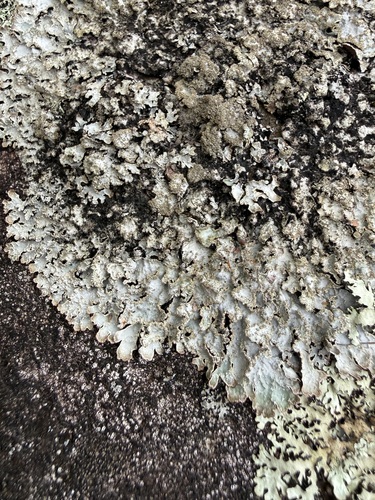
Parmelia barrenoae is a species of foliose lichen in the large family Parmeliaceae. It was formally described as a new species in 2005. Before this, it was lumped together as one of several lichens in the Parmelia sulcata group—a species complex of genetically distinct lookalikes. Parmelia barrenoae is widely distributed, occurring in Europe, western North America, Africa, and Asia. The greenish grey to whitish grey leafy thallus of Parmelia barrenoae grows up to 10 cm (4 in) in diameter. Features of the thallus surface include tiny pores for gas exchange, and vegetative propagules called soralia. The lichen usually grows on tree bark, but is occasionally found on moss-covered rocks in open and sunny places. The lookalike species Parmelia submontana and Parmelia sulcata can be distinguished from Parmelia barrenoae by small differences in morphology. Studies indicate that Parmelia barrenoae is sensitive to air pollution, and it has been proposed for use as an indicator of well conserved and sustainably managed forests.
From Wikipedia, CC BY-SA 4.0. Read the original article.
Recent finds
No community finds tagged with this species yet. Log a find.
More in the genus Parmelia
-
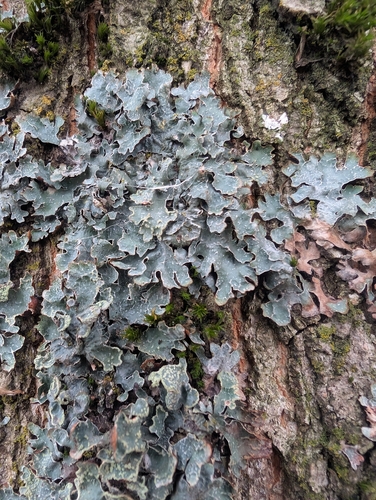
Netted Shield Lichen
Parmelia sulcata
Edibility unknown — do not eat -
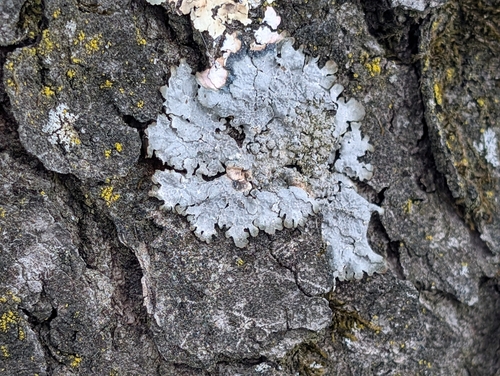
Bottle Brush Shield Lichen
Parmelia squarrosa
Edibility unknown — do not eat -
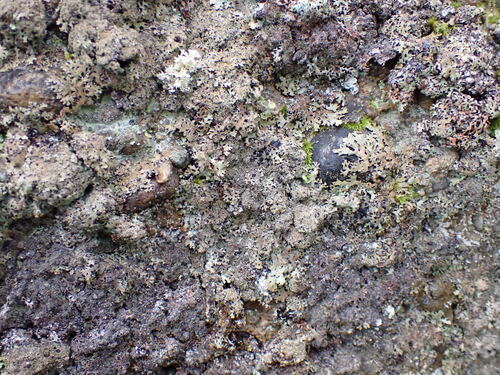
Salted Shield Lichen
Parmelia saxatilis
Edibility unknown — do not eat -
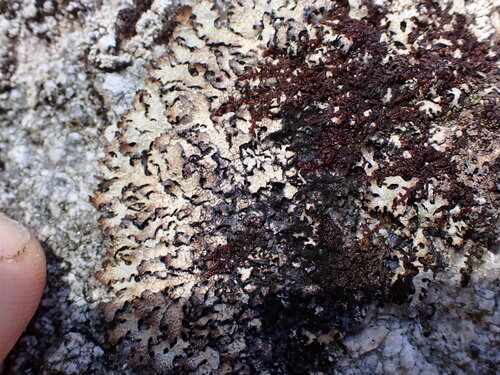
Smoky Crottle
Parmelia omphalodes
Edibility unknown — do not eat -

Western Shield Lichen
Parmelia hygrophila
Edibility unknown — do not eat -
Pea-green Shield Lichen
Parmelia fraudans
Edibility unknown — do not eat - No photo yet
Parmelia rigida
Edibility unknown — do not eat - No photo yet
Appalachian Shield Lichen
Parmelia neodiscordans
Edibility unknown — do not eat
Never eat a wild mushroom based on this site or any app. See safety basics and the disclaimer.