

Parmelia asiatica
Parmelia asiatica A.Crespo & Divakar
Edibility
Edibility unknown — do not eat
Never eat a wild mushroom based on this site or any app.
Lookalikes
No lookalikes are recorded for this species yet. That does not mean there are none. Many mushrooms look alike, so never rely on appearance alone.
Season
When this species has been recorded, by month, from open-licensed US and Canada observations. It shows when people report it, not a guarantee it is fruiting.
The highlighted bar is the current month.
View season data as a table
| Month | Records |
|---|---|
| January | 0 |
| February | 0 |
| March | 2 |
| April | 0 |
| May | 0 |
| June | 0 |
| July | 7 |
| August | 1 |
| September | 0 |
| October | 0 |
| November | 1 |
| December | 0 |
Where it is found
States and provinces with the most records. Check the foraging rules for the place you plan to visit.
- British Columbia 5 records · Foraging rules
- Alaska 4 records · Foraging rules
- Washington 2 records · Foraging rules
About
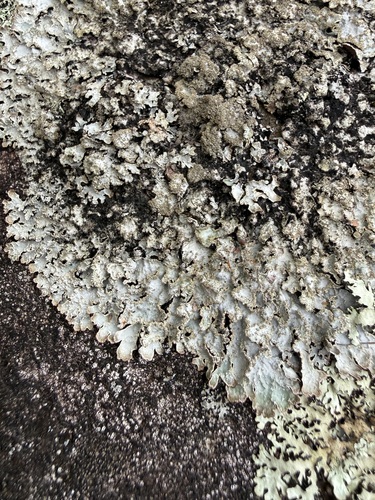
Parmelia asiatica is a species of corticolous (bark-dwelling) foliose lichen in the family Parmeliaceae. It was described as new to science in 2011 by lichenologists Ana Crespo and Pradeep Divakar, based on specimens from Yunnan, China. Since then, its known distribution has expanded to include various regions of Russia, parts of North America, and as of 2024, European Russia. The species is found in the forests of temperate and boreal climates, growing on the bark of various tree species. Parmelia asiatica is distinguished by its small thallus with narrow, more or less linear lobes, soralia that appear at the ends of the lobes, marginal linear pseudocyphellae, and a chemical composition that includes atranorin, salazinic acid, and consalazinic acid. While similar to other Parmelia species, it can be differentiated from them by its morphological and chemical characteristics.
From Wikipedia, CC BY-SA 4.0. Read the original article.
Recent finds
No community finds tagged with this species yet. Log a find.
More in the genus Parmelia
-
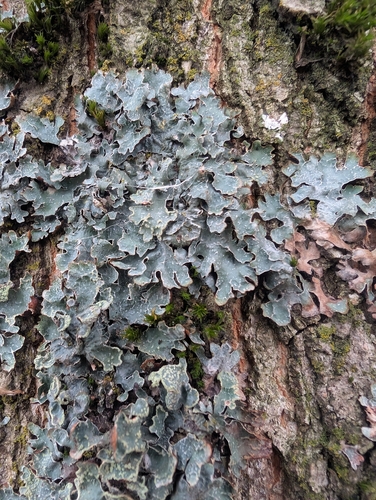
Netted Shield Lichen
Parmelia sulcata
Edibility unknown — do not eat -
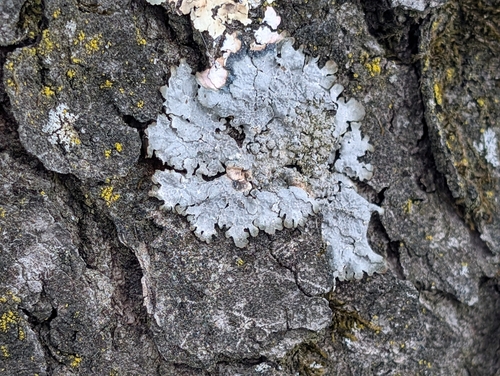
Bottle Brush Shield Lichen
Parmelia squarrosa
Edibility unknown — do not eat -
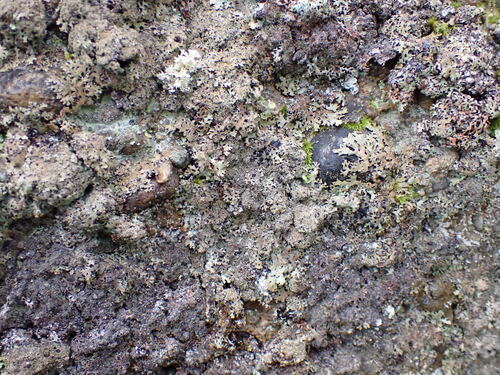
Salted Shield Lichen
Parmelia saxatilis
Edibility unknown — do not eat -
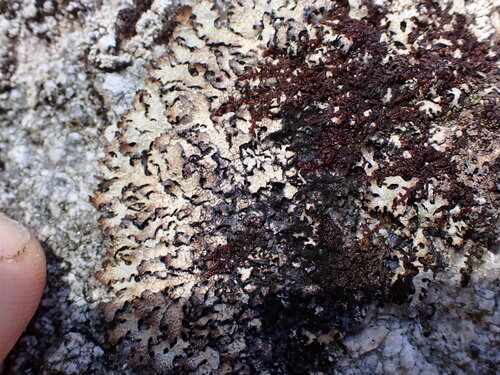
Smoky Crottle
Parmelia omphalodes
Edibility unknown — do not eat -

Western Shield Lichen
Parmelia hygrophila
Edibility unknown — do not eat -
Pea-green Shield Lichen
Parmelia fraudans
Edibility unknown — do not eat - No photo yet
Parmelia rigida
Edibility unknown — do not eat - No photo yet
Appalachian Shield Lichen
Parmelia neodiscordans
Edibility unknown — do not eat
Never eat a wild mushroom based on this site or any app. See safety basics and the disclaimer.