

Suillus serotinus
Suillus serotinus (Frost) Kretzer & T.D.Bruns
Edibility
Edibility unknown — do not eat
Never eat a wild mushroom based on this site or any app.
Lookalikes
No lookalikes are recorded for this species yet. That does not mean there are none. Many mushrooms look alike, so never rely on appearance alone.
Season
When this species has been recorded, by month, from open-licensed US and Canada observations. It shows when people report it, not a guarantee it is fruiting.
The highlighted bar is the current month.
View season data as a table
| Month | Records |
|---|---|
| January | 0 |
| February | 0 |
| March | 0 |
| April | 0 |
| May | 0 |
| June | 0 |
| July | 0 |
| August | 12 |
| September | 14 |
| October | 6 |
| November | 0 |
| December | 0 |
Where it is found
States and provinces with the most records. Check the foraging rules for the place you plan to visit.
- Quebec 13 records · Foraging rules
- Minnesota 6 records · Foraging rules
- Alaska 4 records · Foraging rules
- New York 4 records · Foraging rules
- Wisconsin 4 records · Foraging rules
- Ontario 3 records · Foraging rules
- Vermont 3 records · Foraging rules
About
Suillus serotinus is a species of bolete fungus found in eastern North America. Originally described as a species of Boletus by American botanist Charles Christopher Frost in 1874, it was transferred to Suillus in 1996. The bolete has a dark red brown and sticky cap up to 12 cm (4.7 in) in diameter. The pore surface is initially white before turning reddish brown in age; the angular pores number from 1 to 3 per millimeter. Mushroom flesh slowly stains bluish after injury, later becoming purplish gray then finally reddish brown. The fungus grows in a mycorrhizal association with larch and fruits on the ground scattered or in groups. The spore print is purplish brown; spores are oblong to ellipsoid, smooth, and measure 8–12 by 4–5 μm. The fruit bodies are edible, but lack any distinctive taste or odor.
From Wikipedia, CC BY-SA 4.0. Read the original article.
Recent finds
No community finds tagged with this species yet. Log a find.
More in the genus Suillus
-
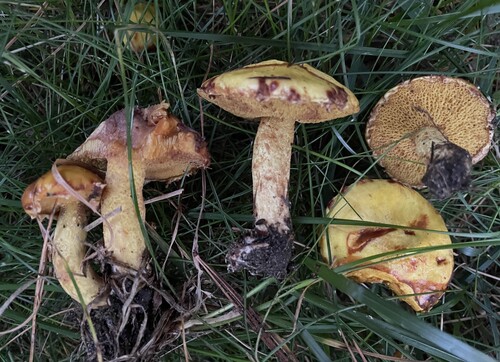
Chicken Fat Mushroom
Suillus americanus
Edible (per source) -
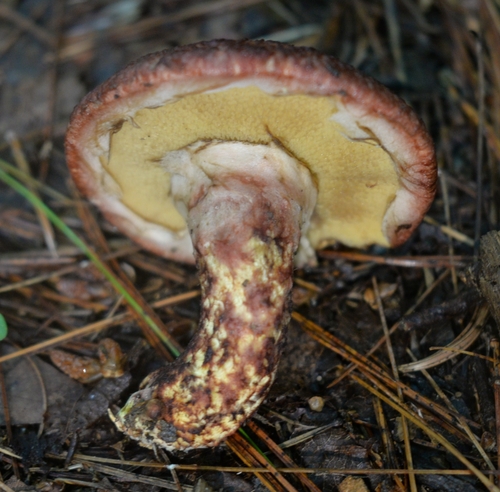
Painted Suillus
Suillus spraguei
Edible (per source) -
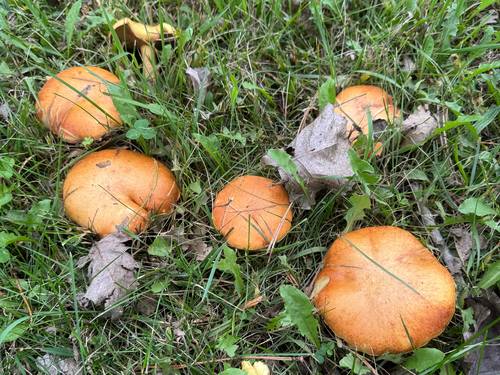
Weeping Bolete
Suillus granulatus
Edibility unknown — do not eat -
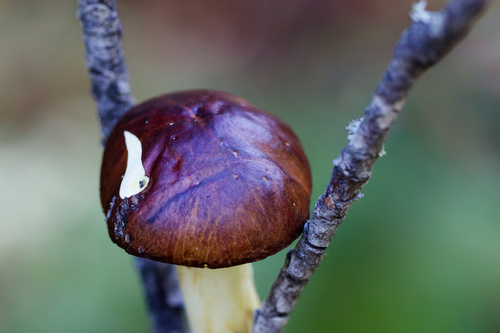
Short-stalked Suillus
Suillus brevipes
Edible (per source) -
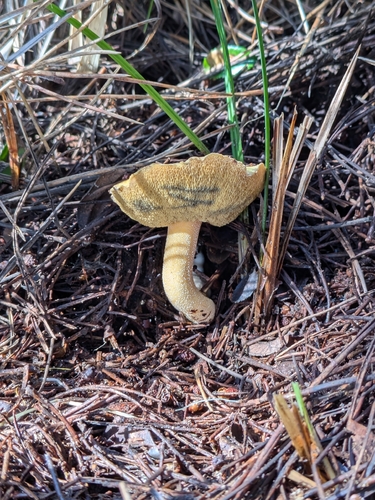
Blue-staining Slippery Jack
Suillus tomentosus
Caution -
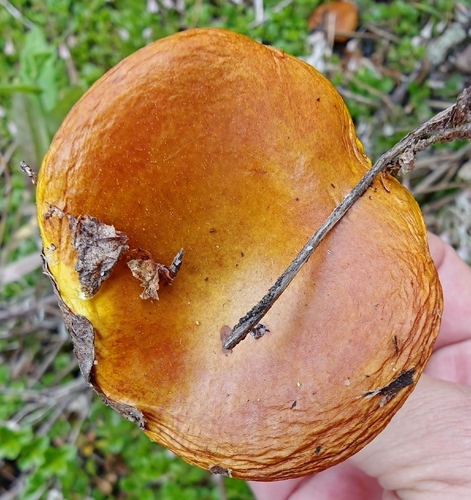
Larch Bolete
Suillus grevillei
Edible (per source) -
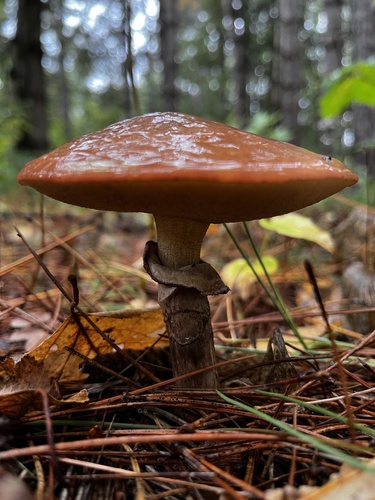
Slippery Jack
Suillus luteus
Edible (per source) -
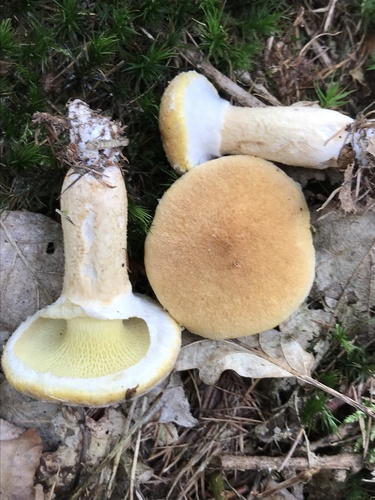
Hollow Bolete
Suillus cavipes
Edible (per source)
Never eat a wild mushroom based on this site or any app. See safety basics and the disclaimer.