

Painted Suillus
Suillus spraguei (Berk. & M.A.Curtis) Kuntze
Safety first
Many edible mushrooms have toxic lookalikes, and some of those can be fatal. Have any mushroom identified in person by a local expert before you eat it.
If someone may have eaten a wild mushroom, call US Poison Control at 1-800-222-1222 or 911 right away. In Canada, call your provincial poison centre or 911.
Edibility
Edible (per source) Source: Wikipedia: Suillus spraguei
Classification from Wikipedia: Suillus spraguei. Sources can be wrong or incomplete, and people react differently.
Never eat a wild mushroom based on this site or any app.
Photos
-
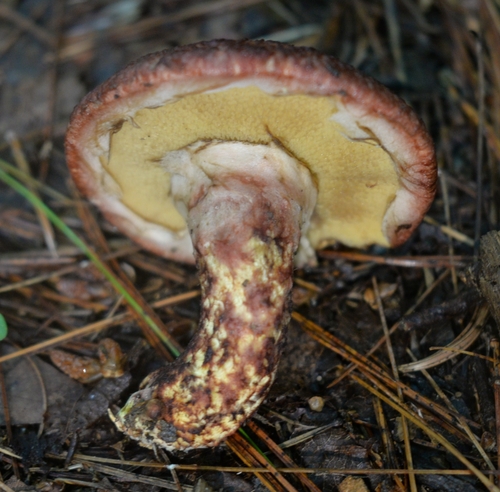
Photo: Ben Gruhot. CC-BY. Source (inaturalist) -
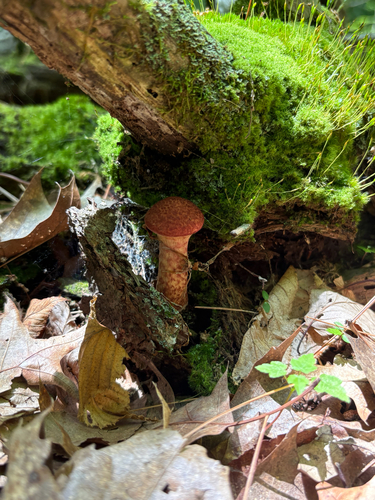
Photo: delognut. CC-BY. Source (inaturalist) -
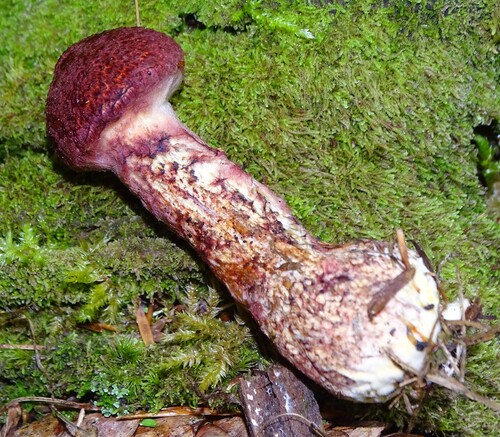
Photo: Shirley Zundell. CC-BY. Source (inaturalist) -
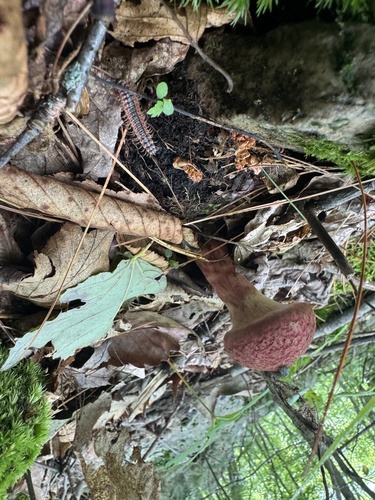
Photo: SiphonophoreSlinger. CC-BY. Source (inaturalist)
Lookalikes
No lookalikes are recorded for this species yet. That does not mean there are none. Many mushrooms look alike, so never rely on appearance alone.
Season
When this species has been recorded, by month, from open-licensed US and Canada observations. It shows when people report it, not a guarantee it is fruiting.
The highlighted bar is the current month.
View season data as a table
| Month | Records |
|---|---|
| January | 1 |
| February | 0 |
| March | 0 |
| April | 0 |
| May | 54 |
| June | 75 |
| July | 416 |
| August | 686 |
| September | 416 |
| October | 163 |
| November | 18 |
| December | 0 |
Where it is found
States and provinces with the most records. Check the foraging rules for the place you plan to visit.
- Ontario 211 records · Foraging rules
- Massachusetts 184 records · Foraging rules
- New York 167 records · Foraging rules
- North Carolina 136 records · Foraging rules
- Michigan 118 records · Foraging rules
- Pennsylvania 94 records · Foraging rules
- New Hampshire 93 records · Foraging rules
- Virginia 88 records · Foraging rules
- Vermont 81 records · Foraging rules
- Maine 79 records · Foraging rules
- Quebec 61 records · Foraging rules
- Nova Scotia 44 records · Foraging rules
- Tennessee 37 records · Foraging rules
- Wisconsin 33 records · Foraging rules
- Minnesota 28 records · Foraging rules
Show 23 more
- West Virginia26 records
- Connecticut25 records
- New Brunswick24 records
- Georgia23 records
- British Columbia8 records
- Rhode Island8 records
- New Jersey6 records
- California4 records
- Florida4 records
- Kentucky4 records
- Ohio4 records
- Colorado3 records
- Prince Edward Island2 records
- Alberta1 records
- District of Columbia1 records
- Illinois1 records
- Indiana1 records
- Maryland1 records
- Montana1 records
- South Carolina1 records
- Texas1 records
- Washington1 records
- Wyoming1 records
Identification traits
| Cap shape | convex |
|---|---|
| Underside (gills, pores or teeth) | pores |
| Ecology | mycorrhizal |
| Stem features | ring |
| Spore print color | olive-brown |
Traits vary. Use them to ask better questions of an expert, not to make a final call.
About
Suillus spraguei is a species of fungus in the family Suillaceae. It is known by a variety of common names, including the painted slipperycap, the painted suillus or the red and yellow suillus. Suillus spraguei has had a complex taxonomical history and is also frequently referred to as Suillus pictus. The readily identifiable fruit bodies have caps that are dark red when fresh, dry to the touch, and covered with mats of hairs and scales that are separated by yellow cracks. On the underside of the cap are small, yellow, angular pores that become brownish as the mushroom ages. The stalk bears a grayish cottony ring and is typically covered with soft hairs or scales. The species bears a resemblance to several other members of Suillus, including S. decipiens, but can be differentiated by variations in color and size. Suillus spraguei grows in a mycorrhizal association with several pine species, particularly eastern white pine, and the fruit bodies grow on the ground, appearing from early summer to autumn. It has a disjunct distribution, and is found in eastern Asia, northeastern North America, and Mexico throughout the range of the host tree. The mushroom is edible; opinions about its quality vary.
From Wikipedia, CC BY-SA 4.0. Read the original article.
More in the genus Suillus

Never eat a wild mushroom based on this site or any app. See safety basics and the disclaimer.