

Chicken Fat Mushroom
Suillus americanus (Peck) Snell
Also called: American Slippery Jack, American Suillus
Safety first
Many edible mushrooms have toxic lookalikes, and some of those can be fatal. Have any mushroom identified in person by a local expert before you eat it.
If someone may have eaten a wild mushroom, call US Poison Control at 1-800-222-1222 or 911 right away. In Canada, call your provincial poison centre or 911.
Edibility
Edible (per source) Source: Wikipedia: Suillus americanus
Classification from Wikipedia: Suillus americanus. Sources can be wrong or incomplete, and people react differently.
Never eat a wild mushroom based on this site or any app.
Photos
-
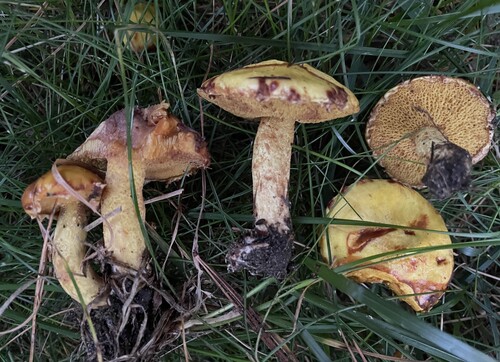
Photo: Henry Van T. Cotter. CC-BY. Source (inaturalist) -
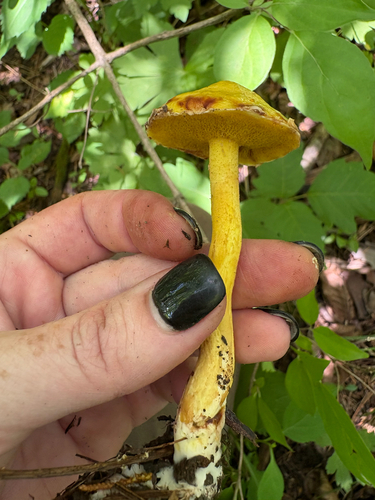
Photo: Katie Muldowney. CC-BY. Source (inaturalist) -
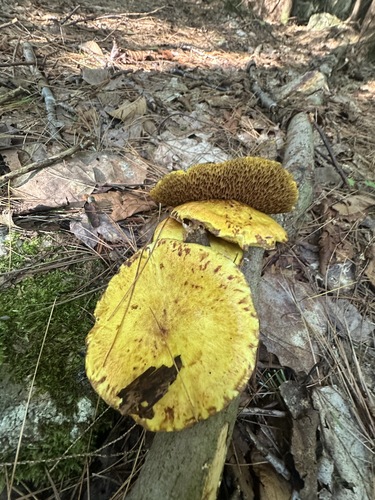
Photo: Jaime McGuigan. CC-BY. Source (inaturalist) -
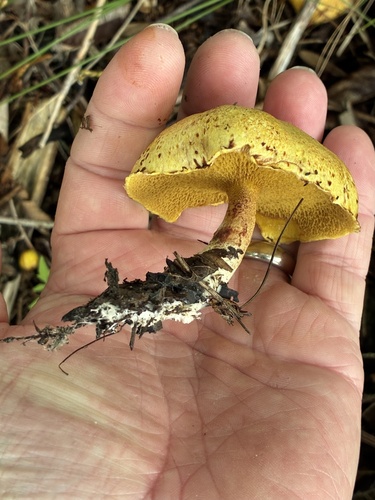
Photo: Jamie VanBuskirk. CC-BY. Source (inaturalist)
Lookalikes
No lookalikes are recorded for this species yet. That does not mean there are none. Many mushrooms look alike, so never rely on appearance alone.
Season
When this species has been recorded, by month, from open-licensed US and Canada observations. It shows when people report it, not a guarantee it is fruiting.
The highlighted bar is the current month.
View season data as a table
| Month | Records |
|---|---|
| January | 1 |
| February | 1 |
| March | 3 |
| April | 0 |
| May | 13 |
| June | 32 |
| July | 202 |
| August | 629 |
| September | 585 |
| October | 384 |
| November | 37 |
| December | 2 |
Where it is found
States and provinces with the most records. Check the foraging rules for the place you plan to visit.
- Ontario 202 records · Foraging rules
- New York 134 records · Foraging rules
- Pennsylvania 130 records · Foraging rules
- Minnesota 109 records · Foraging rules
- North Carolina 98 records · Foraging rules
- Michigan 89 records · Foraging rules
- Quebec 85 records · Foraging rules
- Massachusetts 83 records · Foraging rules
- Ohio 56 records · Foraging rules
- Tennessee 46 records · Foraging rules
- Illinois 45 records · Foraging rules
- Idaho 45 records · Foraging rules
- Virginia 43 records · Foraging rules
- Vermont 41 records · Foraging rules
- Washington 37 records · Foraging rules
Show 32 more
- Nova Scotia36 records
- Indiana35 records
- Wisconsin35 records
- Arizona29 records
- West Virginia27 records
- Colorado25 records
- Maryland25 records
- New Hampshire23 records
- California22 records
- Connecticut22 records
- Maine20 records
- Wyoming17 records
- Oregon13 records
- New Mexico11 records
- Iowa9 records
- Montana8 records
- New Jersey8 records
- British Columbia7 records
- New Brunswick7 records
- Florida6 records
- Alberta5 records
- Kentucky5 records
- Alaska2 records
- District of Columbia2 records
- Georgia2 records
- Texas2 records
- Alabama1 records
- Delaware1 records
- Kansas1 records
- Missouri1 records
- South Carolina1 records
- Utah1 records
Identification traits
| Cap shape | convex |
|---|---|
| Underside (gills, pores or teeth) | pores |
| Ecology | mycorrhizal |
| Stem features | bare |
| Spore print color | brown |
Traits vary. Use them to ask better questions of an expert, not to make a final call.
About
Suillus americanus is a species of mushroom-forming fungus in the family Suillaceae. Commonly known as the chicken fat mushroom and the American suillus, it produces bright yellow, often slimy caps marked with red to reddish-brown scales, a pore surface of large yellow angular pores that can stain brownish when bruised, and a slender yellow stipe dotted with darker glandular spots. The species was first described in the late 19th century by the American mycologist Charles Horton Peck and later transferred to Suillus. It closely resembles S. sibiricus, and DNA-based studies have led some authors to treat the two names as referring to a single, wide-ranging species complex, with several regional variants recognized at infraspecific rank. Suillus americanus is an ectomycorrhizal fungus that forms symbiotic associations with pines, best known in North America from eastern white pine (Pinus strobus). Fruiting bodies appear on the ground, singly or in clusters, most often from late summer into autumn, and records based on collections and DNA sequencing indicate a broader Northern Hemisphere distribution than was once assumed, including parts of East Asia and the Balkan Peninsula. Greenhouse experiments suggest strong host filtering during spore germination, and competition studies indicate it can colonize pine seedlings readily and dominate some other pine-associated Suillus species. The mushroom is edible but often considered mediocre because of its slimy texture, and some people develop contact dermatitis after handling it; laboratory work has also identified a beta glucan with anti-inflammatory activity. Although assessed as Least Concern globally, it has been treated as threatened or legally protected in parts of southeastern Europe where it occurs with scattered high-elevation five-needle pine forests.
From Wikipedia, CC BY-SA 4.0. Read the original article.
More in the genus Suillus

Never eat a wild mushroom based on this site or any app. See safety basics and the disclaimer.