

Ruddy Bolete
Rubroboletus rhodoxanthus (Krombh.) Kuan Zhao & Zhu L.Yang
Safety first
This mushroom is listed as poisonous. Eating it can make you seriously ill.
Many edible mushrooms have toxic lookalikes, and some of those can be fatal. Have any mushroom identified in person by a local expert before you eat it.
If someone may have eaten a wild mushroom, call US Poison Control at 1-800-222-1222 or 911 right away. In Canada, call your provincial poison centre or 911.
Edibility
Poisonous Source: Wikipedia: Rubroboletus rhodoxanthus
Classification from Wikipedia: Rubroboletus rhodoxanthus. Sources can be wrong or incomplete, and people react differently.
Never eat a wild mushroom based on this site or any app.
Photos
-
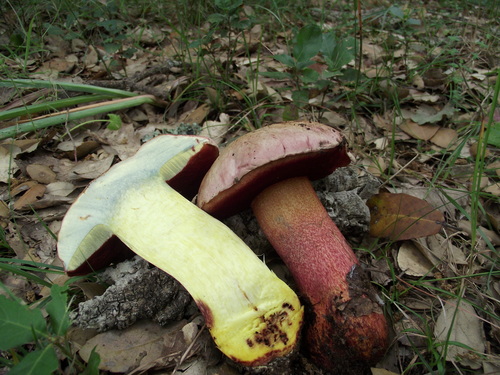
Photo: Davide Puddu. CC-BY. Source (inaturalist) -

Photo: Davide Puddu. CC-BY. Source (inaturalist)
Lookalikes
No lookalikes are recorded for this species yet. That does not mean there are none. Many mushrooms look alike, so never rely on appearance alone.
Season
Season data is not available for this species yet.
Where it is found
States and provinces with the most records. Check the foraging rules for the place you plan to visit.
- Pennsylvania 1 records · Foraging rules
Identification traits
| Cap shape | convex |
|---|---|
| Underside (gills, pores or teeth) | pores |
| Ecology | mycorrhizal |
| Stem features | bare |
| Spore print color | olive-brown |
Traits vary. Use them to ask better questions of an expert, not to make a final call.
About
Rubroboletus rhodoxanthus is a species of bolete in the family Boletaceae, native to Europe. Previously known as Boletus rhodoxanthus, it was transferred in 2014 to the newly erected genus Rubroboletus, based on DNA data. It produces large, colourful fruit bodies with pink patches on the cap, red pores in the hymenial surface and has a robust stem decorated in a dense, red-coloured network pattern. When longitudinally sliced, its flesh is distinctly bright yellow in the stem and discolours blue only in the cap, an excellent diagnostic feature distinguishing it from similar species. The fungus is more widespread in warm broad-leaved forests of southern Europe, where it grows in mycorrhizal symbiosis with trees of the family Fagaceae, particularly oak (Quercus) and beech (Fagus). However, it is rare in northern regions and regarded as critically endangered or extinct in some countries. Rubroboletus rhodoxanthus is generally regarded as inedible and may cause adverse gastrointestinal symptoms if consumed.
From Wikipedia, CC BY-SA 4.0. Read the original article.
Recent finds
No community finds tagged with this species yet. Log a find.
More in the genus Rubroboletus
-

Satan’s Bolete
Rubroboletus pulcherrimus
Deadly — can kill -

Alice Eastwood's Bolete
Rubroboletus eastwoodiae
Edibility unknown — do not eat -
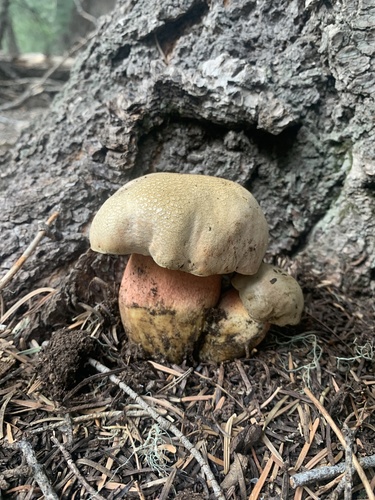
Mountain Satan's Bolete
Rubroboletus haematinus
Edibility unknown — do not eat -

Devil's Bolete
Rubroboletus satanas
Edibility unknown — do not eat -
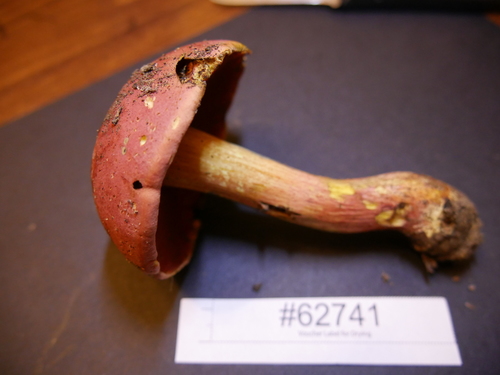
Perfumed Bolete
Rubroboletus rhodosanguineus
Edibility unknown — do not eat - No photo yet
Dupain's Bolete
Rubroboletus dupainii
Edibility unknown — do not eat
Never eat a wild mushroom based on this site or any app. See safety basics and the disclaimer.