

Alice Eastwood's Bolete
Rubroboletus eastwoodiae (Murrill) Vasquez, Simonini, Svetash., Mikšík & Vizzini
Also called: California Satan's Bolete
Edibility
Edibility unknown — do not eat
Never eat a wild mushroom based on this site or any app.
Photos
-

Photo: dloarie. CC-BY. Source (inaturalist) -

Photo: Ken-ichi Ueda. CC-BY. Source (inaturalist) -
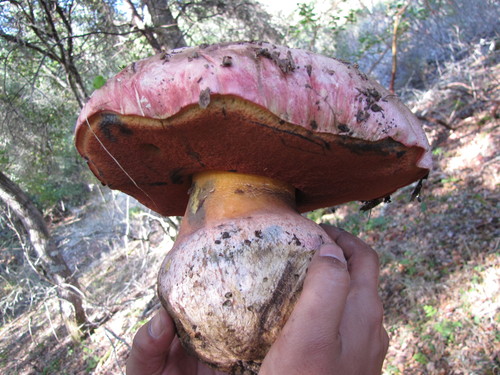
Photo: Alan Rockefeller. CC-BY. Source (inaturalist) -
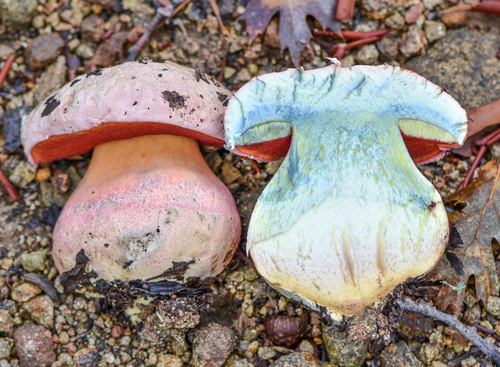
Photo: Don Loarie. CC-BY. Source (inaturalist)
Lookalikes
No lookalikes are recorded for this species yet. That does not mean there are none. Many mushrooms look alike, so never rely on appearance alone.
Season
When this species has been recorded, by month, from open-licensed US and Canada observations. It shows when people report it, not a guarantee it is fruiting.
The highlighted bar is the current month.
View season data as a table
| Month | Records |
|---|---|
| January | 0 |
| February | 3 |
| March | 0 |
| April | 0 |
| May | 0 |
| June | 0 |
| July | 0 |
| August | 6 |
| September | 2 |
| October | 14 |
| November | 33 |
| December | 19 |
Where it is found
States and provinces with the most records. Check the foraging rules for the place you plan to visit.
- California 56 records · Foraging rules
- British Columbia 4 records · Foraging rules
- Washington 3 records · Foraging rules
- Idaho 2 records · Foraging rules
- Oregon 2 records · Foraging rules
Identification traits
| Cap shape | convex |
|---|---|
| Underside (gills, pores or teeth) | pores |
| Ecology | mycorrhizal |
| Stem features | bare |
| Spore print color | olive-brown |
Traits vary. Use them to ask better questions of an expert, not to make a final call.
About
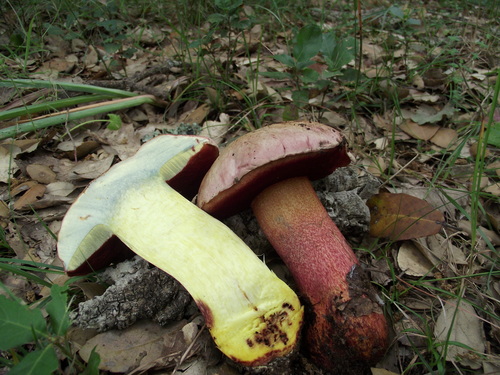
Rubroboletus eastwoodiae, sometimes called satan's bolete, is a possibly toxic basidiomycete fungus of the bolete family. The cap is 6–25 centimetres (2+1⁄2–10 in) wide, convex, olive-colored, pinkish in age, dry, has margin that curves inward then expands, and yellowish flesh. The stalk is 7–15 cm (3–6 in) tall and 3–6 cm (1+1⁄4–2+1⁄4 in) wide. The flesh turns blue when cut. The spores are olive-brown, elliptical, and smooth. The spore print is olive brown. It is closely related to Rubroboletus pulcherrimus. It looks similar to but is genetically distinct from the European species R. satanas. It is also similar to R. pulcherrimus and Suillellus amygdalinus. It occurs under oak on the West Coast of the United States from November to January. The edibility of the species is unknown; it may be poisonous.
From Wikipedia, CC BY-SA 4.0. Read the original article.
Recent finds
No community finds tagged with this species yet. Log a find.
More in the genus Rubroboletus
-

Satan’s Bolete
Rubroboletus pulcherrimus
Deadly — can kill -
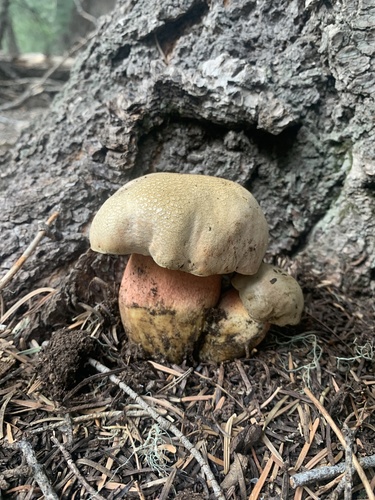
Mountain Satan's Bolete
Rubroboletus haematinus
Edibility unknown — do not eat -

Devil's Bolete
Rubroboletus satanas
Edibility unknown — do not eat -
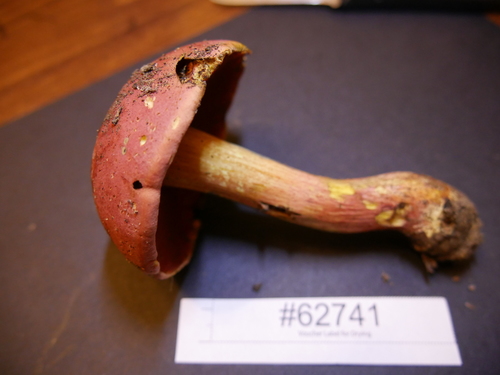
Perfumed Bolete
Rubroboletus rhodosanguineus
Edibility unknown — do not eat -
Ruddy Bolete
Rubroboletus rhodoxanthus
Poisonous - No photo yet
Dupain's Bolete
Rubroboletus dupainii
Edibility unknown — do not eat
Never eat a wild mushroom based on this site or any app. See safety basics and the disclaimer.