

Dupain's Bolete
Rubroboletus dupainii (Boud.) Kuan Zhao & Zhu L.Yang
Edibility
Edibility unknown — do not eat
Never eat a wild mushroom based on this site or any app.
Lookalikes
No lookalikes are recorded for this species yet. That does not mean there are none. Many mushrooms look alike, so never rely on appearance alone.
Season
Season data is not available for this species yet.
Where it is found
No regional records yet.
Identification traits
| Cap shape | convex |
|---|---|
| Underside (gills, pores or teeth) | pores |
| Ecology | mycorrhizal |
| Stem features | bare |
| Spore print color | olive-brown |
Traits vary. Use them to ask better questions of an expert, not to make a final call.
About
Rubroboletus dupainii, commonly known as Dupain's bolete, is a bolete fungus of the genus Rubroboletus. It is native to Europe, where it is threatened, and red listed in six countries. It also occurs in North America, although it is rare there. It was first recorded from North Carolina, and then from Iowa in 2009. It was reported from Belize in 2007, growing under Quercus peduncularis - a species of oak tree. The bolete was first described scientifically by French mycologist Jean Louis Émile Boudier in 1902. It was transferred to the new genus Rubroboletus in 2014 along with several other allied reddish colored, blue-staining bolete species. Phylogenetically, R. dupainii is the sister species of Rubroboletus lupinus.
From Wikipedia, CC BY-SA 4.0. Read the original article.
Recent finds
No community finds tagged with this species yet. Log a find.
More in the genus Rubroboletus
-

Satan’s Bolete
Rubroboletus pulcherrimus
Deadly — can kill -

Alice Eastwood's Bolete
Rubroboletus eastwoodiae
Edibility unknown — do not eat -
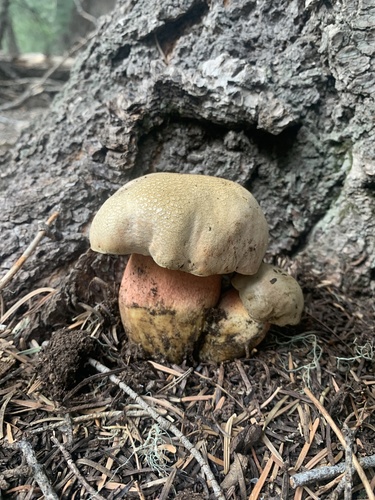
Mountain Satan's Bolete
Rubroboletus haematinus
Edibility unknown — do not eat -

Devil's Bolete
Rubroboletus satanas
Edibility unknown — do not eat -
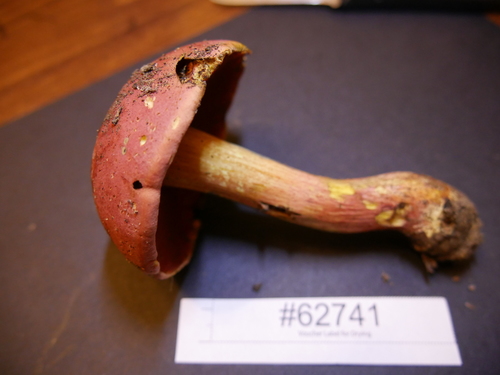
Perfumed Bolete
Rubroboletus rhodosanguineus
Edibility unknown — do not eat -
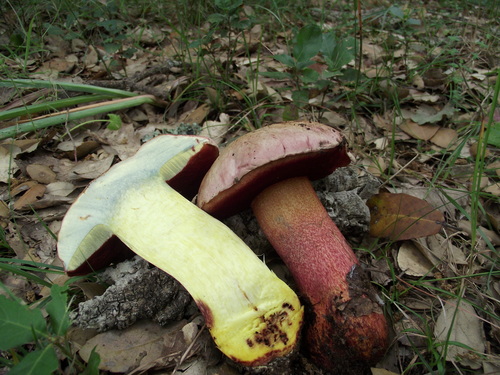
Ruddy Bolete
Rubroboletus rhodoxanthus
Poisonous
Never eat a wild mushroom based on this site or any app. See safety basics and the disclaimer.