

Lace Lichen
Ramalina menziesii Taylor
Also called: California Spanish Moss, Menzies' cartilage lichen
Edibility
Edibility unknown — do not eat
Never eat a wild mushroom based on this site or any app.
Photos
-
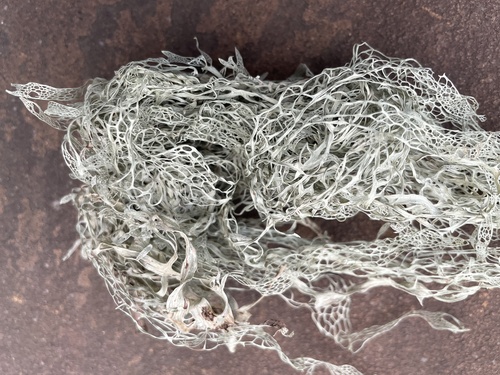
Photo: rescuelady. CC0. Source (inaturalist) -
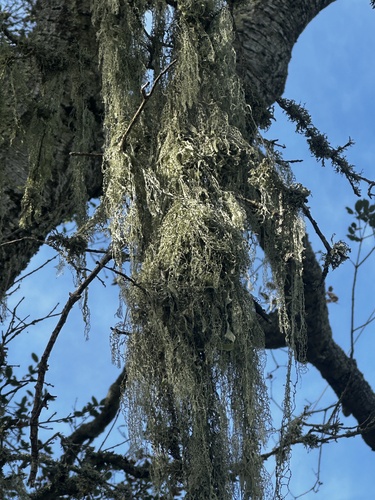
Photo: Katrina Mccollough. CC0. Source (inaturalist) -
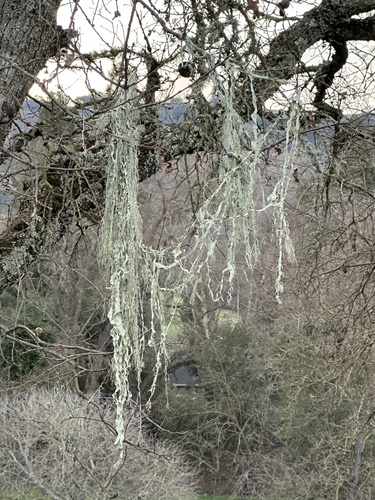
Photo: Irina Mitine. CC-BY. Source (inaturalist) -
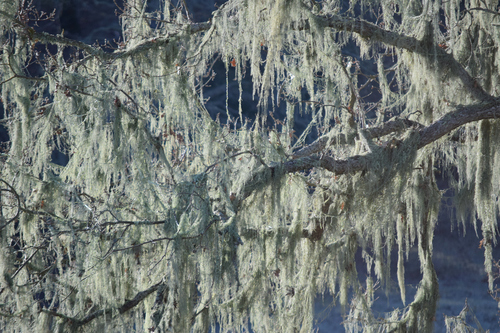
Photo: Anne Parsons. CC0. Source (inaturalist)
Lookalikes
No lookalikes are recorded for this species yet. That does not mean there are none. Many mushrooms look alike, so never rely on appearance alone.
Season
When this species has been recorded, by month, from open-licensed US and Canada observations. It shows when people report it, not a guarantee it is fruiting.
The highlighted bar is the current month.
View season data as a table
| Month | Records |
|---|---|
| January | 194 |
| February | 208 |
| March | 214 |
| April | 275 |
| May | 212 |
| June | 222 |
| July | 340 |
| August | 224 |
| September | 184 |
| October | 169 |
| November | 204 |
| December | 183 |
Where it is found
States and provinces with the most records. Check the foraging rules for the place you plan to visit.
- California 1,987 records · Foraging rules
- British Columbia 308 records · Foraging rules
- Oregon 265 records · Foraging rules
- Washington 221 records · Foraging rules
- Alaska 11 records · Foraging rules
- Hawaii 3 records · Foraging rules
- Minnesota 2 records · Foraging rules
- New Jersey 1 records · Foraging rules
- New Mexico 1 records · Foraging rules
- Arkansas 1 records · Foraging rules
- Texas 1 records · Foraging rules
- Michigan 1 records · Foraging rules
About
Ramalina menziesii, the lace lichen or fishnet, is a pale yellowish-green to grayish-green fruticose lichen. It grows up to a meter long, hanging from bark and twigs in a distinctive net-like or lace-like pattern that is unlike any other lichen in North America. It becomes a deeper green when wet. Apothecia are lecanorine. Lace lichen is an important food source for deer in the Coast Range of California, and a source of nest material for birds. It is highly variable in its growth form, with branches sometimes so slender as to appear like strands, sometimes tiny, and sometimes large with broadly flattened branches. After years of effort, the California Lichen Society was able to convince the state legislature to recognize the lichen as the state lichen of California, the first lichen so honored.
From Wikipedia, CC BY-SA 4.0. Read the original article.
Recent finds
No community finds tagged with this species yet. Log a find.
More in the genus Ramalina
-

Farinose Cartilage Lichen
Ramalina farinacea
Edibility unknown — do not eat -

Sinewed Bushy Lichen
Ramalina americana
Edibility unknown — do not eat - No photo yet
Rock Bushy Lichen
Ramalina intermedia
Edibility unknown — do not eat - No photo yet
Punctured Bushy Lichen
Ramalina dilacerata
Edibility unknown — do not eat - No photo yet
Frayed Ribbon Lichen
Ramalina roesleri
Edibility unknown — do not eat - No photo yet
Southern Strap
Ramalina stenospora
Edibility unknown — do not eat - No photo yet
Western Strap Lichen
Ramalina leptocarpha
Edibility unknown — do not eat - No photo yet
cartilage lichen
Ramalina complanata
Edibility unknown — do not eat
Never eat a wild mushroom based on this site or any app. See safety basics and the disclaimer.