

Dwarf Bovist
Lycoperdon dermoxanthum Vittad.
Also called: Dwarf Puffball
Edibility
Edibility unknown — do not eat
Never eat a wild mushroom based on this site or any app.
Lookalikes
No lookalikes are recorded for this species yet. That does not mean there are none. Many mushrooms look alike, so never rely on appearance alone.
Season
When this species has been recorded, by month, from open-licensed US and Canada observations. It shows when people report it, not a guarantee it is fruiting.
The highlighted bar is the current month.
View season data as a table
| Month | Records |
|---|---|
| January | 0 |
| February | 0 |
| March | 0 |
| April | 1 |
| May | 0 |
| June | 4 |
| July | 13 |
| August | 20 |
| September | 25 |
| October | 9 |
| November | 5 |
| December | 3 |
Where it is found
States and provinces with the most records. Check the foraging rules for the place you plan to visit.
- Ontario 12 records · Foraging rules
- New York 10 records · Foraging rules
- Massachusetts 9 records · Foraging rules
- Oregon 6 records · Foraging rules
- Utah 6 records · Foraging rules
- South Carolina 5 records · Foraging rules
- Kansas 5 records · Foraging rules
- Ohio 4 records · Foraging rules
- British Columbia 4 records · Foraging rules
- Arizona 3 records · Foraging rules
- Pennsylvania 3 records · Foraging rules
- Florida 2 records · Foraging rules
- Washington 2 records · Foraging rules
- Missouri 2 records · Foraging rules
- Quebec 2 records · Foraging rules
Show 13 more
- Alabama2 records
- New Jersey2 records
- California2 records
- Colorado2 records
- Indiana2 records
- Wisconsin1 records
- Yukon1 records
- Idaho1 records
- North Carolina1 records
- North Dakota1 records
- Nebraska1 records
- Tennessee1 records
- Texas1 records
About
Bovista dermoxantha is a small, white, nearly round puffball, recognized when young by a cottony-felty outer surface that becomes inconspicuously warted, eventually leaving fine, pallid, scales on an ochre to brown endoperidium. Bovista plumbea is similar, but has a smoother surface when young, and lacks a basal mycelial cord. In age it is distinguished by a dull greyish endoperidium. Large specimens of Bovista dermoxantha may also be mistaken for Bovista pila. Both have a mycelial cord attachment to the substrate, but Bovista pila differs in releasing spores through tears or splits in the endoperidium rather than by an apical pore.
From Wikipedia, CC BY-SA 4.0. Read the original article.
Recent finds
No community finds tagged with this species yet. Log a find.
More in the genus Lycoperdon
-
Common Puffball
Lycoperdon perlatum
Inedible -
Peeling Puffball
Lycoperdon marginatum
Inedible -
Umber-brown Puffball
Lycoperdon umbrinum
Edible (per source) -
Lycoperdon subincarnatum
Edibility unknown — do not eat -
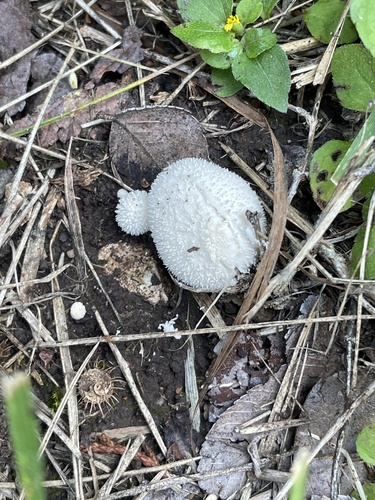
Curtis's Puffball
Lycoperdon curtisii
Edibility unknown — do not eat -
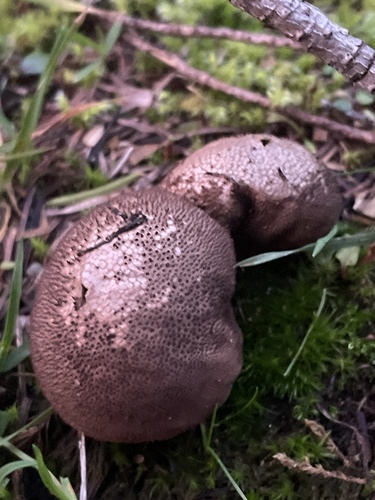
Blackish Puffball
Lycoperdon nigrescens
Edibility unknown — do not eat -
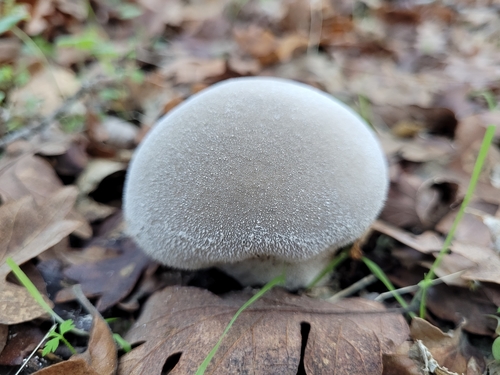
Soft Puffball
Lycoperdon molle
Edible (per source) -

Lycoperdon rimulatum
Edibility unknown — do not eat
Never eat a wild mushroom based on this site or any app. See safety basics and the disclaimer.