

Dark Crottle
Hypogymnia physodes (L.) Nyl.
Also called: Hooded Tube Lichen, Hooded Bone, Monk's-hood Lichen, tube lichen
Edibility
Edibility unknown — do not eat
Never eat a wild mushroom based on this site or any app.
Photos
-
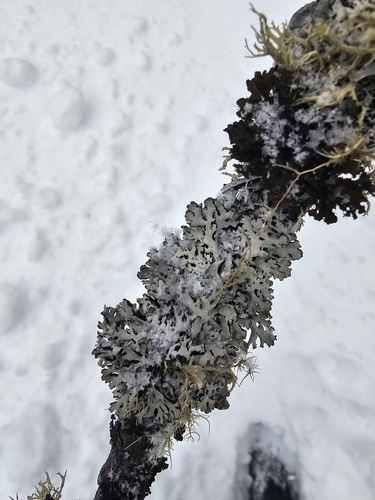
Photo: Norma Malinowski. CC-BY. Source (inaturalist) -
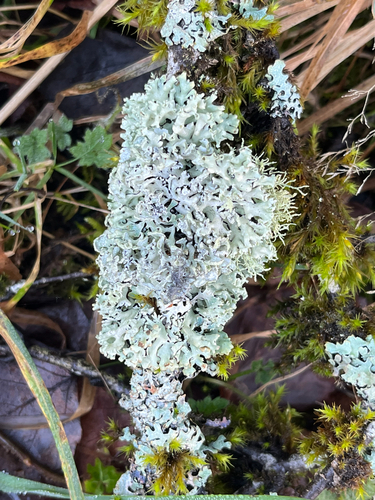
Photo: Therese Phillips. CC-BY. Source (inaturalist) -
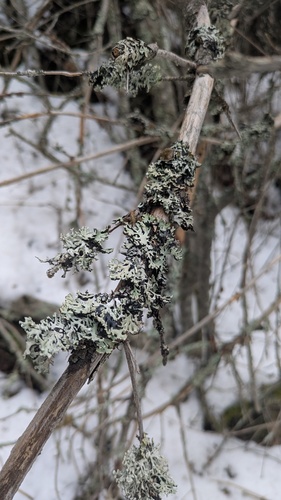
Photo: machaut2. CC-BY. Source (inaturalist) -
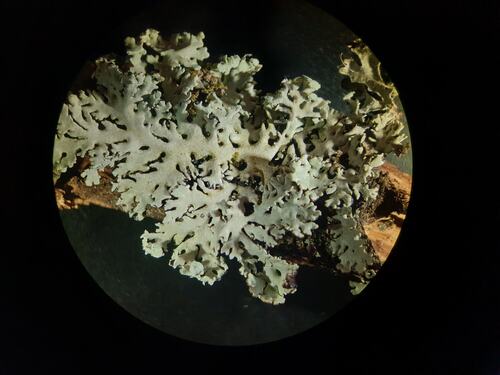
Photo: Étienne Lacroix-Carignan. CC0. Source (inaturalist)
Lookalikes
No lookalikes are recorded for this species yet. That does not mean there are none. Many mushrooms look alike, so never rely on appearance alone.
Season
When this species has been recorded, by month, from open-licensed US and Canada observations. It shows when people report it, not a guarantee it is fruiting.
The highlighted bar is the current month.
View season data as a table
| Month | Records |
|---|---|
| January | 113 |
| February | 162 |
| March | 229 |
| April | 374 |
| May | 665 |
| June | 1,060 |
| July | 2,010 |
| August | 1,503 |
| September | 696 |
| October | 403 |
| November | 163 |
| December | 121 |
Where it is found
States and provinces with the most records. Check the foraging rules for the place you plan to visit.
- British Columbia 1,074 records · Foraging rules
- Michigan 668 records · Foraging rules
- Ontario 561 records · Foraging rules
- Minnesota 505 records · Foraging rules
- Washington 459 records · Foraging rules
- Quebec 379 records · Foraging rules
- Alaska 342 records · Foraging rules
- New York 311 records · Foraging rules
- Maine 308 records · Foraging rules
- Massachusetts 230 records · Foraging rules
- Oregon 213 records · Foraging rules
- Alberta 203 records · Foraging rules
- New Hampshire 189 records · Foraging rules
- Wisconsin 188 records · Foraging rules
- Pennsylvania 185 records · Foraging rules
Show 37 more
- North Carolina180 records
- West Virginia160 records
- Manitoba148 records
- Northwest Territories147 records
- Vermont125 records
- Virginia111 records
- Nova Scotia106 records
- California96 records
- Newfoundland and Labrador95 records
- Montana92 records
- Connecticut86 records
- New Brunswick77 records
- South Dakota70 records
- Colorado64 records
- North Dakota60 records
- Yukon59 records
- Tennessee54 records
- Idaho53 records
- New Jersey43 records
- Nunavut43 records
- Maryland42 records
- Ohio23 records
- Arizona21 records
- Wyoming19 records
- Prince Edward Island11 records
- Saskatchewan9 records
- Nebraska8 records
- Kentucky7 records
- New Mexico6 records
- Rhode Island6 records
- Georgia5 records
- Delaware3 records
- Illinois2 records
- Alabama1 records
- Florida1 records
- Hawaii1 records
- Utah1 records
About
Hypogymnia physodes, commonly known as the monk's-hood lichen, is a species of foliose lichen in the family Parmeliaceae. It is a common and widespread species in boreal and temperate forests of the Northern Hemisphere. It has a grey to yellowish-green thallus that is loosely attached to its substrate and forms large irregular patches. Hollow lobes are 2–3mm wide. The outer edge turns up and is frequently covered with white powdery soredia underneath. Its lower surface is black, wrinkled and has some browning toward the lobe margins. The pycnidia are black and abundant, and their presence creates a pepper-like effect across the upper surface. Because of its abundance and its moderate sensitivity to sulphur dioxide and heavy metals, Hypogymnia physodes is often used in bioindicator and biomonitoring studies that enable the assessment of air pollution and other environmental conditions.
From Wikipedia, CC BY-SA 4.0. Read the original article.
More in the genus Hypogymnia

Never eat a wild mushroom based on this site or any app. See safety basics and the disclaimer.