

Budding Tube Lichen
Hypogymnia enteromorpha (Ach.) Nyl.
Also called: Beaded Tube Lichen, tube lichen
Edibility
Edibility unknown — do not eat
Never eat a wild mushroom based on this site or any app.
Photos
-
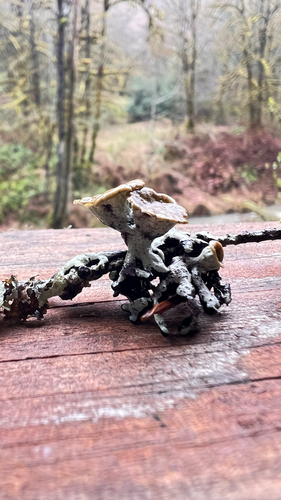
Photo: Michele Karmartsang. CC-BY. Source (inaturalist) -
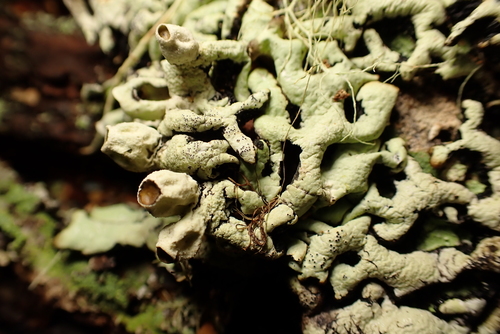
Photo: Sean Vanderluit. CC-BY. Source (inaturalist) -
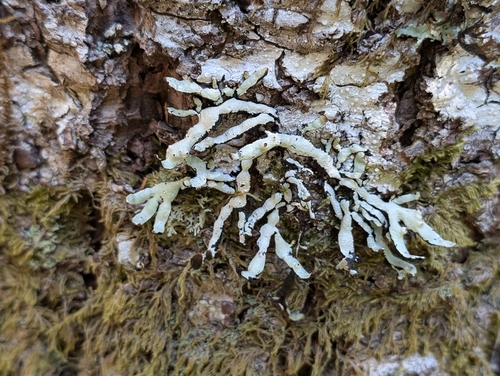
Photo: Tom and T Herman. CC-BY. Source (inaturalist) -
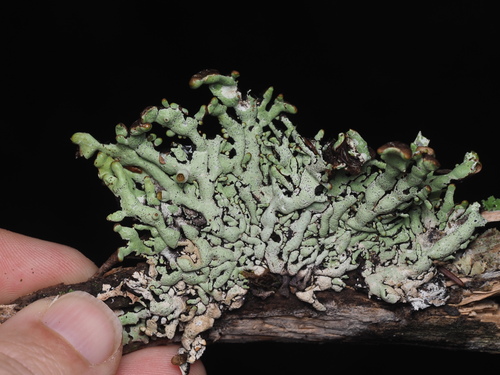
Photo: Randal. CC0. Source (inaturalist)
Lookalikes
No lookalikes are recorded for this species yet. That does not mean there are none. Many mushrooms look alike, so never rely on appearance alone.
Season
When this species has been recorded, by month, from open-licensed US and Canada observations. It shows when people report it, not a guarantee it is fruiting.
The highlighted bar is the current month.
View season data as a table
| Month | Records |
|---|---|
| January | 12 |
| February | 31 |
| March | 77 |
| April | 96 |
| May | 155 |
| June | 172 |
| July | 272 |
| August | 358 |
| September | 286 |
| October | 105 |
| November | 51 |
| December | 35 |
Where it is found
States and provinces with the most records. Check the foraging rules for the place you plan to visit.
- Washington 623 records · Foraging rules
- British Columbia 430 records · Foraging rules
- Oregon 238 records · Foraging rules
- California 221 records · Foraging rules
- Alaska 138 records · Foraging rules
- Maine 35 records · Foraging rules
- North Carolina 29 records · Foraging rules
- Tennessee 26 records · Foraging rules
- Montana 13 records · Foraging rules
- New Hampshire 12 records · Foraging rules
- Idaho 10 records · Foraging rules
- Alberta 7 records · Foraging rules
- West Virginia 6 records · Foraging rules
- New York 4 records · Foraging rules
- Vermont 4 records · Foraging rules
Show 5 more
- Virginia2 records
- Colorado1 records
- Michigan1 records
- Northwest Territories1 records
- Quebec1 records
About
Hypogymnia enteromorpha, the budding tube lichen or gut lichen, is a species of foliose lichen in the family Parmeliaceae. It is most often found in moist conifer forests of western North America, where it grows on bark and weathered wood. The species forms pale grey, hollow lobes with a black underside and commonly develops small bud-like outgrowths along the margins. It is one of the larger and more conspicuous members of its genus, and is frequently identified with chemical spot tests in addition to its characteristic growth form.
From Wikipedia, CC BY-SA 4.0. Read the original article.
More in the genus Hypogymnia

Never eat a wild mushroom based on this site or any app. See safety basics and the disclaimer.