

Collemopsidium sublitorale
Collemopsidium sublitorale (Leight.) Grube & B.D.Ryan
Edibility
Edibility unknown — do not eat
Never eat a wild mushroom based on this site or any app.
Photos
-

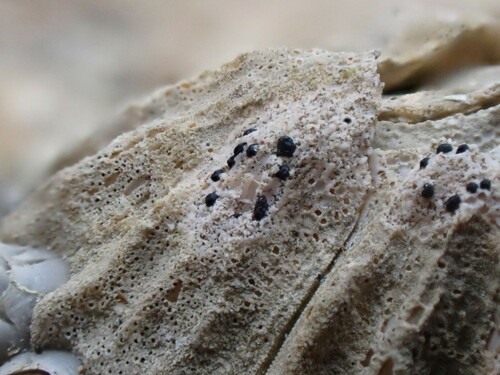
Photo: Randal. CC0. Source (inaturalist) -
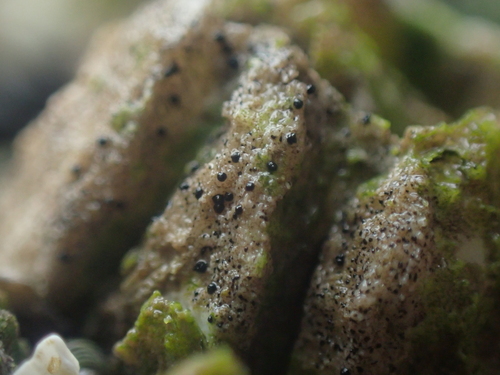
Photo: Deniz Wilson. CC0. Source (inaturalist)
Lookalikes
No lookalikes are recorded for this species yet. That does not mean there are none. Many mushrooms look alike, so never rely on appearance alone.
Season
When this species has been recorded, by month, from open-licensed US and Canada observations. It shows when people report it, not a guarantee it is fruiting.
The highlighted bar is the current month.
View season data as a table
| Month | Records |
|---|---|
| January | 2 |
| February | 0 |
| March | 1 |
| April | 0 |
| May | 0 |
| June | 5 |
| July | 7 |
| August | 6 |
| September | 1 |
| October | 1 |
| November | 1 |
| December | 1 |
Where it is found
States and provinces with the most records. Check the foraging rules for the place you plan to visit.
- California 10 records · Foraging rules
- British Columbia 6 records · Foraging rules
- Massachusetts 3 records · Foraging rules
- Washington 3 records · Foraging rules
- Newfoundland and Labrador 1 records · Foraging rules
- Alaska 1 records · Foraging rules
- Maine 1 records · Foraging rules
About
Collemopsidium sublitorale is a species of lichen in the family Xanthopyreniaceae. First described in 1871, it forms a "borderline" symbiotic relationship with cyanobacteria that is less structured than typical lichen partnerships. The species is characterised by an immersed thallus and black, roughly spherical fruiting bodies measuring 0.15–0.55 mm in diameter. It inhabits the intertidal and littoral fringe of marine environments, where it grows exclusively on calcareous surfaces such as limestone and marine shells. Its range includes north-west Europe and the Pacific coast of North America (United States and Canada).
From Wikipedia, CC BY-SA 4.0. Read the original article.
Recent finds
No community finds tagged with this species yet. Log a find.
More in the genus Collemopsidium
Never eat a wild mushroom based on this site or any app. See safety basics and the disclaimer.