

Boletus aurantiosplendens
Boletus aurantiosplendens T.J.Baroni
Edibility
Edibility unknown — do not eat
Never eat a wild mushroom based on this site or any app.
Photos
-
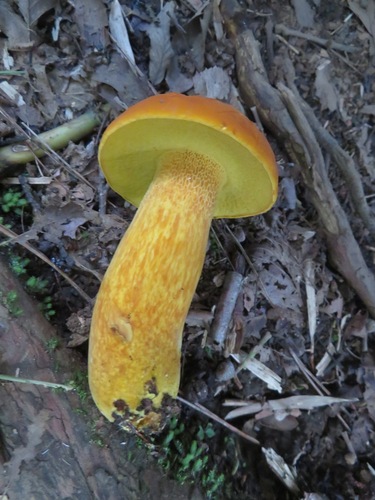
Photo: Marco Mussita. CC-BY. Source (inaturalist) -
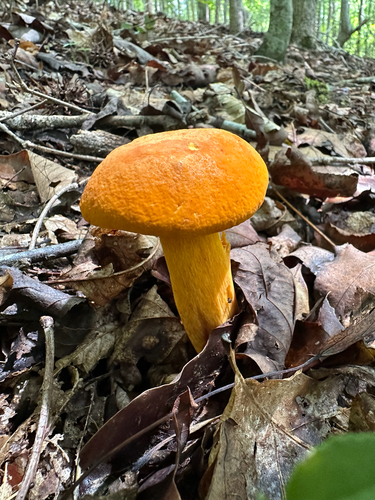
Photo: Bryce Thorson. CC-BY. Source (inaturalist) -
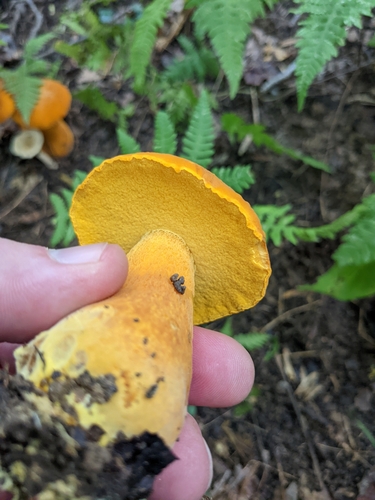
Photo: Sam Taylor. CC-BY. Source (inaturalist) -
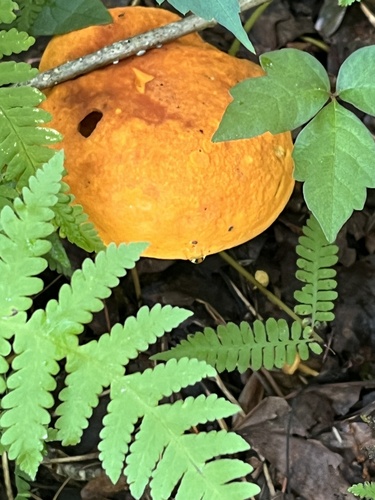
Photo: Phillip Salzinger. CC0. Source (inaturalist)
Lookalikes
No lookalikes are recorded for this species yet. That does not mean there are none. Many mushrooms look alike, so never rely on appearance alone.
Season
When this species has been recorded, by month, from open-licensed US and Canada observations. It shows when people report it, not a guarantee it is fruiting.
The highlighted bar is the current month.
View season data as a table
| Month | Records |
|---|---|
| January | 0 |
| February | 0 |
| March | 0 |
| April | 0 |
| May | 3 |
| June | 12 |
| July | 4 |
| August | 11 |
| September | 2 |
| October | 1 |
| November | 0 |
| December | 0 |
Where it is found
States and provinces with the most records. Check the foraging rules for the place you plan to visit.
- Georgia 19 records · Foraging rules
- North Carolina 6 records · Foraging rules
- Tennessee 3 records · Foraging rules
- Kansas 1 records · Foraging rules
- South Carolina 1 records · Foraging rules
About
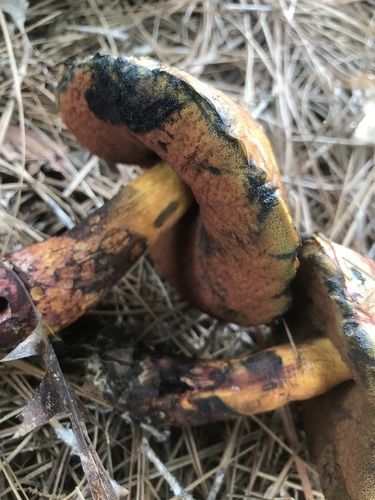
Boletus aurantiosplendens is a species of fungus native to eastern North America. Timothy J Baroni described the species in 1998, from material collected near Franklin in Macon County, North Carolina. The species name is from the Latin words aurantium "orange", and splendens "bright". The cap is 3–11 centimetres (1.2–4.3 in) in diameter, and is convex to flattened in shape. Its colour ranges from mandarin orange to yellowish brown, with young mushroom caps having a more tan centre and orange at the cap margin. The cap surface has a velvety or suede feel. The flesh is bright or light yellow and darkens slightly on bruising. Underneath the cap, the mushroom has bright yellow pores. They are adnexed at the junction of the stalk. The pores themselves are 0.5 to 1 millimetre (0.020 to 0.039 in) in diameter and round or slightly angular. The spore print is olive or dark brown. The stalk is 5–8 centimetres (2.0–3.1 in) high and 1.5–3 centimetres (0.59–1.18 in) wide. Its edibility is unknown. The mushrooms appear from July to September, in humus in mixed woodlands under North American beech (Fagus grandifolia), oak (Quercus), hickory (Carya), red maple (Acer rubrum), American tulip tree (Liriodendron tulipifera) and shortleaf pine (Pinus echinata). It is only known from seven sites across 600 km, in central and western North Carolina, western South Carolina, northern Georgia and eastern Tennessee. As it is such a striking mushroom, it is hard to overlook and is hence thought not to have many overlooked colonies. It has therefore been proposed that this species be rated as near threatened on the IUCN Red List.
From Wikipedia, CC BY-SA 4.0. Read the original article.
Recent finds
No community finds tagged with this species yet. Log a find.
More in the genus Boletus
-
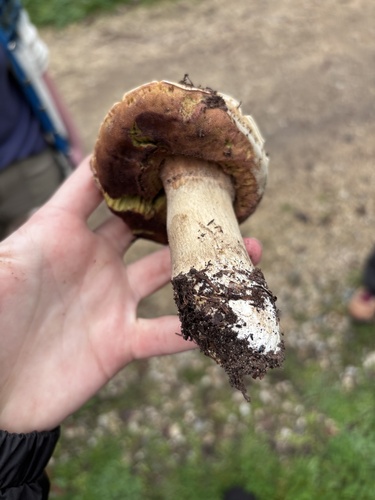
Cep
Boletus edulis
Edible (per source) -

Boletus bicolor
Edibility unknown — do not eat -

Strigose-stemmed Bolete
Boletus subvelutipes
Caution -
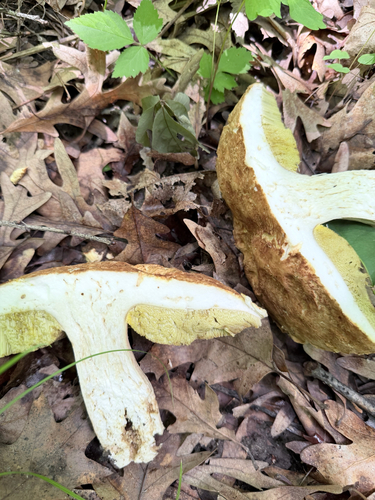
Boletus variipes
Edibility unknown — do not eat -
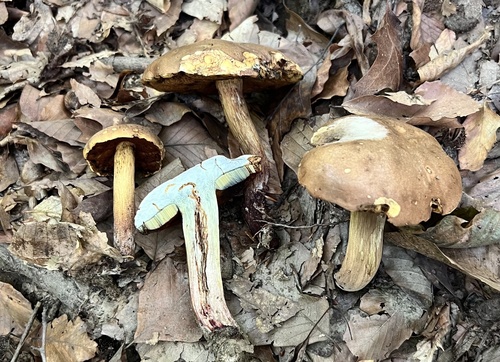
Boletus vermiculosus
Edibility unknown — do not eat -

Boletus speciosus
Edibility unknown — do not eat -
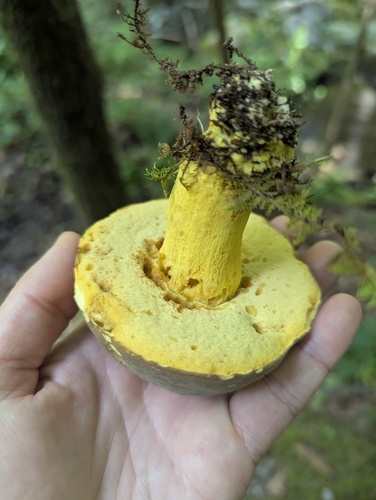
butter-foot bolete
Boletus auripes
Edible (per source) -
Boletus subluridellus
Edibility unknown — do not eat
Never eat a wild mushroom based on this site or any app. See safety basics and the disclaimer.