

Cep
Boletus edulis Bull.
Also called: Penny Bun, King Bolete, Cep, Penny Bun
Safety first
Many edible mushrooms have toxic lookalikes, and some of those can be fatal. Have any mushroom identified in person by a local expert before you eat it.
If someone may have eaten a wild mushroom, call US Poison Control at 1-800-222-1222 or 911 right away. In Canada, call your provincial poison centre or 911.
Edibility
Edible (per source) Source: Wikipedia: Boletus edulis
Classification from Wikipedia: Boletus edulis. Sources can be wrong or incomplete, and people react differently.
Never eat a wild mushroom based on this site or any app.
Photos
-
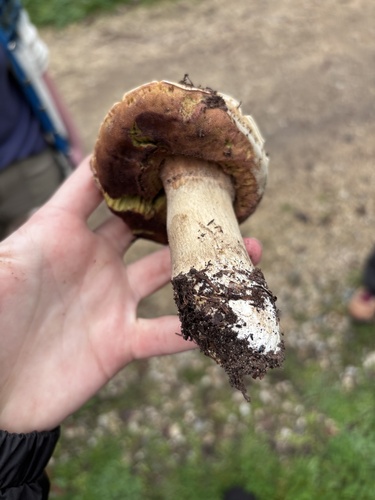
Photo: reagan peschke. CC-BY. Source (inaturalist) -
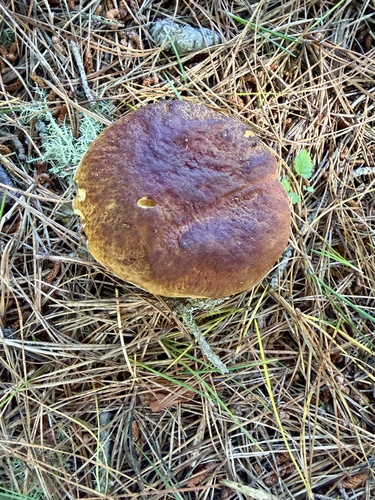
Photo: Dutza K.. CC-BY. Source (inaturalist) -
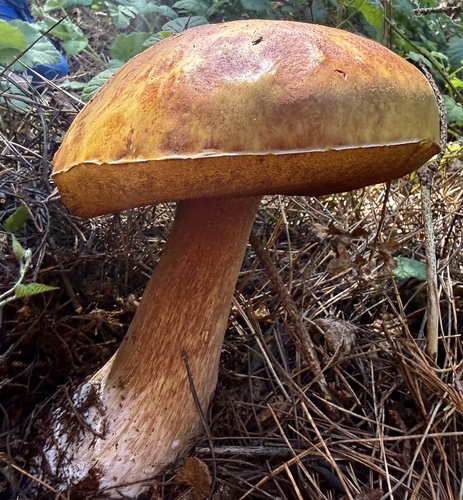
Photo: Chuck Wilson. CC0. Source (inaturalist) -
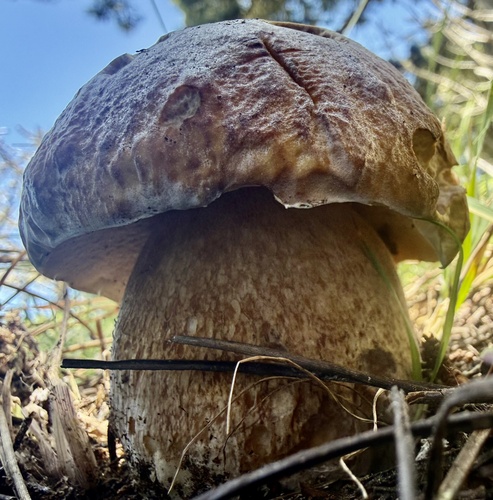
Photo: Chuck Wilson. CC0. Source (inaturalist)
Lookalikes
No lookalikes are recorded for this species yet. That does not mean there are none. Many mushrooms look alike, so never rely on appearance alone.
Season
When this species has been recorded, by month, from open-licensed US and Canada observations. It shows when people report it, not a guarantee it is fruiting.
The highlighted bar is the current month.
View season data as a table
| Month | Records |
|---|---|
| January | 12 |
| February | 2 |
| March | 1 |
| April | 4 |
| May | 34 |
| June | 75 |
| July | 265 |
| August | 357 |
| September | 314 |
| October | 287 |
| November | 103 |
| December | 50 |
Where it is found
States and provinces with the most records. Check the foraging rules for the place you plan to visit.
- California 357 records · Foraging rules
- Washington 139 records · Foraging rules
- British Columbia 126 records · Foraging rules
- Alaska 90 records · Foraging rules
- Oregon 84 records · Foraging rules
- Ontario 76 records · Foraging rules
- Colorado 68 records · Foraging rules
- Quebec 61 records · Foraging rules
- North Carolina 59 records · Foraging rules
- Pennsylvania 58 records · Foraging rules
- Wyoming 55 records · Foraging rules
- Utah 51 records · Foraging rules
- New York 46 records · Foraging rules
- Nova Scotia 42 records · Foraging rules
- Minnesota 38 records · Foraging rules
Show 37 more
- Massachusetts33 records
- Florida31 records
- Vermont28 records
- Virginia28 records
- Michigan27 records
- Idaho26 records
- Maine19 records
- Alabama15 records
- Arizona15 records
- Newfoundland and Labrador14 records
- New Hampshire14 records
- Maryland13 records
- Wisconsin13 records
- Missouri11 records
- New Jersey10 records
- Texas9 records
- Connecticut8 records
- Montana8 records
- Tennessee8 records
- Ohio7 records
- Mississippi6 records
- New Mexico6 records
- Alberta6 records
- Rhode Island5 records
- West Virginia5 records
- Illinois4 records
- Kentucky4 records
- New Brunswick4 records
- Georgia3 records
- Manitoba2 records
- District of Columbia2 records
- Iowa2 records
- Prince Edward Island2 records
- Louisiana2 records
- Delaware1 records
- South Carolina1 records
- Indiana1 records
Identification traits
| Cap shape | convex |
|---|---|
| Underside (gills, pores or teeth) | pores |
| Ecology | mycorrhizal |
| Stem features | bare |
| Spore print color | brown |
Traits vary. Use them to ask better questions of an expert, not to make a final call.
About
Boletus edulis (English: cep, penny bun, porcino) is a basidiomycete fungus, and the type species of the genus Boletus. It is prized as an edible mushroom. The fungus produces spore-bearing fruit bodies above ground in summer and autumn. The fruit body has a large brown cap which can reach 30 cm (12 in) in diameter and 3 kg (6 lb 10 oz) in weight. Like other boletes, it has tubes extending downward from the underside of the cap, rather than gills; spores escape at maturity through the tube openings (pores). The pore surface of the fruit body is whitish when young, aging to a greenish-yellow. The stout stipe (or stem) is white or yellowish, up to 25 cm (10 in) tall and 7 cm (3 in) thick, and partially covered with a raised network pattern (reticulations). The fungus grows in deciduous and coniferous forests and tree plantations, forming symbiotic ectomycorrhizal associations with living trees by enveloping the tree's underground roots with sheaths of fungal tissue. Widely distributed in the Northern Hemisphere across Eurasia and North America, it does not occur naturally in the Southern Hemisphere but has been introduced to it. Several closely related European mushrooms formerly thought to be varieties or forms of B. edulis have been shown using molecular phylogenetic analysis to be distinct species, while others previously classified as separate species are conspecific with B. edulis. The western North American species commonly known as the California king bolete (B. edulis var. grandedulis) is a large, darker-coloured variant first formally identified in 2007. B. edulis is held in high regard in many cuisines and is commonly prepared and eaten in soups, pasta, or risotto. The mushroom is low in fat and digestible carbohydrates, while being high in protein, vitamins, minerals and dietary fibre. Although it is sold commercially, it is very difficult to cultivate. Available fresh in autumn throughout Europe and Russia, it is most often dried, packaged, and distributed worldwide. It keeps its flavour after drying and is then reconstituted and used in cooking. B. edulis is also one of the few fungi sold pickled.
From Wikipedia, CC BY-SA 4.0. Read the original article.
Never eat a wild mushroom based on this site or any app. See safety basics and the disclaimer.