

Tylopilus ammiratii
Tylopilus ammiratii Thiers
Edibility
Edibility unknown — do not eat
Never eat a wild mushroom based on this site or any app.
Lookalikes
No lookalikes are recorded for this species yet. That does not mean there are none. Many mushrooms look alike, so never rely on appearance alone.
Season
When this species has been recorded, by month, from open-licensed US and Canada observations. It shows when people report it, not a guarantee it is fruiting.
The highlighted bar is the current month.
View season data as a table
| Month | Records |
|---|---|
| January | 0 |
| February | 0 |
| March | 0 |
| April | 0 |
| May | 0 |
| June | 0 |
| July | 0 |
| August | 0 |
| September | 1 |
| October | 0 |
| November | 6 |
| December | 1 |
Where it is found
States and provinces with the most records. Check the foraging rules for the place you plan to visit.
- California 9 records · Foraging rules
About
Tylopilus ammiratii is a fungus of the genus Tylopilus found in California, where it fruits scattered or in groups under black oak. Fruiting occurs from October to December. It was described as new to science by mycologist Harry Delbert Thiers in 1975. The type collection was made in Shasta County in November 1971 by Joseph Ammirati, for whom the species is named. Fruit bodies of T. ammiratii have convex, brownish caps measuring 5–10 cm (2.0–3.9 in) in diameter. The pore surface on the cap underside is initially white before turning to brown in maturity. They number about 1–2 per millimeter, and will stain vinaceous to brown when injured. The stipe measures 4–9 cm (1.6–3.5 in) long by 1.5–2.5 cm (0.6–1.0 in) thick. It has a smooth to slightly scurfy surface (i.e., covered with tiny flakes), and generally lack reticulations, although occasionally the stipe apex is slightly reticulate. Spores are smooth-walled, somewhat spindle-shaped (subfusoid) to cylindric, and typically measure 8.6–11.4 by 3.3–4 μm. Closely related Tylopilus species include T. indecisus and T. ferrugineus.
From Wikipedia, CC BY-SA 4.0. Read the original article.
Recent finds
No community finds tagged with this species yet. Log a find.
More in the genus Tylopilus
-
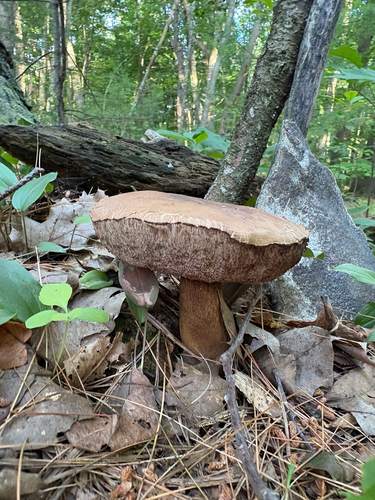
Bitter Bolete
Tylopilus felleus
Edibility unknown — do not eat -
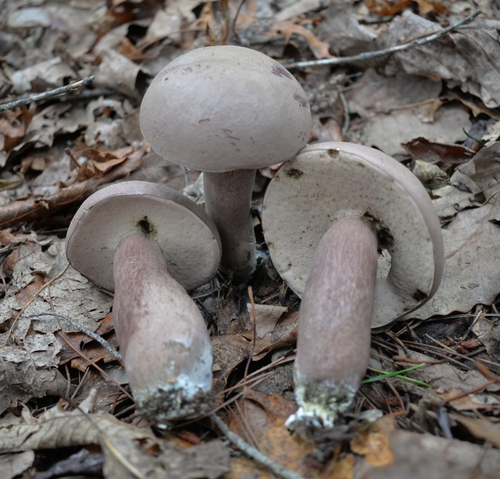
Violet Gray Bolete
Tylopilus plumbeoviolaceus
Inedible -
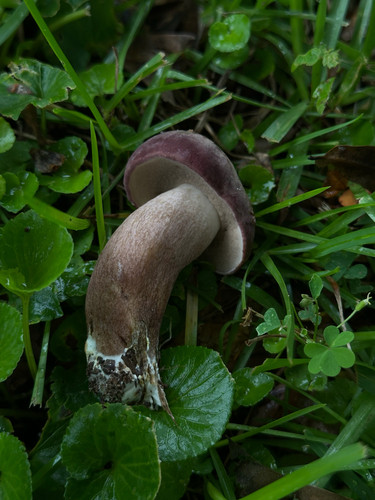
reddish brown bitter bolete
Tylopilus rubrobrunneus
Edibility unknown — do not eat -
Black velvet bolete
Tylopilus alboater
Edible (per source) -
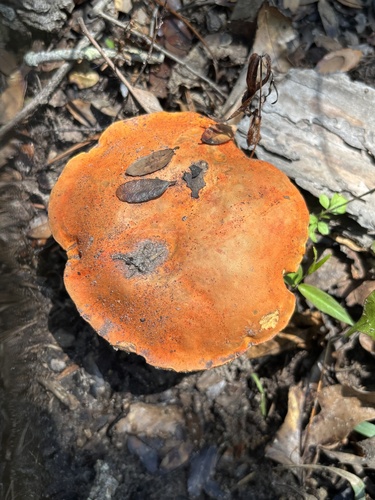
Burnt-orange Bolete
Tylopilus balloui
Edibility unknown — do not eat - No photo yet
Tylopilus ferrugineus
Edibility unknown — do not eat - No photo yet
Beveled-cap Bolete
Tylopilus badiceps
Edibility unknown — do not eat - No photo yet
Tylopilus pseudoscaber
Edibility unknown — do not eat
Never eat a wild mushroom based on this site or any app. See safety basics and the disclaimer.