

Turkeytail
Trametes versicolor (L.) Lloyd
Also called: Turkey-tail
Edibility
Edibility unknown — do not eat
Never eat a wild mushroom based on this site or any app.
Photos
-
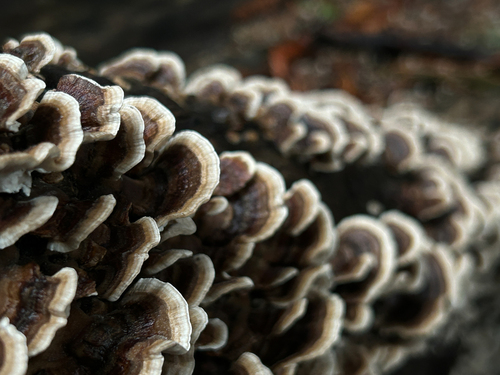
Photo: Annette Herz. CC-BY. Source (inaturalist) -
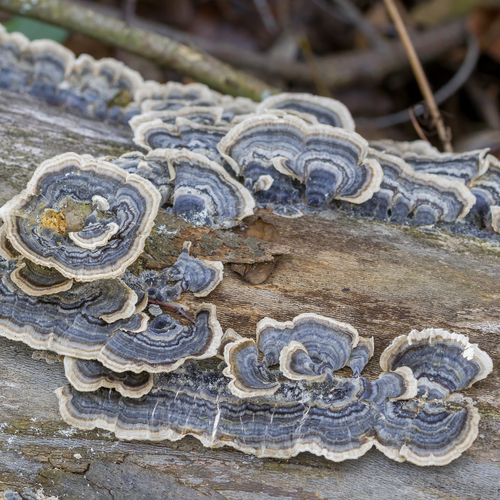
Photo: Dan Vickers. CC-BY. Source (inaturalist) -
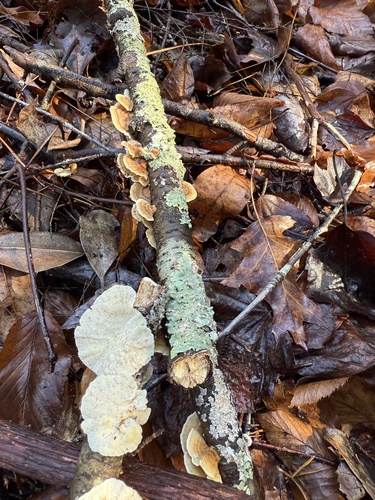
Photo: Hill Craddock. CC-BY. Source (inaturalist) -
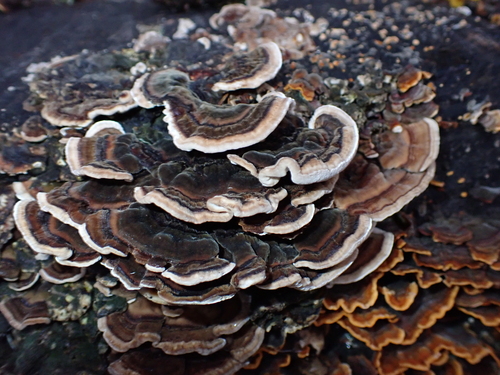
Photo: harrier. CC-BY. Source (inaturalist)
Lookalikes
No lookalikes are recorded for this species yet. That does not mean there are none. Many mushrooms look alike, so never rely on appearance alone.
Season
When this species has been recorded, by month, from open-licensed US and Canada observations. It shows when people report it, not a guarantee it is fruiting.
The highlighted bar is the current month.
View season data as a table
| Month | Records |
|---|---|
| January | 1,018 |
| February | 846 |
| March | 1,030 |
| April | 1,240 |
| May | 731 |
| June | 454 |
| July | 680 |
| August | 1,558 |
| September | 1,954 |
| October | 2,084 |
| November | 1,183 |
| December | 1,114 |
Where it is found
States and provinces with the most records. Check the foraging rules for the place you plan to visit.
- California 1,669 records · Foraging rules
- Ontario 1,178 records · Foraging rules
- New York 887 records · Foraging rules
- Pennsylvania 774 records · Foraging rules
- British Columbia 658 records · Foraging rules
- Ohio 657 records · Foraging rules
- Virginia 545 records · Foraging rules
- North Carolina 467 records · Foraging rules
- Illinois 461 records · Foraging rules
- Maryland 406 records · Foraging rules
- Indiana 384 records · Foraging rules
- Washington 381 records · Foraging rules
- Georgia 336 records · Foraging rules
- New Jersey 306 records · Foraging rules
- Massachusetts 292 records · Foraging rules
Show 47 more
- Connecticut292 records
- Wisconsin281 records
- Quebec273 records
- Minnesota239 records
- Michigan238 records
- Louisiana230 records
- Tennessee222 records
- Oregon222 records
- Vermont189 records
- Missouri189 records
- Florida175 records
- Texas170 records
- New Hampshire163 records
- District of Columbia158 records
- Nova Scotia150 records
- West Virginia133 records
- South Carolina125 records
- Maine123 records
- Iowa115 records
- Kentucky104 records
- Alabama94 records
- Arkansas76 records
- Idaho61 records
- Kansas58 records
- Mississippi48 records
- Prince Edward Island45 records
- Delaware44 records
- Rhode Island44 records
- New Brunswick42 records
- North Dakota38 records
- Oklahoma37 records
- Nebraska36 records
- Arizona31 records
- Colorado31 records
- Manitoba29 records
- Utah27 records
- Alaska26 records
- Hawaii20 records
- Montana19 records
- South Dakota14 records
- Newfoundland and Labrador7 records
- New Mexico6 records
- Yukon2 records
- Alberta1 records
- Nevada1 records
- Saskatchewan1 records
- Wyoming1 records
Identification traits
| Cap shape | offset |
|---|---|
| Underside (gills, pores or teeth) | pores |
| Ecology | saprotrophic |
| Spore print color | white |
Traits vary. Use them to ask better questions of an expert, not to make a final call.
About
Trametes versicolor – also known as Coriolus versicolor and Polyporus versicolor – is a common polypore mushroom found throughout the world. Because its shape is similar to that of a wild turkey's tail feathers when spread, T. versicolor is most commonly referred to as turkey tail. Although polysaccharide-K, an extract of T. versicolor, is approved in Japan as an adjuvant therapy in cancer treatment, it is not approved in the United States for treatment of cancer or any clinical condition. Extracts of turkey tail or the mushroom itself are commonly marketed as a dietary supplement for various health benefits, and quality can vary due to inconsistent processing and labeling.
From Wikipedia, CC BY-SA 4.0. Read the original article.
More in the genus Trametes


Never eat a wild mushroom based on this site or any app. See safety basics and the disclaimer.