

Oak Leaf Blister
Taphrina caerulescens (Desm. & Mont.) Tul.
Edibility
Edibility unknown — do not eat
Never eat a wild mushroom based on this site or any app.
Photos
-
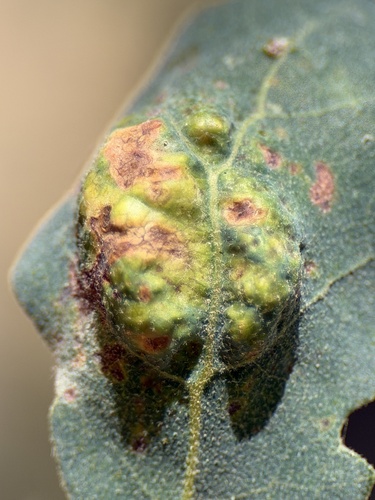
Photo: Alex Heyman. CC0. Source (inaturalist) -
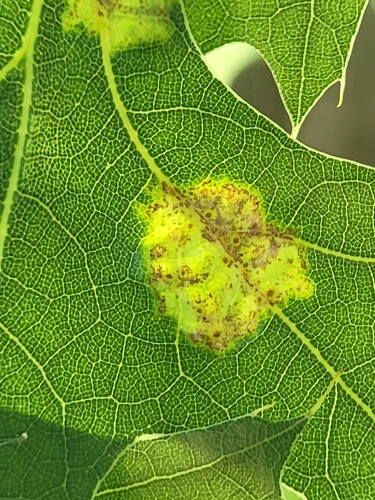
Photo: Daniella Marie. CC-BY. Source (inaturalist) -
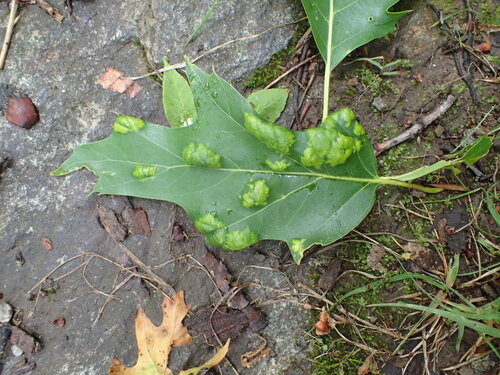
Photo: Trix Niernberger. CC0. Source (inaturalist) -
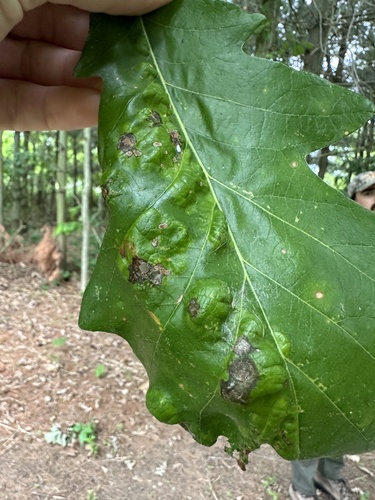
Photo: brendanboyd. CC-BY. Source (inaturalist)
Lookalikes
No lookalikes are recorded for this species yet. That does not mean there are none. Many mushrooms look alike, so never rely on appearance alone.
Season
When this species has been recorded, by month, from open-licensed US and Canada observations. It shows when people report it, not a guarantee it is fruiting.
The highlighted bar is the current month.
View season data as a table
| Month | Records |
|---|---|
| January | 18 |
| February | 6 |
| March | 22 |
| April | 188 |
| May | 508 |
| June | 804 |
| July | 537 |
| August | 170 |
| September | 56 |
| October | 34 |
| November | 3 |
| December | 7 |
Where it is found
States and provinces with the most records. Check the foraging rules for the place you plan to visit.
- Kansas 332 records · Foraging rules
- New York 244 records · Foraging rules
- Florida 156 records · Foraging rules
- Massachusetts 133 records · Foraging rules
- Georgia 112 records · Foraging rules
- Maryland 109 records · Foraging rules
- Alabama 105 records · Foraging rules
- North Carolina 102 records · Foraging rules
- Wisconsin 95 records · Foraging rules
- California 74 records · Foraging rules
- Virginia 70 records · Foraging rules
- Pennsylvania 68 records · Foraging rules
- Connecticut 64 records · Foraging rules
- Mississippi 52 records · Foraging rules
- Utah 50 records · Foraging rules
Show 41 more
- Michigan50 records
- Ontario48 records
- Ohio46 records
- South Carolina45 records
- Colorado45 records
- New Hampshire37 records
- Louisiana36 records
- Texas34 records
- Delaware28 records
- Missouri25 records
- Arkansas22 records
- Illinois22 records
- New Jersey19 records
- Tennessee17 records
- Wyoming16 records
- Minnesota15 records
- Quebec12 records
- Indiana12 records
- British Columbia10 records
- Maine9 records
- Nova Scotia8 records
- Manitoba8 records
- District of Columbia8 records
- Vermont7 records
- Washington6 records
- Iowa6 records
- Oklahoma6 records
- Alberta4 records
- Saskatchewan4 records
- West Virginia4 records
- Kentucky3 records
- Alaska3 records
- New Mexico3 records
- Rhode Island2 records
- New Brunswick2 records
- Prince Edward Island1 records
- North Dakota1 records
- Nevada1 records
- Arizona1 records
- Montana1 records
- Oregon1 records
About
Taphrina caerulescens is a species of fungus in the family Taphrinaceae. It is a pathogenic Ascomycete fungus that causes oak leaf blister disease on various species of oak trees (Quercus spp.). The associated anamorph species is Lalaria coccinea, described in 1990. This disease causes lesions and blisters on Oak leaves. Effects of the disease are mostly cosmetic. Although not taxonomically defined, strains of T. caerulescens have been shown to be host specific with varying ¬ascus morphology between strains. There are differences in strains' abilities to metabolize various carbon and nitrogen compounds. This has been proposed as a method of taxonomically defining subspecies within T. caerulescens. Taphrina caerulescens is very closely related to Taphrina deformans, which causes peach leaf curl. These two pathogens have indistinguishable asci. However, T. deformans infects peach tree species while T. caerulescens infects Oak tree species only.
From Wikipedia, CC BY-SA 4.0. Read the original article.
Never eat a wild mushroom based on this site or any app. See safety basics and the disclaimer.