

Charred-Pancake Cup
Sarcosoma globosum (Schmidel) Casp.
Also called: Witches Cauldron, Sarcosoma spp., Witches' Cauldron
Edibility
Edibility unknown — do not eat
Never eat a wild mushroom based on this site or any app.
Photos
-

Photo: Eugene Popov. CC-BY. Source (inaturalist) -
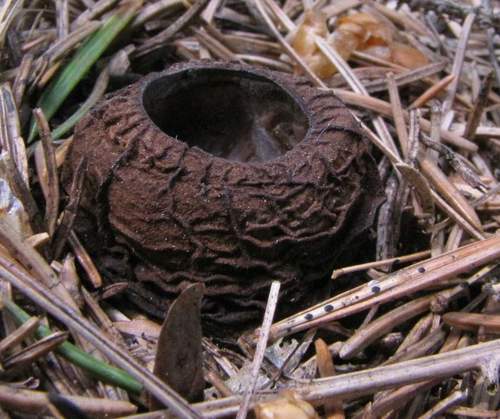
Photo: christine123. CC-BY. Source (inaturalist) -

Photo: Norma Malinowski. CC-BY. Source (inaturalist) -
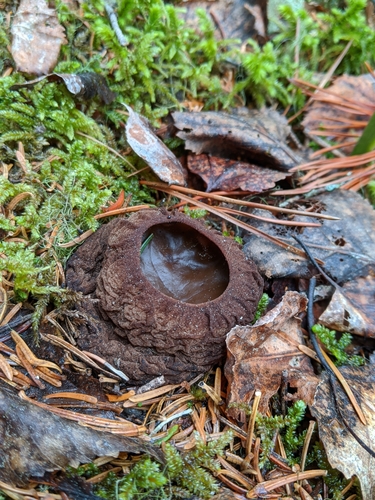
Photo: Ben Keen. CC0. Source (inaturalist)
Lookalikes
No lookalikes are recorded for this species yet. That does not mean there are none. Many mushrooms look alike, so never rely on appearance alone.
Season
When this species has been recorded, by month, from open-licensed US and Canada observations. It shows when people report it, not a guarantee it is fruiting.
The highlighted bar is the current month.
View season data as a table
| Month | Records |
|---|---|
| January | 0 |
| February | 0 |
| March | 1 |
| April | 3 |
| May | 31 |
| June | 22 |
| July | 1 |
| August | 0 |
| September | 0 |
| October | 0 |
| November | 1 |
| December | 0 |
Where it is found
States and provinces with the most records. Check the foraging rules for the place you plan to visit.
- Ontario 22 records · Foraging rules
- Quebec 12 records · Foraging rules
- Minnesota 11 records · Foraging rules
- Idaho 5 records · Foraging rules
- Alberta 4 records · Foraging rules
- British Columbia 4 records · Foraging rules
- New York 1 records · Foraging rules
- Oregon 1 records · Foraging rules
- Pennsylvania 1 records · Foraging rules
About
Sarcosoma globosum, or witches cauldron, is a species of fungus in the family Sarcosomataceae. It was first described in 1793 by Casimir Christoph Schmidel. Johann Xaver Robert Caspary transferred it to the genus Sarcosoma in 1891. Also known as the charred-pancake cup, it is a near-threatened fungus native to Northern Europe. It is rarely found in some parts of northeastern North America, particularly in the Great Lakes region. To biologists' surprise, in 2021 it was found in Northern British Columbia. The witches cauldron is an ascomycete or sac fungus, meaning that its microscopic structure utilizes the ascus, a spore-bearing cell, for sexual reproduction. It is a detritivore, and survives on decomposing plant matter, most commonly leaf litter. It is found in spruce forests and does not currently have any human uses.
From Wikipedia, CC BY-SA 4.0. Read the original article.
Recent finds
No community finds tagged with this species yet. Log a find.
More in the genus Sarcosoma
Never eat a wild mushroom based on this site or any app. See safety basics and the disclaimer.