

Short-stemmed Russula
Russula brevipes Peck
Safety first
Many edible mushrooms have toxic lookalikes, and some of those can be fatal. Have any mushroom identified in person by a local expert before you eat it.
If someone may have eaten a wild mushroom, call US Poison Control at 1-800-222-1222 or 911 right away. In Canada, call your provincial poison centre or 911.
Edibility
Edible (per source) Source: Wikipedia: Russula brevipes
Classification from Wikipedia: Russula brevipes. Sources can be wrong or incomplete, and people react differently.
Never eat a wild mushroom based on this site or any app.
Photos
-
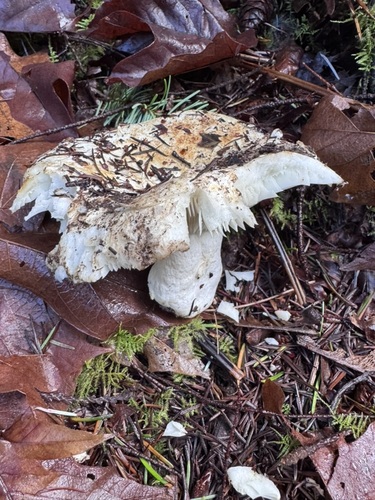
Photo: dpcmiller. CC-BY. Source (inaturalist) -
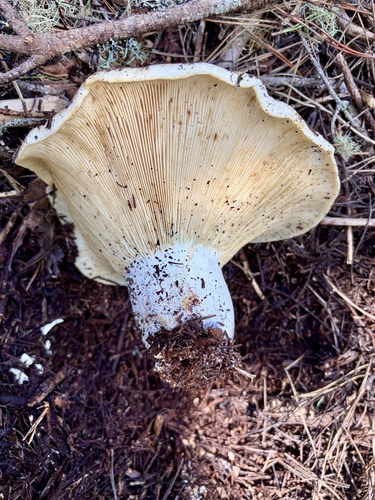
Photo: Dutza K.. CC-BY. Source (inaturalist) -
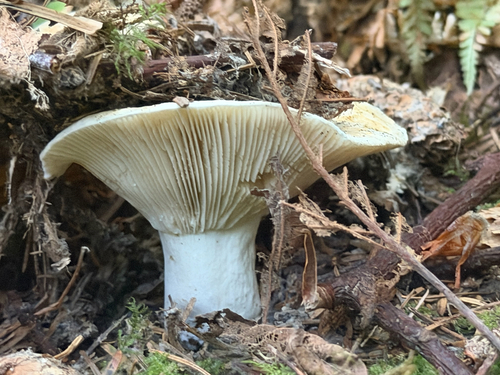
Photo: Ian McFaul. CC-BY. Source (inaturalist) -
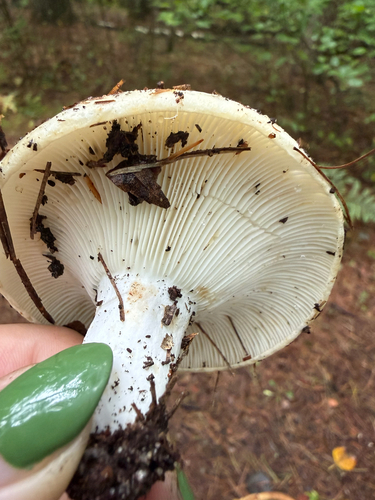
Photo: Em Marg. CC-BY. Source (inaturalist)
Lookalikes
No lookalikes are recorded for this species yet. That does not mean there are none. Many mushrooms look alike, so never rely on appearance alone.
Season
When this species has been recorded, by month, from open-licensed US and Canada observations. It shows when people report it, not a guarantee it is fruiting.
The highlighted bar is the current month.
View season data as a table
| Month | Records |
|---|---|
| January | 21 |
| February | 9 |
| March | 1 |
| April | 2 |
| May | 39 |
| June | 68 |
| July | 252 |
| August | 640 |
| September | 335 |
| October | 372 |
| November | 130 |
| December | 44 |
Where it is found
States and provinces with the most records. Check the foraging rules for the place you plan to visit.
- California 162 records · Foraging rules
- Washington 122 records · Foraging rules
- British Columbia 101 records · Foraging rules
- Oregon 47 records · Foraging rules
- Quebec 43 records · Foraging rules
- Alaska 41 records · Foraging rules
- Minnesota 39 records · Foraging rules
- Wyoming 39 records · Foraging rules
- Ontario 37 records · Foraging rules
- Colorado 27 records · Foraging rules
- West Virginia 23 records · Foraging rules
- New York 21 records · Foraging rules
- Idaho 20 records · Foraging rules
- Indiana 20 records · Foraging rules
- Illinois 19 records · Foraging rules
Show 32 more
- North Carolina18 records
- Michigan16 records
- Ohio16 records
- New Jersey12 records
- Texas11 records
- Vermont11 records
- Alabama9 records
- Virginia9 records
- Maryland8 records
- Utah8 records
- Arizona7 records
- Connecticut7 records
- New Mexico7 records
- Maine6 records
- Tennessee6 records
- Wisconsin6 records
- Alberta5 records
- Massachusetts5 records
- New Brunswick5 records
- Mississippi4 records
- Montana4 records
- Missouri3 records
- Oklahoma3 records
- Pennsylvania3 records
- Arkansas2 records
- Florida2 records
- Georgia2 records
- New Hampshire2 records
- Rhode Island2 records
- Newfoundland and Labrador1 records
- Northwest Territories1 records
- Nova Scotia1 records
Identification traits
| Cap shape | flat |
|---|---|
| Underside (gills, pores or teeth) | gills |
| Ecology | mycorrhizal |
| Stem features | bare |
| Spore print color | white |
Traits vary. Use them to ask better questions of an expert, not to make a final call.
About
Russula brevipes is a species of mushroom commonly known as the short-stemmed russula or the stubby brittlegill. The fruit bodies are white and large, with convex to funnel-shaped caps measuring 7–30 cm (3–12 in) wide set atop a thick stipe up to 8 cm (3 in) long. The gills on the cap underside are closely spaced and sometimes have a faint bluish tint. The spores are roughly spherical and have a network-like surface dotted with warts. Forms of the mushroom that develop a bluish band at the top of the stipe are sometimes referred to as variety acrior. Fruiting from summer to autumn, the mushrooms often develop under masses of leaves or conifer needles in a mycorrhizal association with trees from several genera, including fir, spruce, Douglas-fir, and hemlock. It is widespread in North America, and was reported from Pakistan in 2006. Although edible, the mushrooms have a bland or bitter flavor. They become more palatable once parasitized by the ascomycete fungus Hypomyces lactifluorum, a bright orange mold that covers the fruit body and transforms them into lobster mushrooms.
From Wikipedia, CC BY-SA 4.0. Read the original article.
Never eat a wild mushroom based on this site or any app. See safety basics and the disclaimer.