

Ripartitella brasiliensis
Ripartitella brasiliensis (Speg.) Singer
Edibility
Edibility unknown — do not eat
Never eat a wild mushroom based on this site or any app.
Photos
-
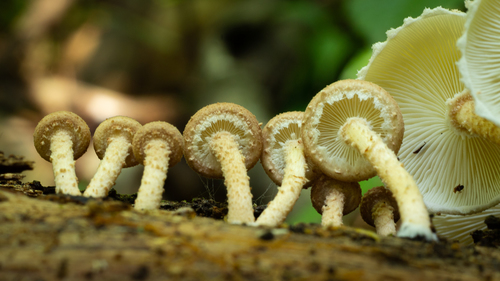
Photo: Denis Zabin. CC-BY. Source (inaturalist) -
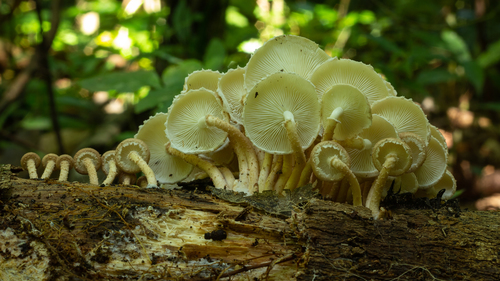
Photo: Denis Zabin. CC-BY. Source (inaturalist) -
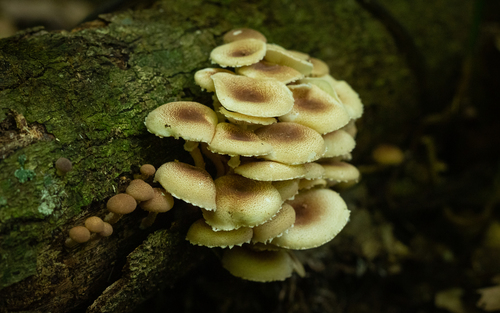
Photo: Denis Zabin. CC-BY. Source (inaturalist) -
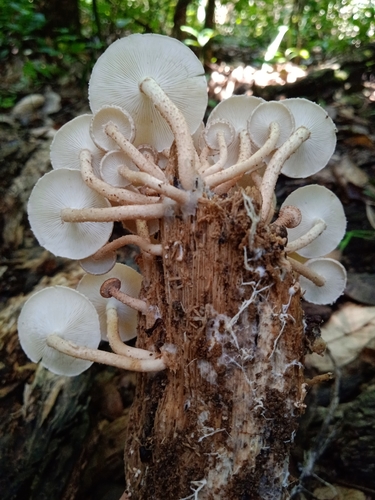
Photo: Denis Zabin. CC-BY. Source (inaturalist)
Lookalikes
No lookalikes are recorded for this species yet. That does not mean there are none. Many mushrooms look alike, so never rely on appearance alone.
Season
When this species has been recorded, by month, from open-licensed US and Canada observations. It shows when people report it, not a guarantee it is fruiting.
The highlighted bar is the current month.
View season data as a table
| Month | Records |
|---|---|
| January | 0 |
| February | 1 |
| March | 0 |
| April | 0 |
| May | 0 |
| June | 2 |
| July | 8 |
| August | 11 |
| September | 3 |
| October | 5 |
| November | 5 |
| December | 1 |
Where it is found
States and provinces with the most records. Check the foraging rules for the place you plan to visit.
- Texas 15 records · Foraging rules
- Florida 11 records · Foraging rules
- Louisiana 4 records · Foraging rules
- Mississippi 1 records · Foraging rules
About
Ripartitella brasiliensis, commonly known as the carnival cap, is a species of fungus in the family Agaricaceae. It was originally described as new to science by Carlos Luigi Spegazzini in 1889. The cap is 1–4 centimetres (1⁄2–1+1⁄2 in) wide, with a white surface largely obscured by scales. The stem is 2–7 cm (3⁄4–2+3⁄4 in) long and 2–6 millimetres (1⁄8–1⁄4 in) thick. The flesh is whitish and the spore print is white. The fungus is found in North America (near the Gulf Coast from May–November), Central and South America, Africa, and the Bonin Islands of the western Pacific Ocean. It fruits in clusters on the decaying wood of hardwood trees, especially oak.
From Wikipedia, CC BY-SA 4.0. Read the original article.
Recent finds
No community finds tagged with this species yet. Log a find.
More in the genus Ripartitella
Never eat a wild mushroom based on this site or any app. See safety basics and the disclaimer.