

Sycamore Tarspot
Rhytisma acerinum (Pers.) Fr.
Also called: Tar-Spot Fungus, Black Tar Spot, European Tar Spot
Edibility
Edibility unknown — do not eat
Never eat a wild mushroom based on this site or any app.
Photos
-
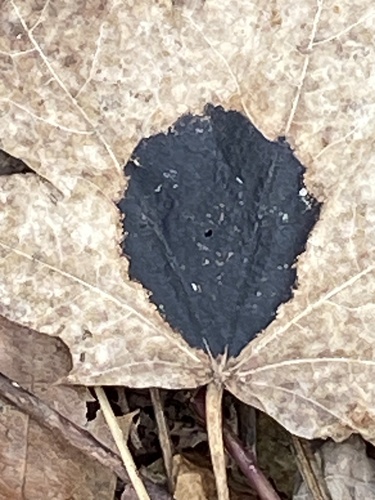
Photo: Sandy Wolkenberg. CC-BY. Source (inaturalist) -
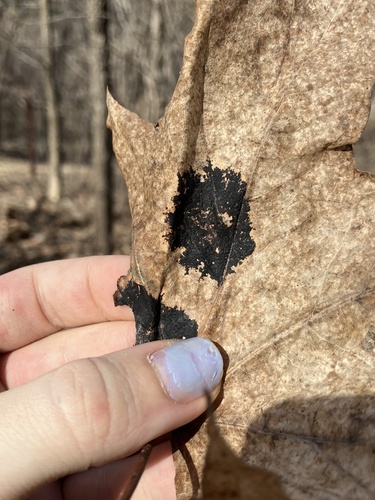
Photo: Rose Zappa. CC-BY. Source (inaturalist) -
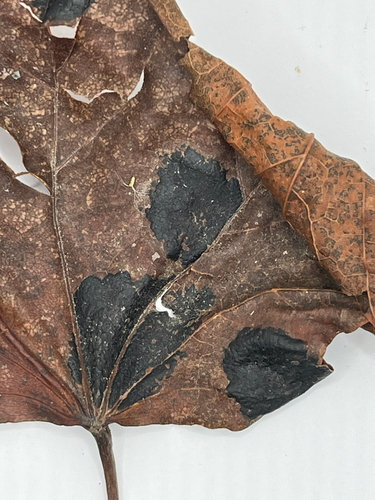
Photo: Andrew Sebastian. CC-BY. Source (inaturalist) -
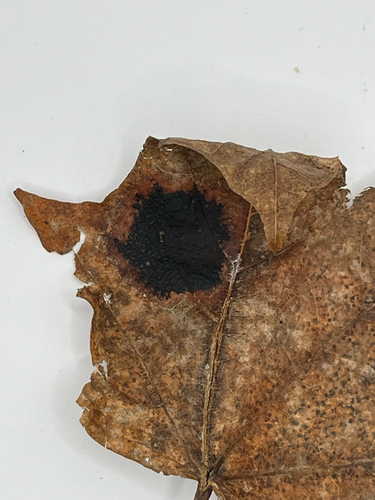
Photo: Andrew Sebastian. CC-BY. Source (inaturalist)
Lookalikes
No lookalikes are recorded for this species yet. That does not mean there are none. Many mushrooms look alike, so never rely on appearance alone.
Season
When this species has been recorded, by month, from open-licensed US and Canada observations. It shows when people report it, not a guarantee it is fruiting.
The highlighted bar is the current month.
View season data as a table
| Month | Records |
|---|---|
| January | 24 |
| February | 15 |
| March | 30 |
| April | 55 |
| May | 100 |
| June | 21 |
| July | 80 |
| August | 341 |
| September | 689 |
| October | 534 |
| November | 214 |
| December | 37 |
Where it is found
States and provinces with the most records. Check the foraging rules for the place you plan to visit.
- Ontario 405 records · Foraging rules
- New York 313 records · Foraging rules
- Wisconsin 147 records · Foraging rules
- Massachusetts 128 records · Foraging rules
- Pennsylvania 121 records · Foraging rules
- Michigan 99 records · Foraging rules
- Illinois 85 records · Foraging rules
- Quebec 80 records · Foraging rules
- New Jersey 72 records · Foraging rules
- Nova Scotia 62 records · Foraging rules
- Connecticut 62 records · Foraging rules
- Minnesota 60 records · Foraging rules
- Maine 58 records · Foraging rules
- Vermont 58 records · Foraging rules
- Florida 41 records · Foraging rules
Show 32 more
- New Hampshire36 records
- Ohio30 records
- Virginia22 records
- New Brunswick22 records
- West Virginia21 records
- Maryland21 records
- North Carolina21 records
- Indiana20 records
- Nebraska19 records
- Louisiana16 records
- District of Columbia14 records
- Prince Edward Island14 records
- Kansas12 records
- Georgia12 records
- Iowa12 records
- Manitoba8 records
- Mississippi8 records
- Washington7 records
- Delaware7 records
- Rhode Island7 records
- Newfoundland and Labrador6 records
- Missouri6 records
- Tennessee6 records
- Alabama4 records
- South Carolina3 records
- South Dakota3 records
- Arkansas3 records
- Kentucky2 records
- California2 records
- Oregon2 records
- Texas2 records
- New Mexico1 records
About
Rhytisma acerinum is a plant pathogen that commonly affects sycamores and maples in late summer and autumn, causing tar spot. Tar spot does not usually have an adverse effect on the trees' long-term health. R. acerinum is an Ascomycete fungus that locally infects the leaves of trees and is a biotrophic parasite. The disease is cosmetic and is therefore usually controlled only with sanitation methods.
From Wikipedia, CC BY-SA 4.0. Read the original article.
More in the genus Rhytisma
- No photo yet
Willow Tarspot
Rhytisma salicinum
Edibility unknown — do not eat - No photo yet
Speckled Tar Spot
Rhytisma punctatum
Edibility unknown — do not eat - No photo yet
American Tar Spot
Rhytisma americanum
Edibility unknown — do not eat - No photo yet
Rhytisma andromedae
Edibility unknown — do not eat - No photo yet
Rhytisma ilicis-canadensis
Edibility unknown — do not eat - No photo yet
Rhytisma decolorans
Edibility unknown — do not eat - No photo yet
Rhytisma solidaginis
Edibility unknown — do not eat - No photo yet
Rhytisma prini
Edibility unknown — do not eat
Never eat a wild mushroom based on this site or any app. See safety basics and the disclaimer.