

Purpureocillium lilacinum
Purpureocillium lilacinum (Thom) Luangsa-ard, Houbraken, Hywel-Jones & Samson
Edibility
Edibility unknown — do not eat
Never eat a wild mushroom based on this site or any app.
Photos
-

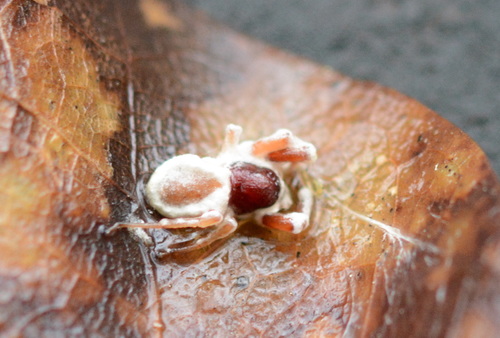
Photo: Atsushi Nakajima. CC-BY. Source (inaturalist)
Lookalikes
No lookalikes are recorded for this species yet. That does not mean there are none. Many mushrooms look alike, so never rely on appearance alone.
Season
When this species has been recorded, by month, from open-licensed US and Canada observations. It shows when people report it, not a guarantee it is fruiting.
The highlighted bar is the current month.
View season data as a table
| Month | Records |
|---|---|
| January | 5 |
| February | 2 |
| March | 2 |
| April | 12 |
| May | 5 |
| June | 9 |
| July | 1 |
| August | 5 |
| September | 4 |
| October | 1 |
| November | 4 |
| December | 1 |
Where it is found
States and provinces with the most records. Check the foraging rules for the place you plan to visit.
- Ontario 14 records · Foraging rules
- Maryland 6 records · Foraging rules
- Oklahoma 2 records · Foraging rules
- Utah 2 records · Foraging rules
- Illinois 2 records · Foraging rules
- British Columbia 1 records · Foraging rules
- Washington 1 records · Foraging rules
- Nova Scotia 1 records · Foraging rules
- Quebec 1 records · Foraging rules
- Colorado 1 records · Foraging rules
- Massachusetts 1 records · Foraging rules
About
Purpureocillium lilacinum is a species of filamentous fungus in the family Ophiocordycipitaceae. It has been isolated from a wide range of habitats, including cultivated and uncultivated soils, forests, grassland, deserts, estuarine sediments and sewage sludge, and insects. It has also been found in nematode eggs, and occasionally from females of root-knot and cyst nematodes. In addition, it has frequently been detected in the rhizosphere of many crops. The species can grow at a wide range of temperatures – from 8 to 38 °C (46 to 100 °F) for a few isolates, with optimal growth in the range 26 to 30 °C (79 to 86 °F). It also has a wide pH tolerance and can grow on a variety of substrates. P. lilacinum has shown promising results for use as a biocontrol agent to control the growth of destructive root-knot nematodes.
From Wikipedia, CC BY-SA 4.0. Read the original article.
Recent finds
No community finds tagged with this species yet. Log a find.
More in the genus Purpureocillium
Never eat a wild mushroom based on this site or any app. See safety basics and the disclaimer.