

Puccinia thaliae
Puccinia thaliae Dietel
Edibility
Edibility unknown — do not eat
Never eat a wild mushroom based on this site or any app.
Lookalikes
No lookalikes are recorded for this species yet. That does not mean there are none. Many mushrooms look alike, so never rely on appearance alone.
Season
When this species has been recorded, by month, from open-licensed US and Canada observations. It shows when people report it, not a guarantee it is fruiting.
The highlighted bar is the current month.
View season data as a table
| Month | Records |
|---|---|
| January | 4 |
| February | 15 |
| March | 3 |
| April | 1 |
| May | 2 |
| June | 1 |
| July | 1 |
| August | 0 |
| September | 3 |
| October | 1 |
| November | 0 |
| December | 0 |
Where it is found
States and provinces with the most records. Check the foraging rules for the place you plan to visit.
- Florida 25 records · Foraging rules
- Hawaii 2 records · Foraging rules
- Louisiana 2 records · Foraging rules
- New York 2 records · Foraging rules
- Texas 2 records · Foraging rules
About
Puccinia thaliae is the causal agent of canna rust, a fungal disease of Canna. Symptoms include yellow to tan spots on the plant's leaves and stems. Initial disease symptoms will result in scattered sori (clustered sporangia), eventually covering the entirety of the leaf with coalescing postulates. Both leaf surfaces, although more predominant on the underside (abaxial) of the leaf, will show yellow to brownish spore-producing these pustulate structures, and these are the signs of the disease. Spots on the upper leaf-surface coalesce and turn to brown-to-black as the disease progresses. Infection spots will become necrotic with time, with small holes (3 to 5mm) developing in older leaves. These infected leaves eventually become dry and prematurely fall.
From Wikipedia, CC BY-SA 4.0. Read the original article.
Recent finds
No community finds tagged with this species yet. Log a find.
More in the genus Puccinia
-
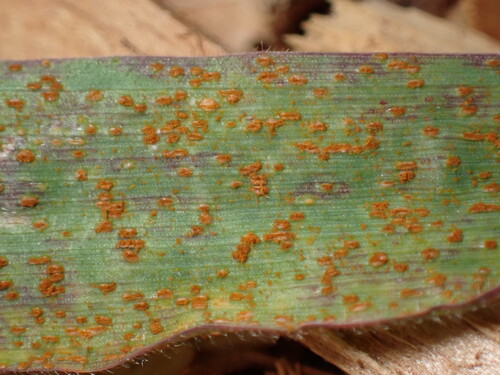
Brown Rust of Wheat
Puccinia recondita
Edibility unknown — do not eat -
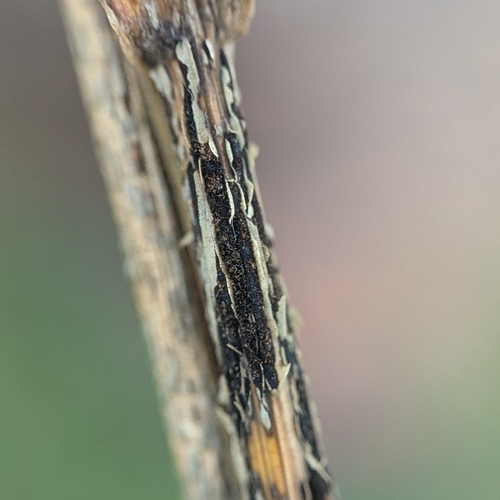
Black Stem Rust
Puccinia graminis
Edibility unknown — do not eat -
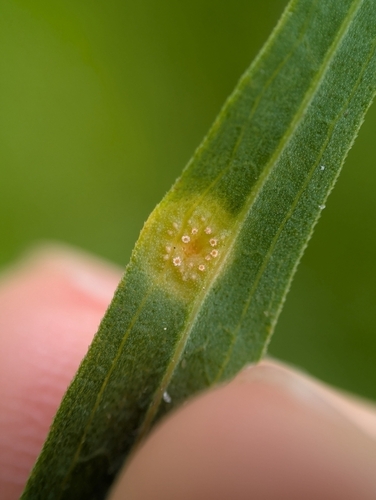
Puccinia dioicae
Edibility unknown — do not eat -
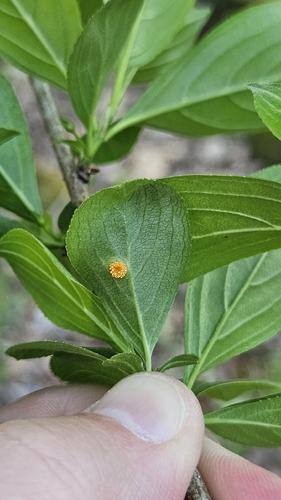
Crown Rust
Puccinia coronata
Edibility unknown — do not eat -
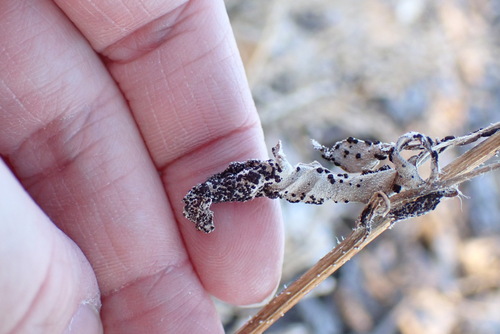
Puccinia helianthi-mollis
Edibility unknown — do not eat -
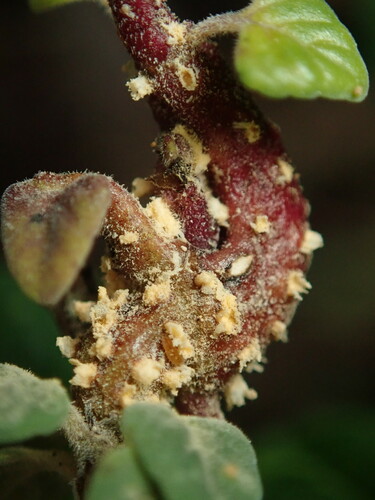
Mint Rust
Puccinia menthae
Edibility unknown — do not eat -
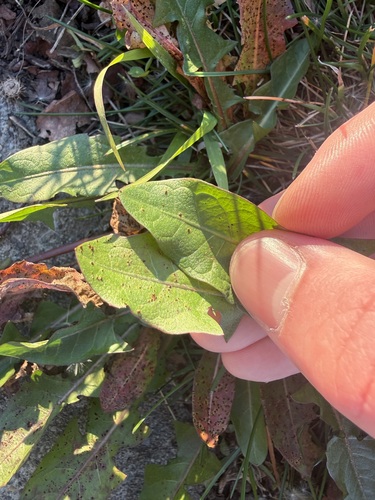
Puccinia hieracii
Edibility unknown — do not eat -
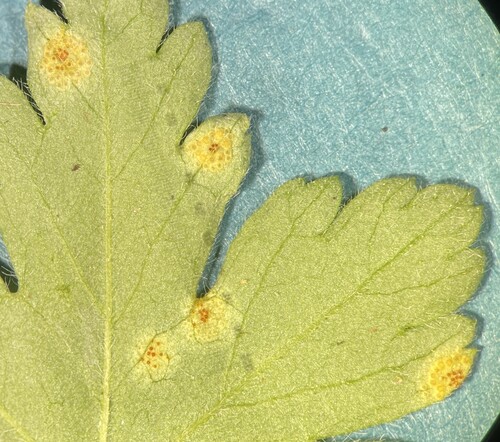
Cluster Cup Rust
Puccinia caricina
Edibility unknown — do not eat
Never eat a wild mushroom based on this site or any app. See safety basics and the disclaimer.