

Puccinia angustata
Puccinia angustata Peck
Edibility
Edibility unknown — do not eat
Never eat a wild mushroom based on this site or any app.
Photos
-
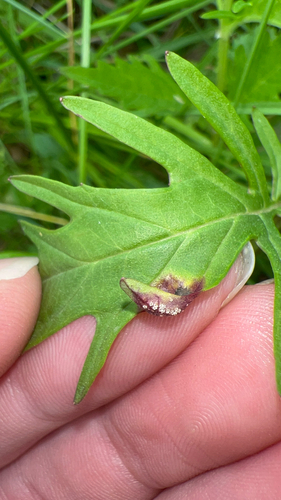
Photo: Zeke Blankenship. CC-BY. Source (inaturalist) -

Photo: Étienne Léveillé-Bourret. CC-BY. Source (inaturalist) -
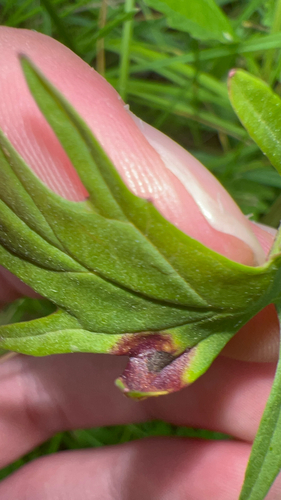
Photo: Zeke Blankenship. CC-BY. Source (inaturalist) -
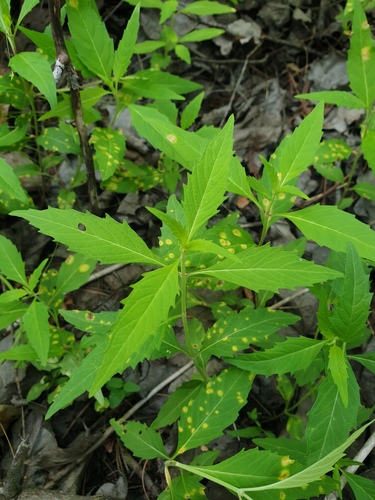
Photo: Étienne Léveillé-Bourret. CC-BY. Source (inaturalist)
Lookalikes
No lookalikes are recorded for this species yet. That does not mean there are none. Many mushrooms look alike, so never rely on appearance alone.
Season
When this species has been recorded, by month, from open-licensed US and Canada observations. It shows when people report it, not a guarantee it is fruiting.
The highlighted bar is the current month.
View season data as a table
| Month | Records |
|---|---|
| January | 5 |
| February | 9 |
| March | 13 |
| April | 18 |
| May | 76 |
| June | 266 |
| July | 224 |
| August | 404 |
| September | 507 |
| October | 272 |
| November | 108 |
| December | 45 |
Where it is found
States and provinces with the most records. Check the foraging rules for the place you plan to visit.
- Ontario 231 records · Foraging rules
- New York 214 records · Foraging rules
- Wisconsin 201 records · Foraging rules
- Massachusetts 153 records · Foraging rules
- Kansas 123 records · Foraging rules
- Indiana 76 records · Foraging rules
- California 73 records · Foraging rules
- Iowa 71 records · Foraging rules
- Michigan 68 records · Foraging rules
- Ohio 68 records · Foraging rules
- Nebraska 63 records · Foraging rules
- Pennsylvania 63 records · Foraging rules
- Illinois 53 records · Foraging rules
- North Dakota 47 records · Foraging rules
- Minnesota 44 records · Foraging rules
Show 38 more
- New Hampshire44 records
- Quebec39 records
- Maine35 records
- Connecticut25 records
- Oregon23 records
- Nova Scotia21 records
- West Virginia20 records
- British Columbia17 records
- Mississippi12 records
- New Brunswick12 records
- Washington11 records
- Delaware11 records
- Idaho10 records
- Manitoba10 records
- Rhode Island10 records
- Florida7 records
- Maryland7 records
- North Carolina7 records
- Saskatchewan7 records
- Wyoming7 records
- Alabama6 records
- Prince Edward Island6 records
- New Jersey5 records
- Virginia5 records
- Montana4 records
- Newfoundland and Labrador4 records
- Vermont4 records
- Missouri3 records
- District of Columbia2 records
- South Dakota2 records
- Tennessee2 records
- Alaska1 records
- Alberta1 records
- Colorado1 records
- Georgia1 records
- Louisiana1 records
- Texas1 records
- Utah1 records
About
Puccinia angustata is a plant pathogen that causes rust on plants in the genus Monarda. It was first described scientifically in 1873 by American mycologist Charles Horton Peck, who found it growing on the leaves on the sedges Scirpus sylvaticum and S. eriophorum.
From Wikipedia, CC BY-SA 4.0. Read the original article.
More in the genus Puccinia
-

Brown Rust of Wheat
Puccinia recondita
Edibility unknown — do not eat -

Black Stem Rust
Puccinia graminis
Edibility unknown — do not eat -

Puccinia dioicae
Edibility unknown — do not eat -

Crown Rust
Puccinia coronata
Edibility unknown — do not eat -

Puccinia helianthi-mollis
Edibility unknown — do not eat -

Mint Rust
Puccinia menthae
Edibility unknown — do not eat -

Puccinia hieracii
Edibility unknown — do not eat -

Cluster Cup Rust
Puccinia caricina
Edibility unknown — do not eat
Never eat a wild mushroom based on this site or any app. See safety basics and the disclaimer.