

Psilocybe makarorae
Psilocybe makarorae P.R.Johnst. & P.K.Buchanan
Safety first
Many edible mushrooms have toxic lookalikes, and some of those can be fatal. Have any mushroom identified in person by a local expert before you eat it.
If someone may have eaten a wild mushroom, call US Poison Control at 1-800-222-1222 or 911 right away. In Canada, call your provincial poison centre or 911.
Edibility
Psychoactive Source: Wikipedia: Psilocybe makarorae
Classification from Wikipedia: Psilocybe makarorae. Sources can be wrong or incomplete, and people react differently.
Never eat a wild mushroom based on this site or any app.
Lookalikes
No lookalikes are recorded for this species yet. That does not mean there are none. Many mushrooms look alike, so never rely on appearance alone.
Season
When this species has been recorded, by month, from open-licensed US and Canada observations. It shows when people report it, not a guarantee it is fruiting.
The highlighted bar is the current month.
View season data as a table
| Month | Records |
|---|---|
| January | 0 |
| February | 0 |
| March | 0 |
| April | 0 |
| May | 0 |
| June | 0 |
| July | 0 |
| August | 0 |
| September | 0 |
| October | 0 |
| November | 1 |
| December | 0 |
Where it is found
No regional records yet.
Identification traits
| Cap shape | umbonate |
|---|---|
| Underside (gills, pores or teeth) | gills |
| Ecology | saprotrophic |
| Stem features | bare |
| Spore print color | purple-brown |
Traits vary. Use them to ask better questions of an expert, not to make a final call.
About
Psilocybe makarorae is a species of psilocybin mushroom in the family Hymenogastraceae. Officially described as new to science in 1995, it is known only from New Zealand, where it grows on rotting wood and twigs of southern beeches. The fruit body (mushroom) has a brownish cap with lighter coloured margins, measuring up to 3.5 cm (1.4 in) wide. The cap shape is either conical, bell-shaped, but as the mushroom grows, it expands to become convex, and it features a prominent umbo. Although the whitish stipe does not form a true ring, it retains remnants of the partial veil that covers and protects the gills of young fruit bodies. P. makarorae mushrooms can be distinguished from the similar North American species Psilocybe caerulipes by microscopic characteristics such as the presence of cystidia on the gill faces (pleurocystidia), and cheilocystidia (found on the gill edges) with more elongated necks. Based on the bluing reaction to injury, P. makarorae is presumed to contain the psychedelic compounds psilocybin and psilocin.
From Wikipedia, CC BY-SA 4.0. Read the original article.
Recent finds
No community finds tagged with this species yet. Log a find.
More in the genus Psilocybe
-
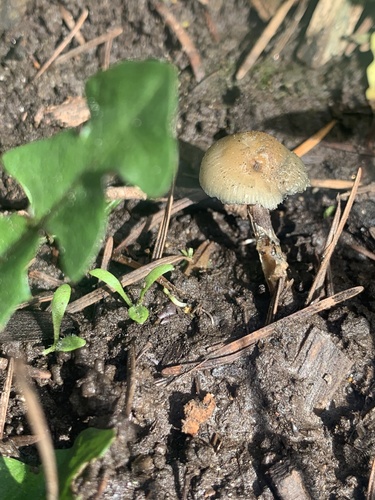
Psychedelic Ovoid Mushroom
Psilocybe ovoideocystidiata
Psychoactive -
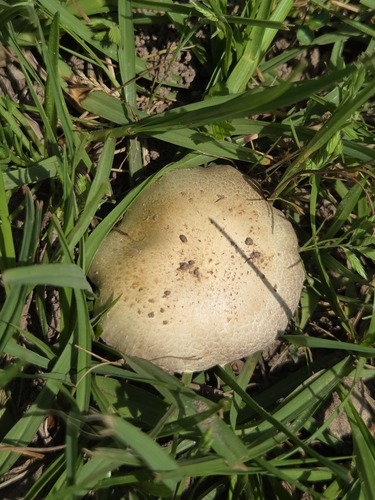
Psilocybe coronilla
Edibility unknown — do not eat -

Psilocybe turficola
Edibility unknown — do not eat -
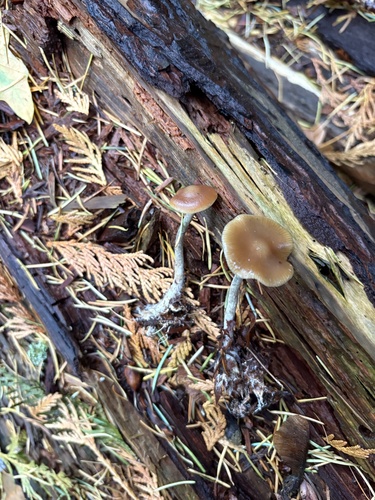
Blueleg Brownie
Psilocybe cyanescens
Psychoactive -

Psilocybe atrobrunnea
Edibility unknown — do not eat -
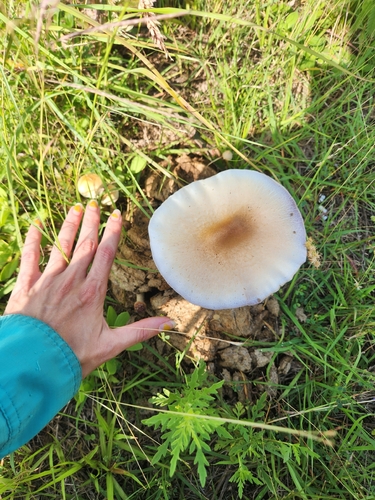
Golden Brownie
Psilocybe cubensis
Psychoactive - No photo yet
Blue-foot
Psilocybe caerulipes
Psychoactive - No photo yet
Psilocybe pelliculosa
Psychoactive
Never eat a wild mushroom based on this site or any app. See safety basics and the disclaimer.