

Psilocybe mairei
Psilocybe mairei Singer
Edibility
Edibility unknown — do not eat
Never eat a wild mushroom based on this site or any app.
Lookalikes
No lookalikes are recorded for this species yet. That does not mean there are none. Many mushrooms look alike, so never rely on appearance alone.
Season
When this species has been recorded, by month, from open-licensed US and Canada observations. It shows when people report it, not a guarantee it is fruiting.
The highlighted bar is the current month.
View season data as a table
| Month | Records |
|---|---|
| January | 0 |
| February | 0 |
| March | 1 |
| April | 0 |
| May | 0 |
| June | 0 |
| July | 0 |
| August | 0 |
| September | 0 |
| October | 0 |
| November | 0 |
| December | 0 |
Where it is found
States and provinces with the most records. Check the foraging rules for the place you plan to visit.
- California 1 records · Foraging rules
About
Psilocybe mairei is a species of mushroom in the family Hymenogastraceae. It is found in Algeria and Morocco and contains the psychoactive compound psilocybin. The oldest example of rock art suggesting use of psychedelic mushrooms might depict P. mairei. In 1992 the Italian ethnobotanist Giorgio Samorini reported finding a painted mural from Tassili n'Ajjer in the Sahara desert in southeast Algeria, dated 7000 to 9000 BCE, portraying mushrooms (later tentatively identified as P. mairei). The species was first described in 1928 by René Maire, collected in the Atlas Mountains above the city of Blida, Algeria under Atlas cedar, and given the name Hypholoma cyanescens. In 1953, it was transferred to the genus Geophilia by Robert Kühner and Henri Romagnesi. In 1973, Rolf Singer recognized it as a Psilocybe, but the name Psilocybe cyanescens was an unavailable name, having been used to describe a different species in 1946. Hence, Singer provided a new species epithet, named in honor of the mycologist who originally described the species.
From Wikipedia, CC BY-SA 4.0. Read the original article.
Recent finds
No community finds tagged with this species yet. Log a find.
More in the genus Psilocybe
-
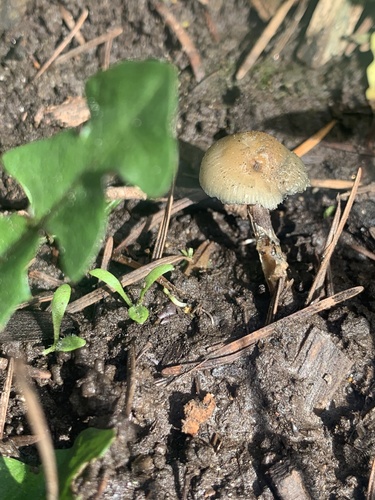
Psychedelic Ovoid Mushroom
Psilocybe ovoideocystidiata
Psychoactive -
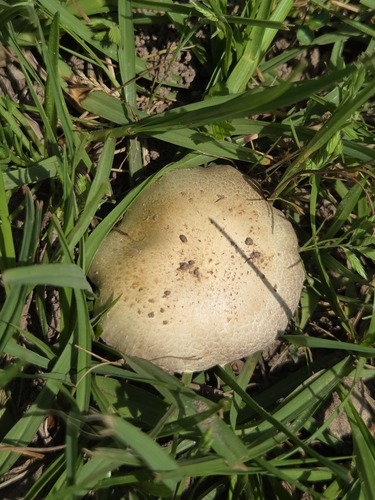
Psilocybe coronilla
Edibility unknown — do not eat -

Psilocybe turficola
Edibility unknown — do not eat -
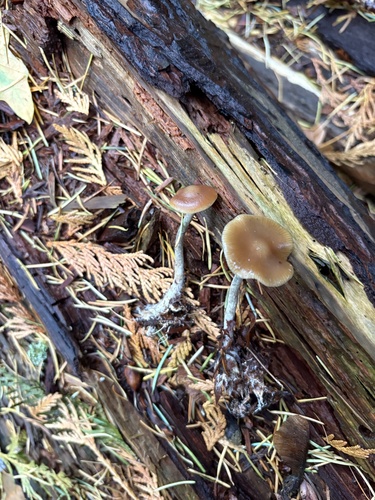
Blueleg Brownie
Psilocybe cyanescens
Psychoactive -

Psilocybe atrobrunnea
Edibility unknown — do not eat -
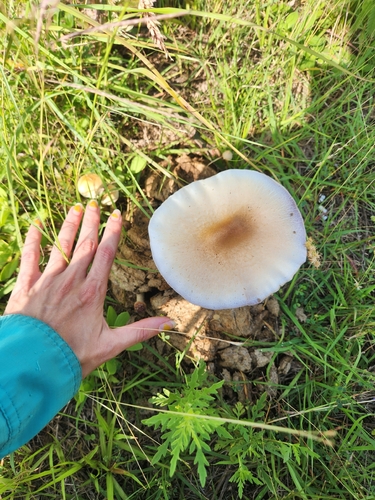
Golden Brownie
Psilocybe cubensis
Psychoactive - No photo yet
Blue-foot
Psilocybe caerulipes
Psychoactive - No photo yet
Psilocybe pelliculosa
Psychoactive
Never eat a wild mushroom based on this site or any app. See safety basics and the disclaimer.