

Common Freckle Pelt Lichen
Peltigera aphthosa (L.) Willd.
Also called: freckled pelt lichen, Common Freckle Pelt, Pelt Lichen, felt lichen
Edibility
Edibility unknown — do not eat
Never eat a wild mushroom based on this site or any app.
Photos
-
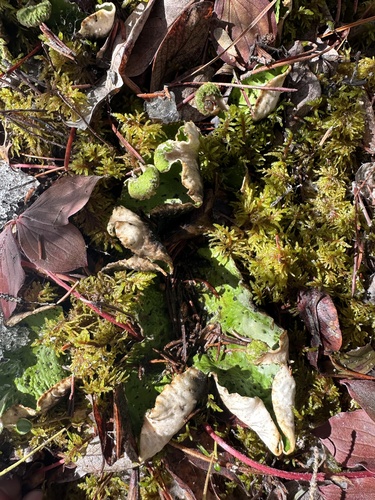
Photo: Allison Gray. CC-BY. Source (inaturalist) -
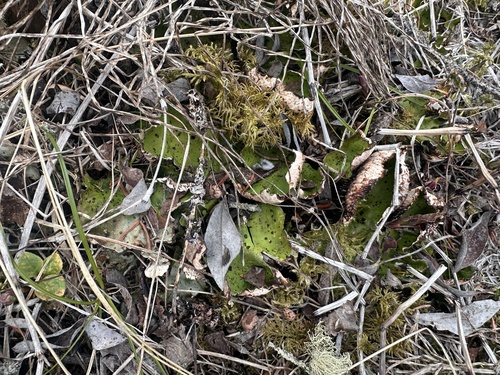
Photo: Allison Gray. CC-BY. Source (inaturalist) -
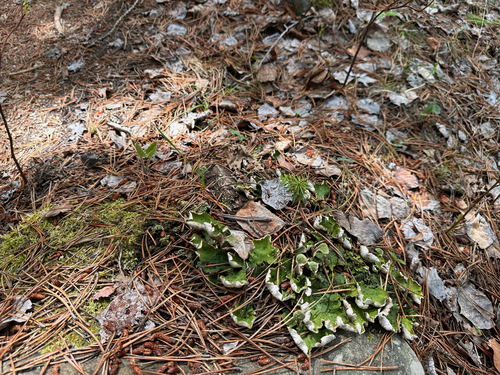
Photo: Daryl Nolan. CC0. Source (inaturalist) -
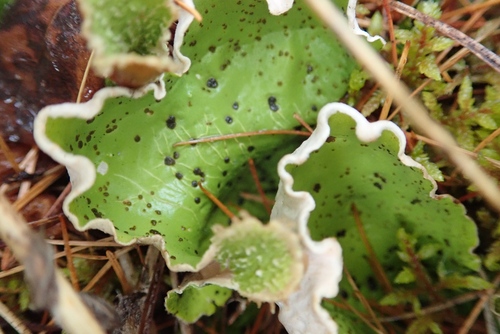
Photo: Simone Littledale. CC-BY. Source (inaturalist)
Lookalikes
No lookalikes are recorded for this species yet. That does not mean there are none. Many mushrooms look alike, so never rely on appearance alone.
Season
When this species has been recorded, by month, from open-licensed US and Canada observations. It shows when people report it, not a guarantee it is fruiting.
The highlighted bar is the current month.
View season data as a table
| Month | Records |
|---|---|
| January | 28 |
| February | 28 |
| March | 38 |
| April | 97 |
| May | 179 |
| June | 619 |
| July | 1,161 |
| August | 891 |
| September | 229 |
| October | 94 |
| November | 46 |
| December | 26 |
Where it is found
States and provinces with the most records. Check the foraging rules for the place you plan to visit.
- Alaska 578 records · Foraging rules
- British Columbia 513 records · Foraging rules
- Quebec 310 records · Foraging rules
- Northwest Territories 219 records · Foraging rules
- Ontario 174 records · Foraging rules
- Minnesota 155 records · Foraging rules
- Michigan 153 records · Foraging rules
- Colorado 144 records · Foraging rules
- Alberta 134 records · Foraging rules
- Washington 128 records · Foraging rules
- Yukon 114 records · Foraging rules
- Oregon 85 records · Foraging rules
- Nunavut 76 records · Foraging rules
- Maine 75 records · Foraging rules
- Manitoba 73 records · Foraging rules
Show 33 more
- Montana71 records
- Nova Scotia57 records
- Newfoundland and Labrador53 records
- Wyoming51 records
- Vermont41 records
- New Hampshire37 records
- Idaho32 records
- South Dakota26 records
- Massachusetts25 records
- New Brunswick24 records
- California21 records
- New Mexico21 records
- North Carolina20 records
- Wisconsin19 records
- New York19 records
- Utah16 records
- West Virginia15 records
- Saskatchewan14 records
- Virginia12 records
- Maryland11 records
- Arizona7 records
- Delaware5 records
- Connecticut5 records
- Pennsylvania5 records
- New Jersey3 records
- Tennessee3 records
- District of Columbia2 records
- Kansas1 records
- Kentucky1 records
- Mississippi1 records
- Missouri1 records
- Prince Edward Island1 records
- Texas1 records
About
Peltigera aphthosa is a species of lichen known by the common names green dog lichen, leafy lichen, felt lichen, and common freckle pelt. It has a circumpolar distribution, occurring throughout the Arctic, boreal, and temperate regions of the Northern Hemisphere. This lichen has a large thallus that may exceed one meter in width. It is divided into lobes up to about 10 centimeters long and 6 wide. It is green, becoming pale as it dries. The thallus is dotted with cephalodia, which contains one of the two symbionts, a species of Nostoc. The other is a species of Coccomyxa. These perform photosynthesis, and the Nostoc also fixes nitrogen. The lichen produces large apothecia, a reproductive structure. This widespread lichen grows in a variety of habitat types, including Arctic ecosystems. It grows in alpine climates in the southern parts of its distribution. This lichen was noted to absorb aluminum and silicon from the ash released from the 1980 eruption of Mount St. Helens. It is a known host to the lichenicolous fungus species Lichenopeltella santessonii.
From Wikipedia, CC BY-SA 4.0. Read the original article.
More in the genus Peltigera


Never eat a wild mushroom based on this site or any app. See safety basics and the disclaimer.