

Perforated Ruffle Lichen
Parmotrema perforatum (Jacq.) A.Massal.
Also called: perforated parmotrema lichen
Edibility
Edibility unknown — do not eat
Never eat a wild mushroom based on this site or any app.
Photos
-
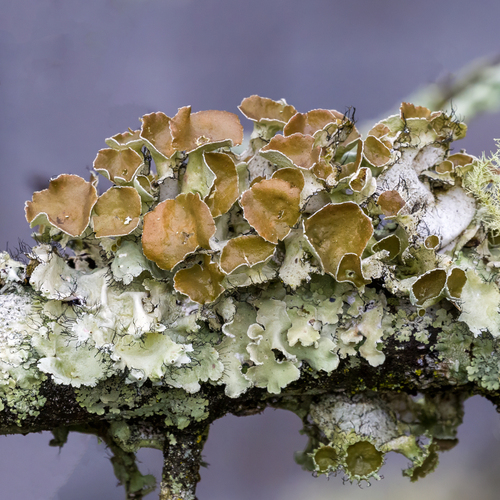
Photo: Dan Vickers. CC-BY. Source (inaturalist) -
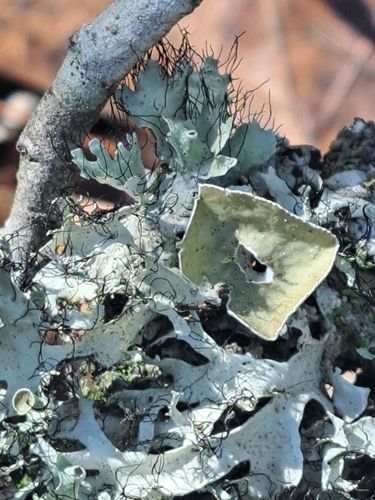
Photo: bfberauer. CC0. Source (inaturalist) -
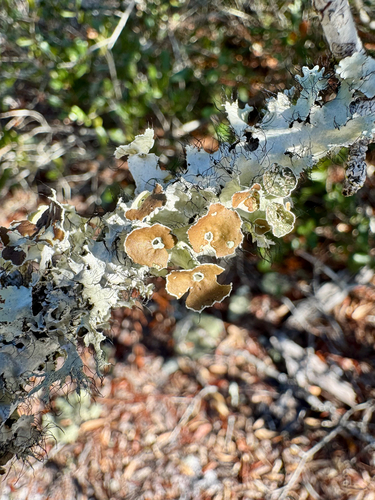
Photo: Karen Guin. CC-BY. Source (inaturalist) -
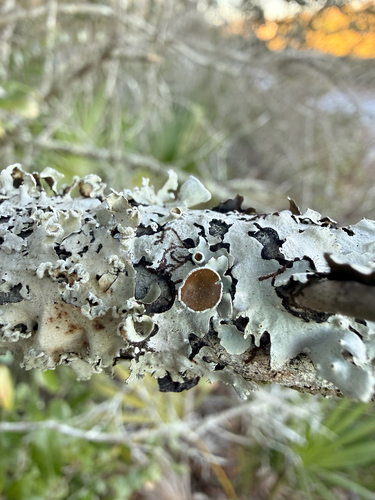
Photo: Melissa Meadows. CC-BY. Source (inaturalist)
Lookalikes
No lookalikes are recorded for this species yet. That does not mean there are none. Many mushrooms look alike, so never rely on appearance alone.
Season
When this species has been recorded, by month, from open-licensed US and Canada observations. It shows when people report it, not a guarantee it is fruiting.
The highlighted bar is the current month.
View season data as a table
| Month | Records |
|---|---|
| January | 180 |
| February | 135 |
| March | 277 |
| April | 329 |
| May | 208 |
| June | 175 |
| July | 192 |
| August | 148 |
| September | 92 |
| October | 172 |
| November | 170 |
| December | 270 |
Where it is found
States and provinces with the most records. Check the foraging rules for the place you plan to visit.
- North Carolina 361 records · Foraging rules
- Alabama 303 records · Foraging rules
- Florida 199 records · Foraging rules
- Texas 175 records · Foraging rules
- Georgia 175 records · Foraging rules
- Louisiana 164 records · Foraging rules
- Arkansas 159 records · Foraging rules
- South Carolina 125 records · Foraging rules
- Virginia 121 records · Foraging rules
- Tennessee 105 records · Foraging rules
- Massachusetts 104 records · Foraging rules
- Mississippi 75 records · Foraging rules
- New York 67 records · Foraging rules
- Maryland 57 records · Foraging rules
- New Jersey 53 records · Foraging rules
Show 24 more
- Missouri46 records
- Kentucky41 records
- Connecticut32 records
- Pennsylvania22 records
- Oklahoma22 records
- Ohio21 records
- Delaware19 records
- Illinois18 records
- California13 records
- Rhode Island11 records
- Hawaii11 records
- Kansas11 records
- Nova Scotia8 records
- Iowa6 records
- Indiana5 records
- District of Columbia4 records
- Michigan3 records
- Minnesota2 records
- Alaska2 records
- Vermont2 records
- North Dakota1 records
- Ontario1 records
- Washington1 records
- West Virginia1 records
About
Parmotrema perforatum, commonly known as the perforated ruffle lichen, is a species of foliose lichen in the family Parmeliaceae. The lichen was first formally described as new species in 1787 by Nikolaus Joseph von Jacquin. It was transferred to the genus Parmotrema by Italian lichenologist Abramo Bartolommeo Massalongo in 1860. The lichen is characterized by its apothecia (fruiting body) often having a perforated hole in the center. The genus Parmotrema has a naked (white) zone on the underside margin and often has long hair-like projections on the lobe edges called cilia; P. perforatum is no different. The thallus (lichen body) is gray and lacks the yellow-green tones that is seen in lichens with usnic acid. There are no asexual structures (soredia, isidia), but there are apothecia (the fungal sexual structures) that have the characteristic hole in the center.
From Wikipedia, CC BY-SA 4.0. Read the original article.
More in the genus Parmotrema


Never eat a wild mushroom based on this site or any app. See safety basics and the disclaimer.