

Bitter Oysterling
Panellus stipticus (Bull.) P.Karst.
Also called: Luminescent Panellus
Safety first
Many edible mushrooms have toxic lookalikes, and some of those can be fatal. Have any mushroom identified in person by a local expert before you eat it.
If someone may have eaten a wild mushroom, call US Poison Control at 1-800-222-1222 or 911 right away. In Canada, call your provincial poison centre or 911.
Edibility
Inedible Source: Wikipedia: Panellus stipticus
Classification from Wikipedia: Panellus stipticus. Sources can be wrong or incomplete, and people react differently.
Never eat a wild mushroom based on this site or any app.
Photos
-
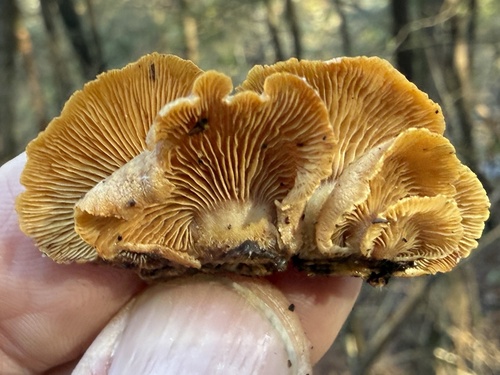
Photo: Hill Craddock. CC-BY. Source (inaturalist) -
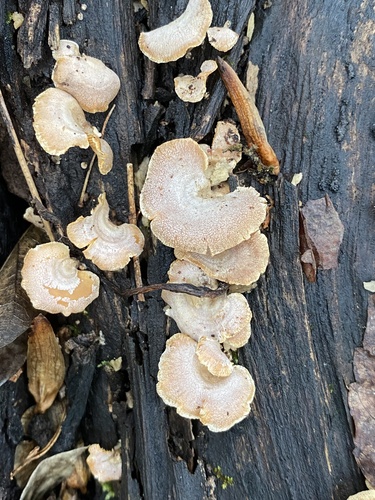
Photo: Nizar Jibrin. CC-BY. Source (inaturalist) -
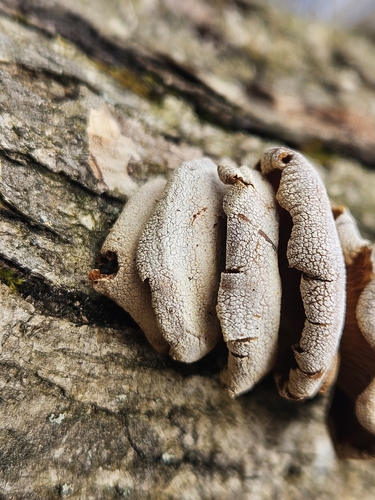
Photo: willingarden. CC-BY. Source (inaturalist) -
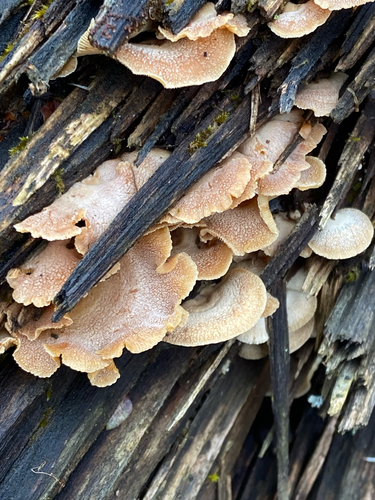
Photo: Aaron W.. CC0. Source (inaturalist)
Lookalikes
No lookalikes are recorded for this species yet. That does not mean there are none. Many mushrooms look alike, so never rely on appearance alone.
Season
When this species has been recorded, by month, from open-licensed US and Canada observations. It shows when people report it, not a guarantee it is fruiting.
The highlighted bar is the current month.
View season data as a table
| Month | Records |
|---|---|
| January | 184 |
| February | 135 |
| March | 143 |
| April | 111 |
| May | 64 |
| June | 73 |
| July | 176 |
| August | 424 |
| September | 544 |
| October | 614 |
| November | 341 |
| December | 317 |
Where it is found
States and provinces with the most records. Check the foraging rules for the place you plan to visit.
- New York 349 records · Foraging rules
- Pennsylvania 324 records · Foraging rules
- Ohio 235 records · Foraging rules
- Virginia 168 records · Foraging rules
- Ontario 166 records · Foraging rules
- Massachusetts 125 records · Foraging rules
- North Carolina 109 records · Foraging rules
- New Jersey 104 records · Foraging rules
- Illinois 99 records · Foraging rules
- Vermont 95 records · Foraging rules
- New Hampshire 93 records · Foraging rules
- Maryland 83 records · Foraging rules
- Connecticut 80 records · Foraging rules
- Indiana 79 records · Foraging rules
- Tennessee 78 records · Foraging rules
Show 35 more
- Quebec76 records
- Wisconsin69 records
- Michigan68 records
- West Virginia62 records
- British Columbia57 records
- Minnesota56 records
- Maine49 records
- Georgia45 records
- Washington41 records
- Alabama40 records
- Nova Scotia38 records
- California36 records
- Arkansas31 records
- Rhode Island28 records
- South Carolina26 records
- Louisiana26 records
- Missouri26 records
- District of Columbia25 records
- Iowa21 records
- Prince Edward Island20 records
- Florida17 records
- Alaska15 records
- Kentucky14 records
- Delaware14 records
- Texas13 records
- New Brunswick12 records
- Newfoundland and Labrador9 records
- Mississippi8 records
- Manitoba6 records
- Oregon3 records
- Kansas2 records
- Nebraska2 records
- Colorado1 records
- Idaho1 records
- Oklahoma1 records
Identification traits
| Cap shape | convex |
|---|---|
| Underside (gills, pores or teeth) | gills |
| Ecology | saprotrophic |
| Stem features | bare |
| Spore print color | white |
Traits vary. Use them to ask better questions of an expert, not to make a final call.
About
Panellus stipticus, commonly known as the bitter oyster, the astringent panus, the luminescent panellus, or the stiptic fungus, is a species of fungus in the family Mycenaceae. It is the type species of the genus Panellus. The fungus was given its current scientific name in 1879, but has been known by many names since French mycologist Jean Bulliard first described it as Agaricus stypticus in 1783. Molecular phylogenetic analysis revealed P. stipticus to have a close genetic relationship with members of the genus Mycena. Starting out as tiny white knobs, over a period of one to three months, the mushrooms develop into fan- or kidney-shaped caps that measure up to 3 cm (1.2 in) broad. The caps are orange-yellow to brownish, and attached to the decaying wood by short stubby stalks that are connected off-center or on the side of the caps. Strains from eastern North America are typically bioluminescent, but those from the Pacific coast regions of North America and from other continents are not. The luminescence is localized to the edges of the gills and the junction of the gills with the stem and cap. Bioluminescence is also observable with mycelia grown in laboratory culture, and the growth conditions for optimal light production have been studied in detail. Several chemicals have been isolated and characterized that are believed to be responsible for light production. Genetic analysis has shown that luminescence is controlled by a single dominant allele. A common and widely distributed species, it is found in Eurasia, Australia, and North America, where it grows in groups or dense overlapping clusters on the logs, stumps, and trunks of deciduous trees, especially beech, oak, and birch. Modern research has probed the potential of P. stipticus as a tool in bioremediation, because of its ability to detoxify various environmental pollutants.
From Wikipedia, CC BY-SA 4.0. Read the original article.
Never eat a wild mushroom based on this site or any app. See safety basics and the disclaimer.