

Moniliophthora perniciosa
Moniliophthora perniciosa (Stahel) Aime & Phillips-Mora
Edibility
Edibility unknown — do not eat
Never eat a wild mushroom based on this site or any app.
Photos
-
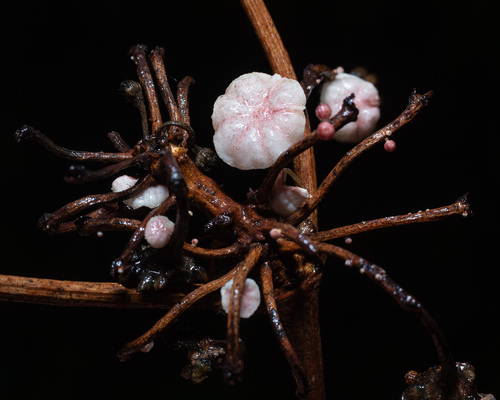
Photo: Denis Zabin. CC-BY. Source (inaturalist) -
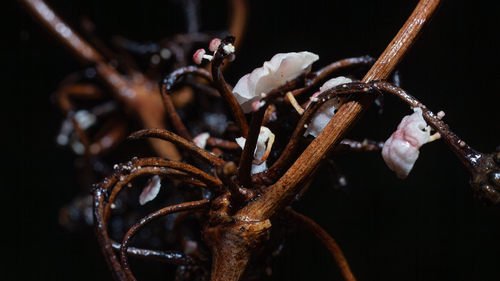
Photo: Denis Zabin. CC-BY. Source (inaturalist) -
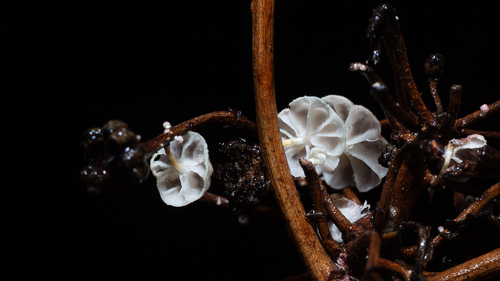
Photo: Denis Zabin. CC-BY. Source (inaturalist)
Lookalikes
No lookalikes are recorded for this species yet. That does not mean there are none. Many mushrooms look alike, so never rely on appearance alone.
Season
When this species has been recorded, by month, from open-licensed US and Canada observations. It shows when people report it, not a guarantee it is fruiting.
The highlighted bar is the current month.
View season data as a table
| Month | Records |
|---|---|
| January | 0 |
| February | 0 |
| March | 0 |
| April | 0 |
| May | 1 |
| June | 0 |
| July | 0 |
| August | 0 |
| September | 0 |
| October | 1 |
| November | 0 |
| December | 0 |
Where it is found
No regional records yet.
About
Moniliophthora perniciosa (previously Crinipellis perniciosa) is a fungus that causes "witches' broom disease" (WBD) of the cocoa tree T. cacao. This pathogen is currently limited to South America, Panama and the Caribbean, and is perhaps one of the best-known cocoa diseases, thought to have co-evolved with cocoa in its centre of origin (first recorded in the Brazilian Amazon in 1785). This fungus is hemibiotroph, with two characteristic phases: biotrophic (expanding and infecting, on living tissue) and saprotrophic (producing basidiospores, on necrotic tissue). The biotrophic stage, and what triggers its switch to a saprotrophic stage, are still not understood.
From Wikipedia, CC BY-SA 4.0. Read the original article.
Recent finds
No community finds tagged with this species yet. Log a find.
Never eat a wild mushroom based on this site or any app. See safety basics and the disclaimer.