

Mixia osmundae
Mixia osmundae (Nishida) C.L.Kramer
Edibility
Edibility unknown — do not eat
Never eat a wild mushroom based on this site or any app.
Photos
-

Photo: Mark Richman. CC-BY. Source (inaturalist) -
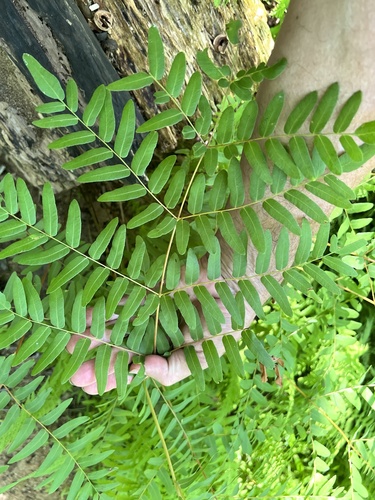
Photo: Mark Richman. CC-BY. Source (inaturalist) -
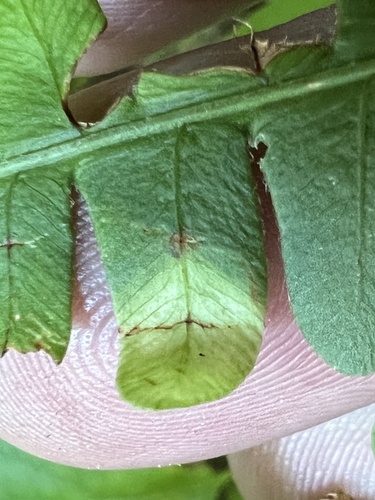
Photo: Mark Richman. CC-BY. Source (inaturalist)
Lookalikes
No lookalikes are recorded for this species yet. That does not mean there are none. Many mushrooms look alike, so never rely on appearance alone.
Season
When this species has been recorded, by month, from open-licensed US and Canada observations. It shows when people report it, not a guarantee it is fruiting.
The highlighted bar is the current month.
View season data as a table
| Month | Records |
|---|---|
| January | 0 |
| February | 0 |
| March | 0 |
| April | 0 |
| May | 1 |
| June | 2 |
| July | 5 |
| August | 0 |
| September | 0 |
| October | 1 |
| November | 0 |
| December | 0 |
Where it is found
States and provinces with the most records. Check the foraging rules for the place you plan to visit.
- Georgia 3 records · Foraging rules
- Virginia 3 records · Foraging rules
About
The Mixiomycetes are a class of fungi in the Pucciniomycotina subdivision of the Basidiomycota. The class contains a single order, the Mixiales, which in turn contains a single family, the Mixiaceae that circumscribes the monotypic genus Mixia. Only one species has been described to date, Mixia osmundae; this species was originally named Taphrina osmundae by Japanese mycologist Toji Nishida in 1911. It is characterized by having multinucleate hyphae, and by producing multiple spores on sporogenous cells. The genus name of Mixia is in honour of Arthur Jackson Mix (1888-1956), who was an American mycologist, who worked at the University of Kansas and used to study of the 'Taphrinales'. The genus was circumscribed by Charles Lawrence Kramer in Mycologia vol.50 (Issue 6) on page 924 in 1958.
From Wikipedia, CC BY-SA 4.0. Read the original article.
Recent finds
No community finds tagged with this species yet. Log a find.
Never eat a wild mushroom based on this site or any app. See safety basics and the disclaimer.