

Verticillium Dry Bubble
Lecanicillium fungicola (Preuss) Zare & W.Gams
Edibility
Edibility unknown — do not eat
Never eat a wild mushroom based on this site or any app.
Photos
-
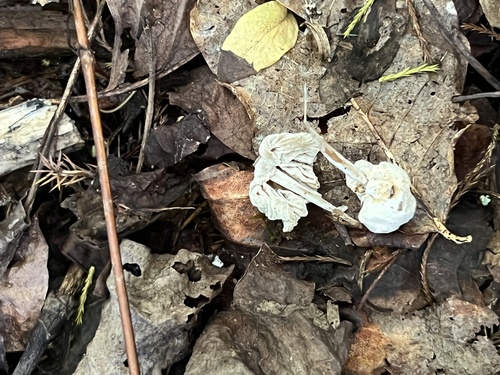
Photo: Brian C. Hunt. CC-BY. Source (inaturalist)
Lookalikes
No lookalikes are recorded for this species yet. That does not mean there are none. Many mushrooms look alike, so never rely on appearance alone.
Season
When this species has been recorded, by month, from open-licensed US and Canada observations. It shows when people report it, not a guarantee it is fruiting.
The highlighted bar is the current month.
View season data as a table
| Month | Records |
|---|---|
| January | 0 |
| February | 0 |
| March | 0 |
| April | 1 |
| May | 4 |
| June | 5 |
| July | 4 |
| August | 7 |
| September | 10 |
| October | 3 |
| November | 6 |
| December | 5 |
Where it is found
States and provinces with the most records. Check the foraging rules for the place you plan to visit.
- Connecticut 14 records · Foraging rules
- New York 3 records · Foraging rules
- Georgia 2 records · Foraging rules
- Virginia 2 records · Foraging rules
- California 1 records · Foraging rules
- North Carolina 1 records · Foraging rules
- New Jersey 1 records · Foraging rules
- Ohio 1 records · Foraging rules
- Maryland 1 records · Foraging rules
- Delaware 1 records · Foraging rules
- Indiana 1 records · Foraging rules
- Massachusetts 1 records · Foraging rules
About
Verticillium dry bubble, recently named Lecanicillium fungicola, is a mycoparasite that attacks white button mushrooms (Agaricus bisporus), among other hosts, during its generative period. L. fungicola infects the casing layer on the cap structure of several edible mushrooms. This fungal pathogen does not typically infect wild mushrooms, but more commonly cultivated mushrooms are infected such as A. bisporus, which are typically grown in large quantities. Severity of disease depends on several factors, including timing of infection and environmental conditions. Dry bubble follows the typical verticillium life cycle, although insect vectors play a large role in the spread of this disease. Control for L. fungicola is limited, and strict measures must be taken to prevent the spread of infection. L. fungicola is a devastating pathogen in the mushroom industry and causes significant losses in the commercial production of its main host A. bisporus. Annual costs for mushroom growers are estimated at 2–4% of total revenue.
From Wikipedia, CC BY-SA 4.0. Read the original article.
Recent finds
No community finds tagged with this species yet. Log a find.
More in the genus Lecanicillium
- No photo yet
Lecanicillium flavidum
Edibility unknown — do not eat - No photo yet
Lecanicillium psalliotae
Edibility unknown — do not eat - No photo yet
Lecanicillium fusisporum
Edibility unknown — do not eat -

Lecanicillium tenuipes
Edibility unknown — do not eat - No photo yet
Lecanicillium aphanocladii
Edibility unknown — do not eat - No photo yet
Lecanicillium praecognitum
Edibility unknown — do not eat - No photo yet
Lecanicillium dimorphum
Edibility unknown — do not eat -
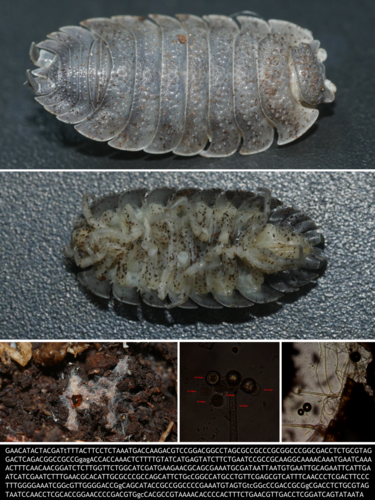
Lecanicillium saksenae
Edibility unknown — do not eat
Never eat a wild mushroom based on this site or any app. See safety basics and the disclaimer.