

Bradley
Lactifluus volemus (Fr.) Kuntze
Also called: Voluminous-latex Milky, Weeping Milk Cap, Fishy Milkcap
Safety first
Many edible mushrooms have toxic lookalikes, and some of those can be fatal. Have any mushroom identified in person by a local expert before you eat it.
If someone may have eaten a wild mushroom, call US Poison Control at 1-800-222-1222 or 911 right away. In Canada, call your provincial poison centre or 911.
Edibility
Edible (per source) Source: Wikipedia: Lactifluus volemus
Classification from Wikipedia: Lactifluus volemus. Sources can be wrong or incomplete, and people react differently.
Never eat a wild mushroom based on this site or any app.
Photos
-
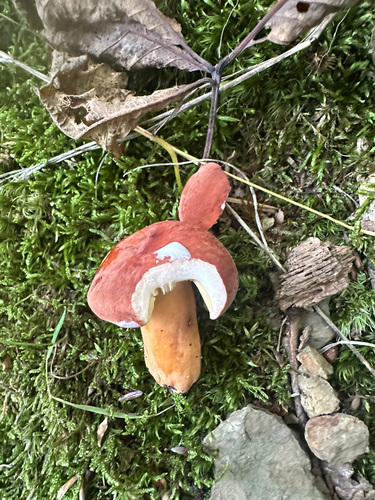
Photo: Richard Jacob. CC-BY. Source (inaturalist) -
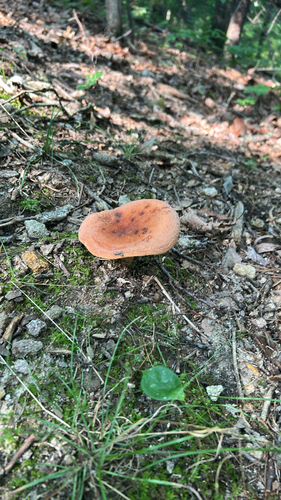
Photo: shrubshrm. CC-BY. Source (inaturalist) -
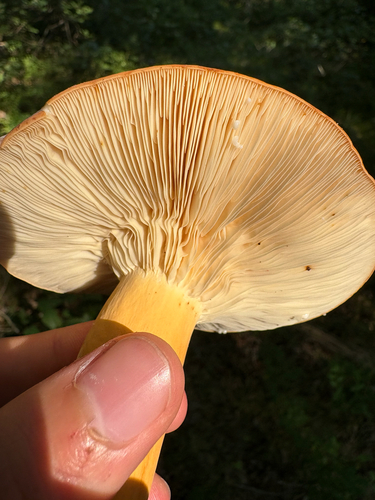
Photo: Frog The Kermit. CC-BY. Source (inaturalist) -
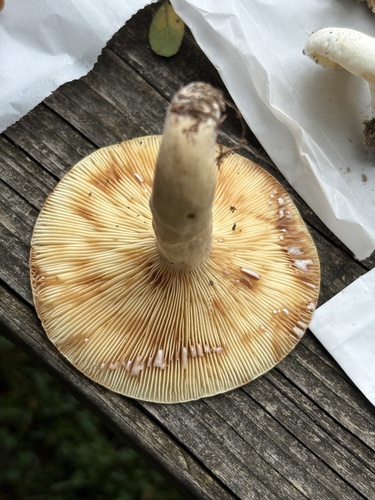
Photo: Luca Gagliano. CC-BY. Source (inaturalist)
Lookalikes
No lookalikes are recorded for this species yet. That does not mean there are none. Many mushrooms look alike, so never rely on appearance alone.
Season
When this species has been recorded, by month, from open-licensed US and Canada observations. It shows when people report it, not a guarantee it is fruiting.
The highlighted bar is the current month.
View season data as a table
| Month | Records |
|---|---|
| January | 1 |
| February | 1 |
| March | 5 |
| April | 3 |
| May | 63 |
| June | 163 |
| July | 516 |
| August | 546 |
| September | 274 |
| October | 234 |
| November | 33 |
| December | 1 |
Where it is found
States and provinces with the most records. Check the foraging rules for the place you plan to visit.
- Pennsylvania 135 records · Foraging rules
- North Carolina 116 records · Foraging rules
- Tennessee 106 records · Foraging rules
- New York 96 records · Foraging rules
- West Virginia 72 records · Foraging rules
- Virginia 64 records · Foraging rules
- Florida 59 records · Foraging rules
- Massachusetts 38 records · Foraging rules
- Texas 37 records · Foraging rules
- Alabama 32 records · Foraging rules
- Georgia 29 records · Foraging rules
- Connecticut 29 records · Foraging rules
- Illinois 25 records · Foraging rules
- Ohio 25 records · Foraging rules
- Maryland 20 records · Foraging rules
Show 27 more
- Mississippi20 records
- New Jersey20 records
- Vermont17 records
- Missouri15 records
- Michigan14 records
- South Carolina13 records
- Nova Scotia13 records
- Indiana12 records
- Wisconsin12 records
- Louisiana11 records
- Iowa10 records
- Oklahoma9 records
- Minnesota8 records
- District of Columbia6 records
- Ontario6 records
- Quebec6 records
- Arkansas4 records
- Kentucky3 records
- New Hampshire3 records
- Rhode Island3 records
- Delaware2 records
- Maine2 records
- Washington2 records
- California1 records
- Colorado1 records
- Kansas1 records
- Utah1 records
Identification traits
| Cap shape | convex |
|---|---|
| Underside (gills, pores or teeth) | gills |
| Ecology | mycorrhizal |
| Stem features | bare |
| Spore print color | white |
Traits vary. Use them to ask better questions of an expert, not to make a final call.
About
Lactifluus volemus, formerly known as Lactarius volemus, and commonly known as the weeping milk cap or bradley, is a species of fungus in the family Russulaceae. Phylogenetic analysis suggests that L. volemus represents several species or subspecies, rather than a single taxon. The colour of the mushroom varies from apricot to tawny, and the cap may be up to 11 cm (4+1⁄2 in) wide. The pale golden yellow gills on the underside of the cap are closely spaced and sometimes forked. One of the mushroom's most distinctive features is the large amount of latex it exudes when the gills are damaged, leading to some of its common names, e.g. voluminous-latex milky. It also has a distinctive fishy smell, which does not affect the taste. The fruit bodies have been chemically analysed and found to contain several sterols related to ergosterol, some of which are unique to this species. The mushroom also contains a natural rubber that has been chemically characterized. L. volemus produces a white spore print and has roughly spherical spores about 7–8 μm in diameter. Several other Lactifluus species resemble L. volemus, such as L. corrugis, but can be distinguished by differences in distribution, visible morphology, and microscopic characteristics. L. volemus is widely distributed in the Northern Hemisphere, in temperate regions of Eurasia and North America, as well as some subtropical and tropical regions of Asia. A mycorrhizal fungus, its fruit bodies grow on the ground at the base of various species of trees from summer to autumn, either individually or in groups. It is valued as an edible mushroom and is sold in some Asian markets.
From Wikipedia, CC BY-SA 4.0. Read the original article.
Never eat a wild mushroom based on this site or any app. See safety basics and the disclaimer.