

Basket Fungus
Ileodictyon cibarium Tul. & C.Tul.
Edibility
Edibility unknown — do not eat
Never eat a wild mushroom based on this site or any app.
Photos
-
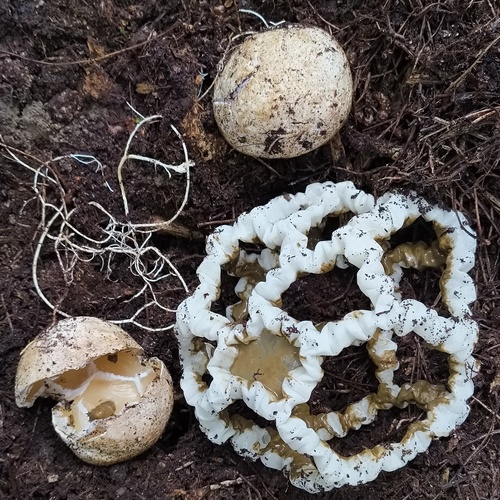
Photo: Zac T.. CC-BY. Source (inaturalist) -
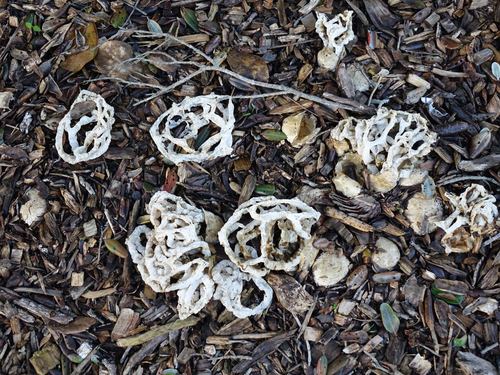
Photo: Jacqui Geux. CC-BY. Source (inaturalist)
Lookalikes
No lookalikes are recorded for this species yet. That does not mean there are none. Many mushrooms look alike, so never rely on appearance alone.
Season
When this species has been recorded, by month, from open-licensed US and Canada observations. It shows when people report it, not a guarantee it is fruiting.
The highlighted bar is the current month.
View season data as a table
| Month | Records |
|---|---|
| January | 0 |
| February | 0 |
| March | 0 |
| April | 0 |
| May | 0 |
| June | 0 |
| July | 2 |
| August | 0 |
| September | 0 |
| October | 0 |
| November | 1 |
| December | 0 |
Where it is found
States and provinces with the most records. Check the foraging rules for the place you plan to visit.
- Washington 2 records · Foraging rules
- British Columbia 1 records · Foraging rules
- Oregon 1 records · Foraging rules
Identification traits
| Underside (gills, pores or teeth) | gleba |
|---|---|
| Spore print color | olive-brown |
Traits vary. Use them to ask better questions of an expert, not to make a final call.
About
Ileodictyon cibarium, commonly known as the white basket fungus or basket fungus, is a species of fungus in the family Phallaceae. The fungus was first described by Edmond Tulasne and Charles Tulasne from material collected in Akaroa. The fungus is found in Argentina, Chile, Australia, and New Zealand. It has also been introduced to East Africa and Southern England. The fruiting bodies develop in two distinct stages: first an "egg stage", followed by a "white-net" lattice stage, which expands into a shape comparable to that of a fullerene. The arms of the lattice stage are covered in sticky, spore-bearing gleba that attracts flies and other insects, which disperse the spores. Mature fruiting bodies can also roll across the ground when pushed by the wind. The fungus was traditionally consumed by the indigenous Māori people of New Zealand and is also present in Māori mythology.
From Wikipedia, CC BY-SA 4.0. Read the original article.
Recent finds
No community finds tagged with this species yet. Log a find.
Never eat a wild mushroom based on this site or any app. See safety basics and the disclaimer.