

Terracotta Hedgehog
Hydnum rufescens Pers.
Edibility
Edibility unknown — do not eat
Never eat a wild mushroom based on this site or any app.
Photos
-
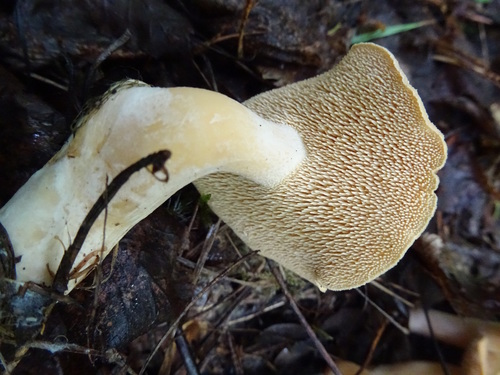
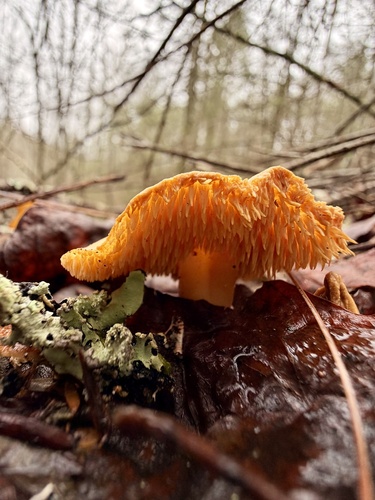
Photo: Наталья Коротких. CC-BY. Source (inaturalist) -
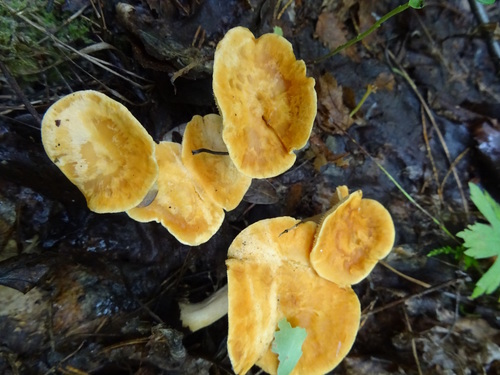
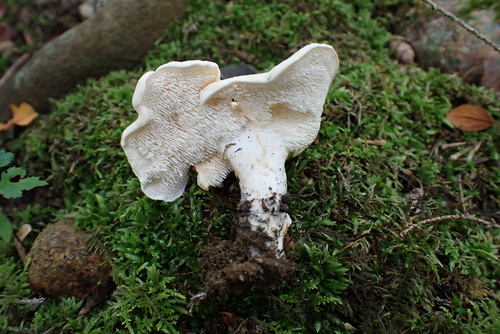
Photo: Наталья Коротких. CC-BY. Source (inaturalist) -
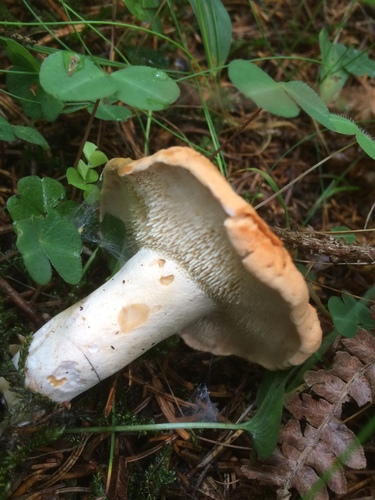
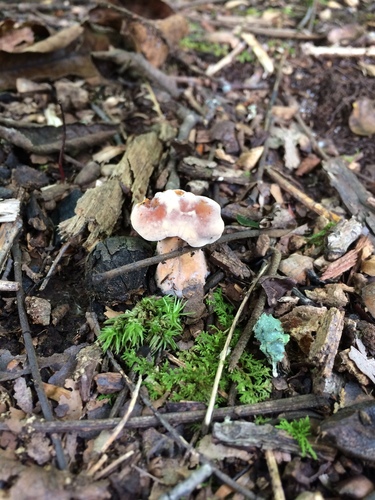
Photo: Daniel Ellehammer Larsen. CC-BY. Source (inaturalist)
Lookalikes
No lookalikes are recorded for this species yet. That does not mean there are none. Many mushrooms look alike, so never rely on appearance alone.
Season
When this species has been recorded, by month, from open-licensed US and Canada observations. It shows when people report it, not a guarantee it is fruiting.
The highlighted bar is the current month.
View season data as a table
| Month | Records |
|---|---|
| January | 0 |
| February | 0 |
| March | 0 |
| April | 0 |
| May | 0 |
| June | 0 |
| July | 2 |
| August | 14 |
| September | 7 |
| October | 1 |
| November | 0 |
| December | 0 |
Where it is found
States and provinces with the most records. Check the foraging rules for the place you plan to visit.
- North Carolina 5 records · Foraging rules
- Quebec 3 records · Foraging rules
- Idaho 3 records · Foraging rules
- Michigan 2 records · Foraging rules
- Maine 1 records · Foraging rules
- Massachusetts 1 records · Foraging rules
- Colorado 1 records · Foraging rules
- Washington 1 records · Foraging rules
- Wisconsin 1 records · Foraging rules
- West Virginia 1 records · Foraging rules
About
Hydnum rufescens, commonly known as the terracotta hedgehog, is an edible basidiomycete of the family Hydnaceae. It belongs to the small group of mushrooms often referred to as the tooth fungi, which produce fruit bodies whose cap undersurfaces are covered by hymenophores resembling spines or teeth, and not pores or gills. It is very similar to the more common hedgehog fungus (Hydnum repandum), and was previously sometimes considered a variety of that species. However, the following differences have been noted: the cap of H. rufescens is russet rather than beige, the overall dimensions are smaller and more regular in shape, with a central stipe, the spines are not decurrent, and the spores are slightly larger. Both species are found in European coniferous and deciduous forests growing on soil. It is reportedly ectomycorrhizal with Picea abies, Pinus sylvestris, Fagus sylvatica and Quercus robur.
From Wikipedia, CC BY-SA 4.0. Read the original article.
Recent finds
No community finds tagged with this species yet. Log a find.
More in the genus Hydnum
-
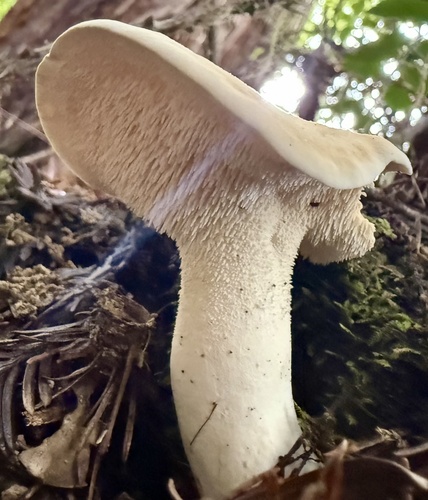
Wood Hedgehog
Hydnum repandum
Edible (per source) -
Umbilicate Hedgehog
Hydnum umbilicatum
Edible (per source) -
White Hedgehog
Hydnum albidum
Edibility unknown — do not eat - No photo yet
Hydnum subincarnatum
Edibility unknown — do not eat - No photo yet
Hydnum membranaceum
Edibility unknown — do not eat -
Hydnum cuspidatum
Edibility unknown — do not eat -

Western Bellybutton Hedgehog
Hydnum oregonense
Edibility unknown — do not eat -

Hydnum melitosarx
Edibility unknown — do not eat
Never eat a wild mushroom based on this site or any app. See safety basics and the disclaimer.