

Helminthosporium solani
Helminthosporium solani Durieu & Mont.
Edibility
Edibility unknown — do not eat
Never eat a wild mushroom based on this site or any app.
Photos
-

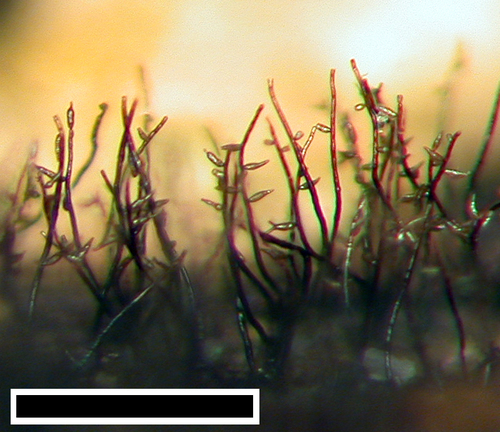
Photo: Jerry Cooper. CC-BY. Source (inaturalist)
Lookalikes
No lookalikes are recorded for this species yet. That does not mean there are none. Many mushrooms look alike, so never rely on appearance alone.
Season
When this species has been recorded, by month, from open-licensed US and Canada observations. It shows when people report it, not a guarantee it is fruiting.
The highlighted bar is the current month.
View season data as a table
| Month | Records |
|---|---|
| January | 5 |
| February | 3 |
| March | 2 |
| April | 7 |
| May | 5 |
| June | 2 |
| July | 1 |
| August | 8 |
| September | 0 |
| October | 2 |
| November | 1 |
| December | 8 |
Where it is found
States and provinces with the most records. Check the foraging rules for the place you plan to visit.
- District of Columbia 9 records · Foraging rules
- Prince Edward Island 7 records · Foraging rules
- New York 7 records · Foraging rules
- Connecticut 3 records · Foraging rules
- Nova Scotia 3 records · Foraging rules
- Manitoba 2 records · Foraging rules
- Ontario 2 records · Foraging rules
- Quebec 2 records · Foraging rules
- Maine 2 records · Foraging rules
- Washington 1 records · Foraging rules
- New Jersey 1 records · Foraging rules
- New Brunswick 1 records · Foraging rules
- Virginia 1 records · Foraging rules
- Newfoundland and Labrador 1 records · Foraging rules
About
Helminthosporium solani is a fungal plant pathogen responsible for the plant disease known as silver scurf. Silver scurf is a blemish disease, meaning the effect it has on tubers is mostly cosmetic and affects "fresh market, processing and seed tuber potatoes." There are some reports of it affecting development, meaning growth and tuber yield. This is caused by light brown lesions, which in turn change the permeability of tuber skin and then it causes tuber shrinkage and water loss, which finally causes weight loss. The disease has become economically important because silver scurf affected potatoes for processing and direct consumption have been rejected by the industry. The disease cycle can be divided into two stages: field and storage. It is mainly a seed borne disease and the primary source of inoculum is mainly infected potato seed tubers. Symptoms develop and worsen in storage because the conditions are conducive to sporulation. The ideal conditions for the spread of this disease are high temperatures and high humidity. There are also many cultural practices that favor spread and development. There are multiple ways to help control the disease.
From Wikipedia, CC BY-SA 4.0. Read the original article.
Recent finds
No community finds tagged with this species yet. Log a find.
More in the genus Helminthosporium
-
Helminthosporium velutinum
Edibility unknown — do not eat - No photo yet
Helminthosporium oligosporum
Edibility unknown — do not eat - No photo yet
Helminthosporium gleicheniae
Edibility unknown — do not eat - No photo yet
Helminthosporium asterinum
Edibility unknown — do not eat - No photo yet
Helminthosporium papulosum
Edibility unknown — do not eat - No photo yet
Helminthosporium pseudotsugae
Edibility unknown — do not eat - No photo yet
Helminthosporium curvulum
Edibility unknown — do not eat - No photo yet
Helminthosporium paraoligosporum
Edibility unknown — do not eat
Never eat a wild mushroom based on this site or any app. See safety basics and the disclaimer.