

Causal agent of chestnut rot
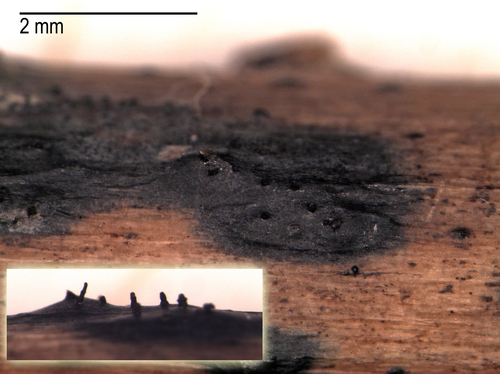
Gnomoniopsis smithogilvyi L.A.Shuttlew., E.C.Y.Liew & D.I.Guest
Also called: Chestnut brown rot fungus
Edibility
Edibility unknown — do not eat
Never eat a wild mushroom based on this site or any app.
Lookalikes
No lookalikes are recorded for this species yet. That does not mean there are none. Many mushrooms look alike, so never rely on appearance alone.
Season
When this species has been recorded, by month, from open-licensed US and Canada observations. It shows when people report it, not a guarantee it is fruiting.
The highlighted bar is the current month.
View season data as a table
| Month | Records |
|---|---|
| January | 0 |
| February | 1 |
| March | 0 |
| April | 0 |
| May | 0 |
| June | 0 |
| July | 0 |
| August | 0 |
| September | 0 |
| October | 0 |
| November | 0 |
| December | 0 |
Where it is found
No regional records yet.
About
Gnomoniopsis castaneae (synonym Gnomoniopsis smithogilvyi) is a fungus of the order Diaporthales that is the most important cause of brown chestnut rot, an emerging disease that damages the fruit of chestnuts. It also causes cankers and necrosis on leaves and on chestnut galls caused by the gall wasp, Dryocosmus kuriphilus. It has been observed to cause cankers in chestnut wood. Additionally, it can cause cankers on other chestnut species, red oak, hazelnut trees, less severe damage to some nut trees, and lives as an endophyte on other nut trees. The disease has been reported in Europe, Oceania, and has recently been found in North America; for this reason, the fungus is considered a potential threat to the reintroduction of the American chestnut. In brown chestnut rot, Gnomoniopsis castaneae infects the kernel of the nut with browning and necrosis of endosperm and embryo. Brown chestnut rot is expressed cryptically with apparently healthy nuts found after harvest to exhibit internal rot. The fungus is believed to initially establish endophyte colonization of chestnut tissues, only becoming pathogenic with ripening of the nuts. Early on, parasitized nuts are difficult to distinguish from good nuts, rot only being detected when processed or eaten. The route of infection is uncertain but is believed to be either infection of chestnut flowers by ascospores or conidia or by inoculum entrance through shell defects. The fungus persists as a saprophyte in duff, such as burs, fallen leaves and other residua, which act as the reservoir for formation of perithecia with eventual release of spores. The nature of the transfer of inoculum and dispersal in time and space and the effect of climate is unknown. The fungus also kills the chestnut gall wasp Dryocosmus kuriphilus and has been proposed as a potential natural biocontrol agent against insect pests, based on studies of its effect on Plodia interpunctella and Trogoderma granarium. Exposure of the fungus to the commercial biofungicide Serenade® ASO (Bacillus amyloliquefaciens QST 713; ASO) induced the fungus to produce the mycotoxins 3-nitropropionic acid and diplodiatoxin. Exposure of the fungus to the chemical fungicide Horizon® (tebuconazole; HOR) induced the fungus to produce diplodiatoxin. These mycotoxins might present a health hazard to human consumers of chestnuts treated with these fungicides. In a chestnut orchard context, strategies for managing Gnomoniopsis castaneae infections include aggressive pruning of infected branches, maintaining tree health via proper hydration and nutrient provision so as to improve resistance, and fungicide application when necessary. Since this fungus can spread through spores, proper sanitation and disposal of infected plant material are also crucial to limit its spread.
From Wikipedia, CC BY-SA 4.0. Read the original article.
Recent finds
No community finds tagged with this species yet. Log a find.
More in the genus Gnomoniopsis
-
Gnomoniopsis idaeicola
Edibility unknown — do not eat - No photo yet
Gnomoniopsis clavulata
Edibility unknown — do not eat - No photo yet
Gnomoniopsis comari
Edibility unknown — do not eat - No photo yet
Gnomoniopsis paraclavulata
Edibility unknown — do not eat - No photo yet
Gnomoniopsis fructicola
Edibility unknown — do not eat - No photo yet
Gnomoniopsis racemula
Edibility unknown — do not eat - No photo yet
Gnomoniopsis alderdunensis
Edibility unknown — do not eat - No photo yet
Gnomoniopsis macounii
Edibility unknown — do not eat
Never eat a wild mushroom based on this site or any app. See safety basics and the disclaimer.