

Glutinous Earthtongue
Glutinoglossum glutinosum (Pers.) Hustad, A.N.Mill., Dentinger & P.F.Cannon
Edibility
Edibility unknown — do not eat
Never eat a wild mushroom based on this site or any app.
Photos
-
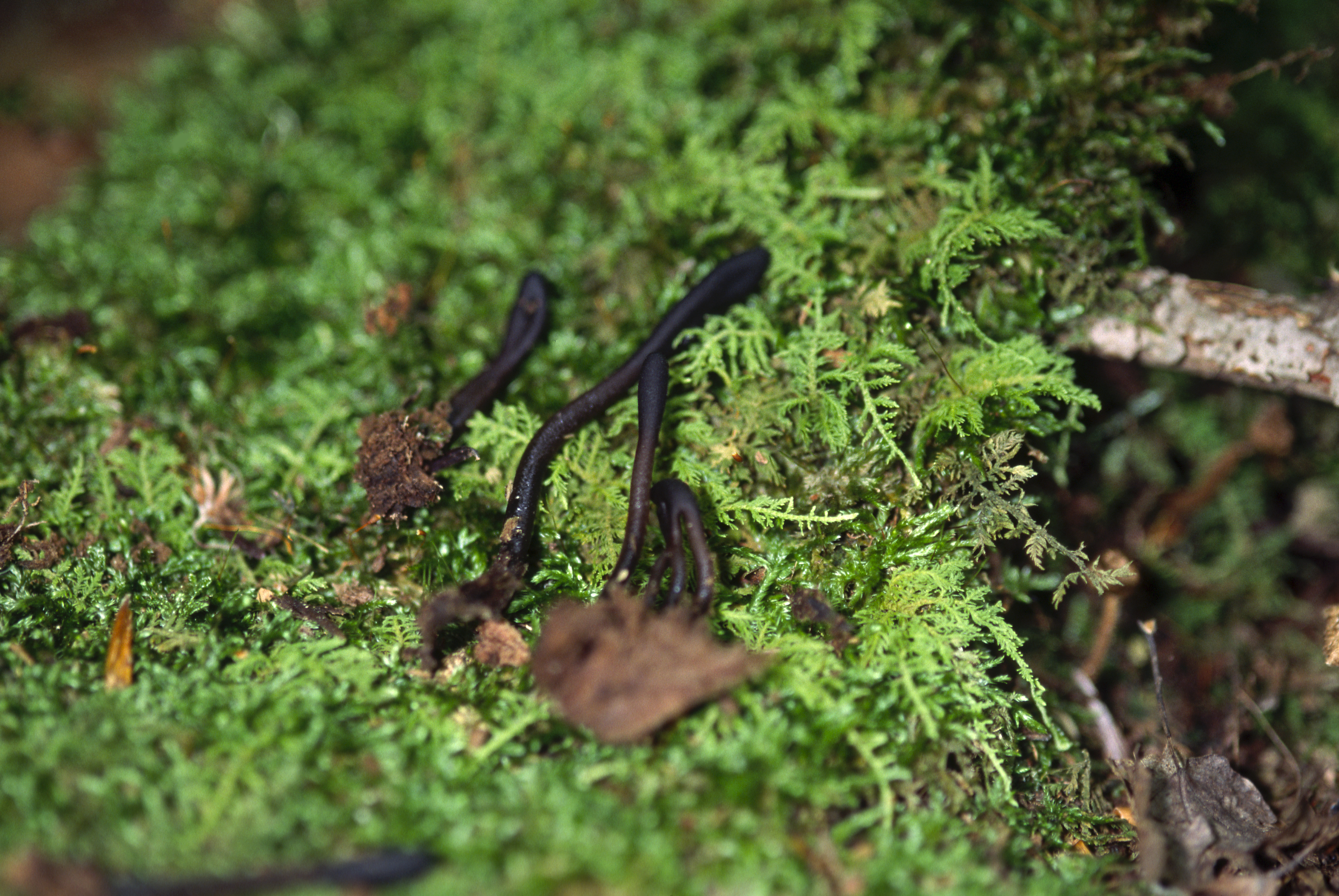
Photo: Cornell University Plant Pathology Herbarium (CUP-). CC0. Source (gbif) -
Photo: University of Florida Herbarium - Fungi (FLAS-). CC0. Source (gbif)
Lookalikes
No lookalikes are recorded for this species yet. That does not mean there are none. Many mushrooms look alike, so never rely on appearance alone.
Season
When this species has been recorded, by month, from open-licensed US and Canada observations. It shows when people report it, not a guarantee it is fruiting.
The highlighted bar is the current month.
View season data as a table
| Month | Records |
|---|---|
| January | 2 |
| February | 1 |
| March | 1 |
| April | 0 |
| May | 13 |
| June | 19 |
| July | 50 |
| August | 88 |
| September | 63 |
| October | 53 |
| November | 6 |
| December | 0 |
Where it is found
States and provinces with the most records. Check the foraging rules for the place you plan to visit.
- Ontario 31 records · Foraging rules
- New York 11 records · Foraging rules
- Pennsylvania 8 records · Foraging rules
- Quebec 6 records · Foraging rules
- North Carolina 5 records · Foraging rules
- Nova Scotia 5 records · Foraging rules
- Maine 5 records · Foraging rules
- Tennessee 4 records · Foraging rules
- Michigan 3 records · Foraging rules
- Massachusetts 3 records · Foraging rules
- British Columbia 2 records · Foraging rules
- California 2 records · Foraging rules
- New Hampshire 2 records · Foraging rules
- Virginia 2 records · Foraging rules
- Vermont 2 records · Foraging rules
Show 4 more
- Missouri1 records
- Connecticut1 records
- Ohio1 records
- Oregon1 records
Identification traits
| Underside (gills, pores or teeth) | smooth |
|---|---|
| Ecology | mycorrhizal |
| Stem features | bare |
Traits vary. Use them to ask better questions of an expert, not to make a final call.
About
Glutinoglossum glutinosum, commonly known as the viscid black earth tongue or the glutinous earthtongue, is a species of fungus in the family Geoglossaceae (the earth tongues). First described in 1796 as a species of Geoglossum, the fungus has gone through several changes of genera in its taxonomic history. It was placed in its current genus, Glutinoglossum, in 2013. The smooth, nearly black, club-shaped fruitbodies grow to heights ranging from 1.5 to 5 cm (1⁄2 to 2 in). The head is up to 0.7 cm (1⁄4 in) long, and the stipes are sticky. Several other black earth tongue species are quite similar in external appearance, and many can be reliably distinguished only by examining differences in microscopic characteristics, such as spores, asci, and paraphyses. Widely distributed in the Northern Hemisphere, it has been found in northern Africa, Asia, Europe, and North America. Although previously thought to exist in Australasia, collections made from these locations have since been referred to new species. G. glutinosum is a saprophytic species that grows on soil in moss or in grassy areas.
From Wikipedia, CC BY-SA 4.0. Read the original article.
Recent finds
No community finds tagged with this species yet. Log a find.
More in the genus Glutinoglossum
- No photo yet
Glutinoglossum americanum
Edibility unknown — do not eat - No photo yet
Glutinoglossum proliferatum
Edibility unknown — do not eat - No photo yet
Glutinoglossum peregrinans
Edibility unknown — do not eat -
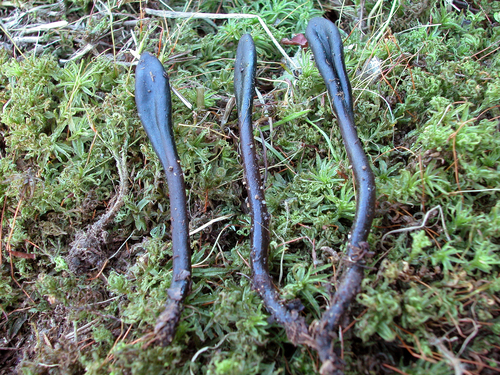
Glutinoglossum orientale
Edibility unknown — do not eat - No photo yet
Glutinoglossum pseudoglutinosum
Edibility unknown — do not eat - No photo yet
Glutinoglossum triseptatum
Edibility unknown — do not eat -

Glutinoglossum heptaseptatum
Edibility unknown — do not eat - No photo yet
Glutinoglossum lumbricale
Edibility unknown — do not eat
Never eat a wild mushroom based on this site or any app. See safety basics and the disclaimer.