

Gallaicolichen pacificus
Gallaicolichen pacificus Sérus. & Lücking
Edibility
Edibility unknown — do not eat
Never eat a wild mushroom based on this site or any app.
Photos
-
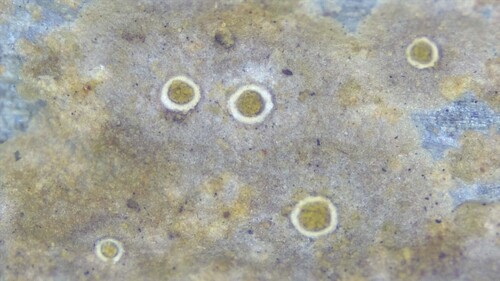
Photo: Kevin Faccenda. CC-BY. Source (inaturalist) -
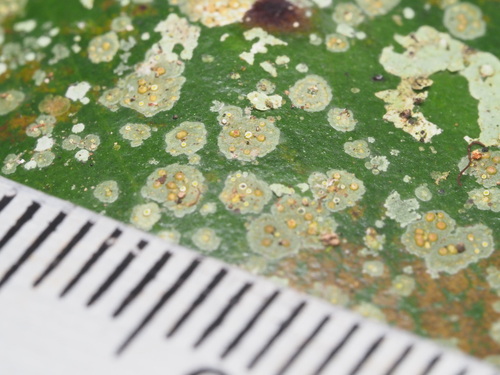
Photo: Kevin Faccenda. CC-BY. Source (inaturalist) -
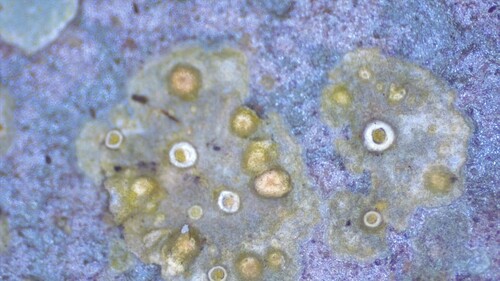
Photo: Kevin Faccenda. CC-BY. Source (inaturalist)
Lookalikes
No lookalikes are recorded for this species yet. That does not mean there are none. Many mushrooms look alike, so never rely on appearance alone.
Season
When this species has been recorded, by month, from open-licensed US and Canada observations. It shows when people report it, not a guarantee it is fruiting.
The highlighted bar is the current month.
View season data as a table
| Month | Records |
|---|---|
| January | 0 |
| February | 0 |
| March | 1 |
| April | 1 |
| May | 0 |
| June | 0 |
| July | 0 |
| August | 0 |
| September | 0 |
| October | 0 |
| November | 0 |
| December | 0 |
Where it is found
States and provinces with the most records. Check the foraging rules for the place you plan to visit.
- Hawaii 2 records · Foraging rules
About
Gallaicolichen is a fungal genus that contains the single species Gallaicolichen pacificus, a foliicolous (leaf-dwelling) lichen. Originally discovered in Hawaii in 2007, G. pacificus has since been found in various locations across the Pacific, including Australia, New Caledonia, Vanuatu, the Philippines, and Japan. The lichen forms small, pale greenish-yellow to yellowish-grey patches on leaves, typically in mid-altitude forests and along forest edges. G. pacificus is notable for its unique reproductive structures called peltidiangia, which produce disc-shaped propagules (peltidia) for asexual reproduction. Initially, its taxonomic classification was uncertain, but recent discoveries of specimens with sexual reproductive structures (perithecia) have enabled scientists to confidently place it within the family Porinaceae.
From Wikipedia, CC BY-SA 4.0. Read the original article.
Recent finds
No community finds tagged with this species yet. Log a find.
Never eat a wild mushroom based on this site or any app. See safety basics and the disclaimer.