

Dirina pacifica
Dirina pacifica Tehler & Ertz
Edibility
Edibility unknown — do not eat
Never eat a wild mushroom based on this site or any app.
Lookalikes
No lookalikes are recorded for this species yet. That does not mean there are none. Many mushrooms look alike, so never rely on appearance alone.
Season
When this species has been recorded, by month, from open-licensed US and Canada observations. It shows when people report it, not a guarantee it is fruiting.
The highlighted bar is the current month.
View season data as a table
| Month | Records |
|---|---|
| January | 0 |
| February | 0 |
| March | 0 |
| April | 0 |
| May | 9 |
| June | 0 |
| July | 0 |
| August | 0 |
| September | 1 |
| October | 1 |
| November | 0 |
| December | 0 |
Where it is found
States and provinces with the most records. Check the foraging rules for the place you plan to visit.
- Hawaii 4 records · Foraging rules
About
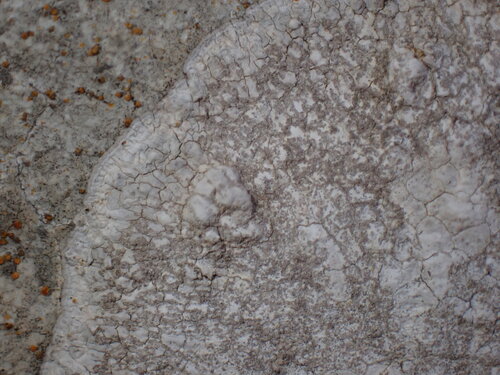
Dirina pacifica is a species of saxicolous (rock-dwelling), crustose lichen in the family Roccellaceae. It is found in both Hawaii and the Galápagos Islands, where it grows in coastal outcrops. The lichen was formally described as a new species in 2013 by Anders Tehler and Damien Ertz. The type specimen was collected from Koolaupoko (Oahu, Hawaii). The species epithet refers to the Pacific Ocean. It has a creamy white to greyish or brownish thallus (0.1–0.3 mm thick) lacking pruina, and a chalk-like medulla. Its ascomata have a circular outline up to 1.5 mm in diameter, with a whitish-grey disc. Its ascospores measure 19–27 by 4–5 μm. Dirina pacifica contains the lichen products erythrin, lecanoric acid, and sometimes three unidentified substances named "C", "F", and "G".
From Wikipedia, CC BY-SA 4.0. Read the original article.
Recent finds
No community finds tagged with this species yet. Log a find.
More in the genus Dirina
Never eat a wild mushroom based on this site or any app. See safety basics and the disclaimer.