

Veiled Polypore
Cryptoporus volvatus (Peck) Shear
Also called: Cryptic Globe Fungus
Edibility
Edibility unknown — do not eat
Never eat a wild mushroom based on this site or any app.
Photos
-
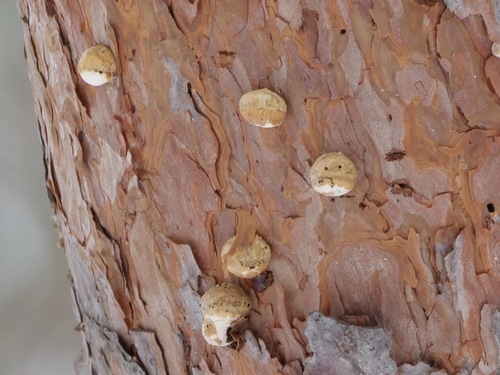
Photo: Aidan Hamilton. CC0. Source (inaturalist) -
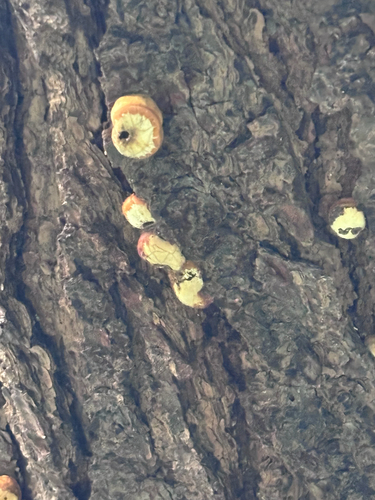
Photo: reagan peschke. CC-BY. Source (inaturalist) -
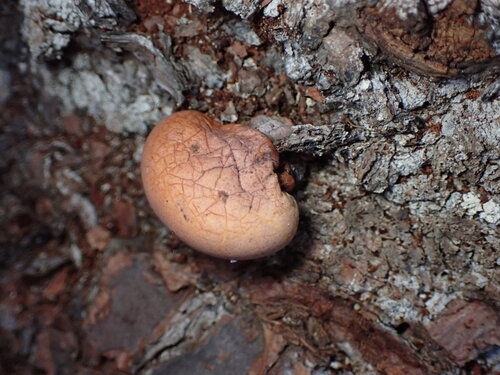
Photo: W Rao. CC-BY. Source (inaturalist) -
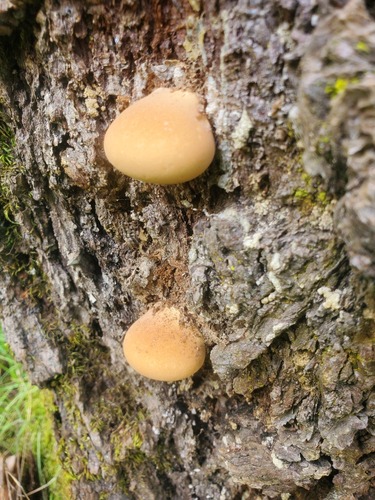
Photo: Alex. CC-BY. Source (inaturalist)
Lookalikes
No lookalikes are recorded for this species yet. That does not mean there are none. Many mushrooms look alike, so never rely on appearance alone.
Season
When this species has been recorded, by month, from open-licensed US and Canada observations. It shows when people report it, not a guarantee it is fruiting.
The highlighted bar is the current month.
View season data as a table
| Month | Records |
|---|---|
| January | 53 |
| February | 75 |
| March | 129 |
| April | 308 |
| May | 459 |
| June | 386 |
| July | 268 |
| August | 245 |
| September | 161 |
| October | 107 |
| November | 57 |
| December | 42 |
Where it is found
States and provinces with the most records. Check the foraging rules for the place you plan to visit.
- California 718 records · Foraging rules
- British Columbia 405 records · Foraging rules
- Oregon 126 records · Foraging rules
- Ontario 109 records · Foraging rules
- Washington 107 records · Foraging rules
- Utah 75 records · Foraging rules
- Massachusetts 66 records · Foraging rules
- Idaho 61 records · Foraging rules
- New York 59 records · Foraging rules
- Colorado 51 records · Foraging rules
- Montana 47 records · Foraging rules
- Pennsylvania 30 records · Foraging rules
- Wyoming 26 records · Foraging rules
- Ohio 25 records · Foraging rules
- Virginia 25 records · Foraging rules
Show 34 more
- Quebec24 records
- West Virginia21 records
- Maryland19 records
- Nevada18 records
- Michigan16 records
- Minnesota15 records
- Arizona11 records
- Vermont10 records
- New Hampshire10 records
- Prince Edward Island10 records
- New Jersey9 records
- Nova Scotia9 records
- Florida8 records
- Manitoba8 records
- Georgia6 records
- District of Columbia5 records
- Tennessee5 records
- Wisconsin5 records
- Alabama4 records
- Maine4 records
- New Brunswick4 records
- New Mexico4 records
- Rhode Island4 records
- Delaware3 records
- North Carolina3 records
- Alaska2 records
- Alberta2 records
- Connecticut2 records
- Iowa2 records
- Texas2 records
- Arkansas1 records
- Indiana1 records
- South Carolina1 records
- South Dakota1 records
Identification traits
| Underside (gills, pores or teeth) | pores |
|---|---|
| Ecology | saprotrophic |
| Spore print color | pink |
Traits vary. Use them to ask better questions of an expert, not to make a final call.
About
Cryptoporus volvatus, commonly known as the veiled polypore or cryptic globe fungus, is a polypore fungus that decomposes the rotting sapwood of conifers. It is an after effect of attack by the pine bark beetle. The fungus was originally described by American mycologist Charles Horton Peck in 1875 as Polyporus volvatus. Cornelius Lott Shear transferred it to the genus Cryptoporus in 1902. The fruiting body is 1.5–8.5 centimetres (1⁄2–3+1⁄4 in) across and cream or tan in color. It is hollow inside and a hole is either torn by insects or a tear appears on the underside. There are 3–4 whitish pores per millimetre, hidden by the veil-like margin. The spores are pinkish. Some insects lay their larvae inside the fruiting body. Due to its toughness, it is inedible.
From Wikipedia, CC BY-SA 4.0. Read the original article.
Never eat a wild mushroom based on this site or any app. See safety basics and the disclaimer.