

Blushing Webcap
Cortinarius cyanites Fr.
Edibility
Edibility unknown — do not eat
Never eat a wild mushroom based on this site or any app.
Lookalikes
No lookalikes are recorded for this species yet. That does not mean there are none. Many mushrooms look alike, so never rely on appearance alone.
Season
When this species has been recorded, by month, from open-licensed US and Canada observations. It shows when people report it, not a guarantee it is fruiting.
The highlighted bar is the current month.
View season data as a table
| Month | Records |
|---|---|
| January | 0 |
| February | 0 |
| March | 0 |
| April | 0 |
| May | 0 |
| June | 1 |
| July | 20 |
| August | 29 |
| September | 12 |
| October | 5 |
| November | 6 |
| December | 0 |
Where it is found
States and provinces with the most records. Check the foraging rules for the place you plan to visit.
- Michigan 18 records · Foraging rules
- British Columbia 10 records · Foraging rules
- Quebec 10 records · Foraging rules
- California 7 records · Foraging rules
- Alaska 6 records · Foraging rules
- Washington 5 records · Foraging rules
- Colorado 2 records · Foraging rules
- Tennessee 2 records · Foraging rules
- North Carolina 2 records · Foraging rules
- Idaho 2 records · Foraging rules
- Wyoming 1 records · Foraging rules
- Massachusetts 1 records · Foraging rules
- Maine 1 records · Foraging rules
- New Hampshire 1 records · Foraging rules
- Alberta 1 records · Foraging rules
About
Cortinarius cyanites is a basidiomycete fungus of the genus Cortinarius native to Europe. Elias Magnus Fries described this species in his 1838 book Epicrisis Systematis Mycologici seu Synopsis Hymenomycetum as Cortinarius cyanites. The species name is derived from the Ancient Greek cyanos "dark blue" Within the large genus Cortinarius, it is classified in the subgenus Phlegmacium and section Cyanites. Genetic analysis showed in 2014 that two previously-described species—C. subcyanites and C. pseudocyanites—lay within the concept of C. cyanites, but conversely revealed three distinct lineages, with two new species—C. boreicyanites and C. violaceorubens—described. The fruitbodies of this fungus have convex caps, with diameters typically in the range 5 to 12 cm (2.0 to 4.7 in), and various shades of violet, brown or grey. They are slimy when young, and later have brown scales. The pale purple stipe is bulbous, 9–15 cm (3.5–5.9 in) in height and 2–3.5 cm (0.79–1.38 in) in width. The flesh is purple, but turns blood red when bruised or cut. The gills on the cap underside have an adnate attachment to the stipe and purple color; later, the deepens to rusty brown as the spores mature. The smell has been described as pleasant and fruity. The lemon-shaped spores measure 8–11.5 by 5–6.5 μm. C. boreicyanites and C. violaceorubens have smaller and larger spores respectively. C. violaceorubens has a dark purple-brown cap, while that of C. boreicyanites is more bluish. Cortinarius cyanites is found in mixed coniferous and deciduous forests in southern Finland, central Sweden southwards into France. Cortinarius cyanites is not edible.
From Wikipedia, CC BY-SA 4.0. Read the original article.
Recent finds
No community finds tagged with this species yet. Log a find.
More in the genus Cortinarius
-

Cortinarius casimirii
Edibility unknown — do not eat -
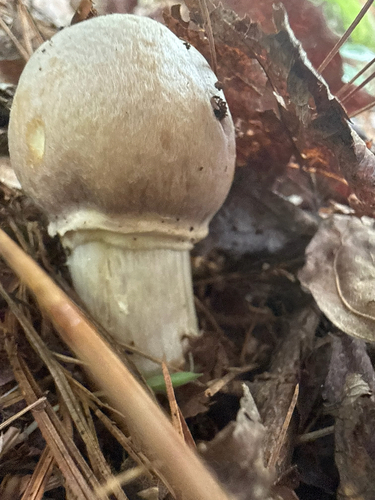
The Gypsy
Cortinarius caperatus
Edible (per source) -
Blunt Webcap
Cortinarius obtusus
Edibility unknown — do not eat -
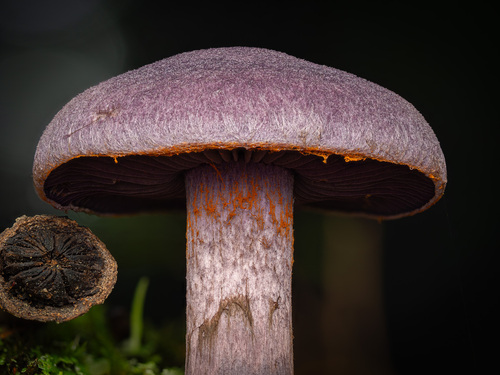
Violet Webcap
Cortinarius violaceus
Caution -
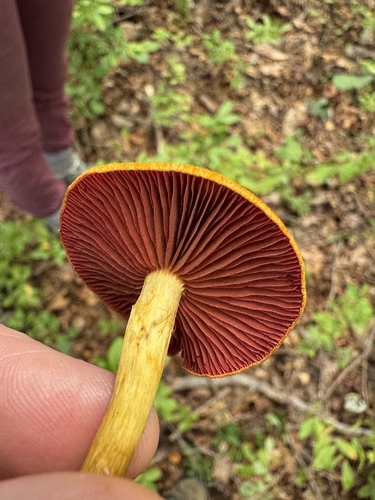
Surprise Webcap
Cortinarius semisanguineus
Edibility unknown — do not eat -
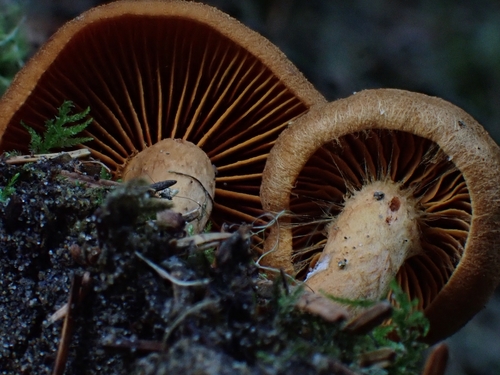
Cinnamon Webcap
Cortinarius cinnamomeus
Caution -
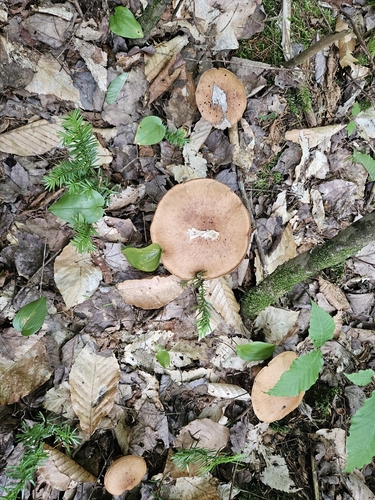
Red Banded Webcap
Cortinarius armillatus
Caution -
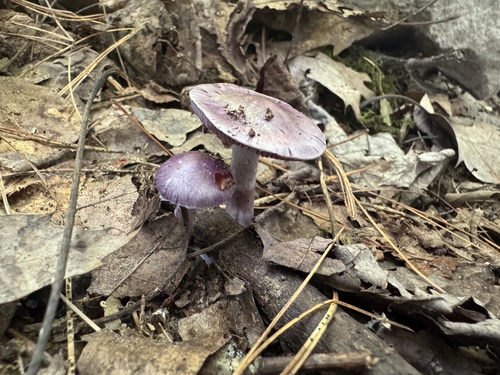
Viscid Violet Cort
Cortinarius iodes
Edibility unknown — do not eat
Never eat a wild mushroom based on this site or any app. See safety basics and the disclaimer.