

Western Pine-Aster Rust
Coleosporium asterum (Dietel) Syd. & P.Syd.
Edibility
Edibility unknown — do not eat
Never eat a wild mushroom based on this site or any app.
Photos
-
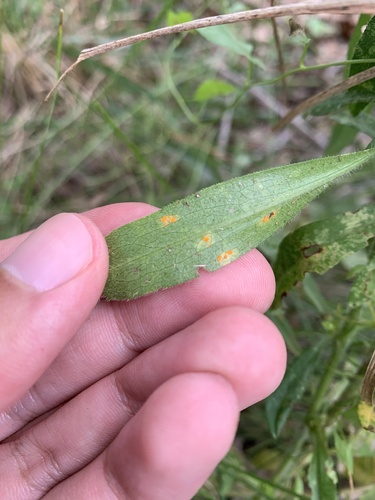
Photo: Senna Bryce Robeson. CC-BY. Source (inaturalist) -
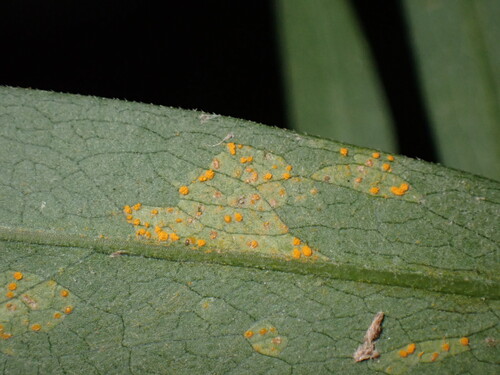
Photo: W Rao. CC-BY. Source (inaturalist) -
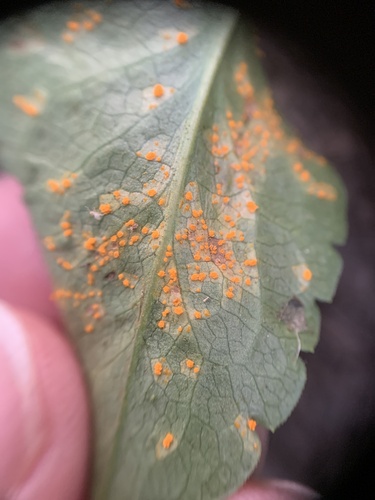
Photo: Senna Bryce Robeson. CC-BY. Source (inaturalist) -
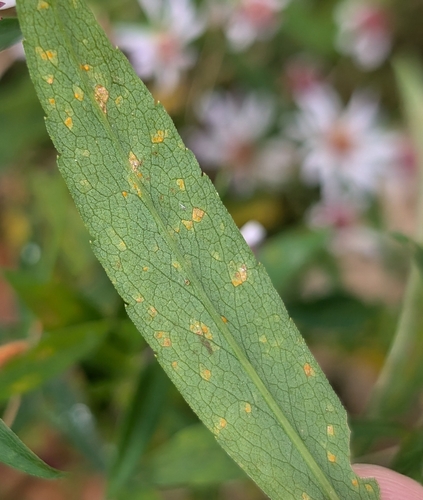
Photo: Alan Prather. CC-BY. Source (inaturalist)
Lookalikes
No lookalikes are recorded for this species yet. That does not mean there are none. Many mushrooms look alike, so never rely on appearance alone.
Season
When this species has been recorded, by month, from open-licensed US and Canada observations. It shows when people report it, not a guarantee it is fruiting.
The highlighted bar is the current month.
View season data as a table
| Month | Records |
|---|---|
| January | 12 |
| February | 29 |
| March | 122 |
| April | 163 |
| May | 496 |
| June | 666 |
| July | 829 |
| August | 2,068 |
| September | 2,591 |
| October | 1,719 |
| November | 189 |
| December | 17 |
Where it is found
States and provinces with the most records. Check the foraging rules for the place you plan to visit.
- New York 818 records · Foraging rules
- Wisconsin 531 records · Foraging rules
- Connecticut 501 records · Foraging rules
- Ontario 488 records · Foraging rules
- Pennsylvania 402 records · Foraging rules
- North Carolina 314 records · Foraging rules
- Maryland 303 records · Foraging rules
- Illinois 288 records · Foraging rules
- Montana 248 records · Foraging rules
- Indiana 238 records · Foraging rules
- Washington 227 records · Foraging rules
- California 223 records · Foraging rules
- Massachusetts 221 records · Foraging rules
- Minnesota 209 records · Foraging rules
- Virginia 209 records · Foraging rules
Show 47 more
- Ohio175 records
- Nebraska173 records
- Tennessee172 records
- Florida170 records
- Quebec169 records
- New Jersey168 records
- New Hampshire145 records
- Colorado142 records
- Georgia141 records
- District of Columbia132 records
- North Dakota131 records
- Idaho128 records
- West Virginia125 records
- Kansas123 records
- Arkansas117 records
- Manitoba110 records
- South Carolina107 records
- Rhode Island105 records
- Maine101 records
- Vermont99 records
- South Dakota94 records
- Oregon92 records
- Missouri87 records
- Alberta81 records
- British Columbia80 records
- Michigan77 records
- Alabama56 records
- Delaware48 records
- Saskatchewan41 records
- Nova Scotia40 records
- Iowa39 records
- New Brunswick31 records
- Kentucky31 records
- Texas28 records
- Mississippi27 records
- Wyoming25 records
- Louisiana24 records
- New Mexico19 records
- Prince Edward Island14 records
- Newfoundland and Labrador13 records
- Yukon10 records
- Alaska10 records
- Arizona5 records
- Northwest Territories5 records
- Oklahoma2 records
- Utah2 records
- Hawaii1 records
About
Coleosporium asterum is a species of rust fungus in the family Coleosporiaceae. It infects species in the Asteraceae family, such as those in genus Aster and Solidago, as well as the needle pines Pinus contorta and P. banksiana. It has been recorded on aster family species Canadanthus modestus, Eurybia conspicua, Solidago missouriensis, Symphyotrichum ciliolatum, S. laeve, and numerous others. The basionym of Coleosporium asterum is Stichopsora asterum, and the fungus originally was found in 1898 on leaves of the Asteraceae species Callistephus chinensis, Aster scaber (now Doellingeria scabra), and Aster tataricus on the island of Honshu, Japan.
From Wikipedia, CC BY-SA 4.0. Read the original article.
More in the genus Coleosporium
- No photo yet
Coleosporium ipomoeae
Edibility unknown — do not eat - No photo yet
Coleosporium vernoniae
Edibility unknown — do not eat - No photo yet
Coleosporium carneum
Edibility unknown — do not eat - No photo yet
Coleosporium elephantopodis
Edibility unknown — do not eat - No photo yet
Coleosporium jonesii
Edibility unknown — do not eat - No photo yet
Coleosporium helianthi
Edibility unknown — do not eat - No photo yet
Coleosporium campanulae
Edibility unknown — do not eat - No photo yet
Coleosporium tussilaginis
Edibility unknown — do not eat
Never eat a wild mushroom based on this site or any app. See safety basics and the disclaimer.