

Cladonia subcervicornis
Cladonia subcervicornis (Vain.) Kernst.
Edibility
Edibility unknown — do not eat
Never eat a wild mushroom based on this site or any app.
Lookalikes
No lookalikes are recorded for this species yet. That does not mean there are none. Many mushrooms look alike, so never rely on appearance alone.
Season
When this species has been recorded, by month, from open-licensed US and Canada observations. It shows when people report it, not a guarantee it is fruiting.
The highlighted bar is the current month.
View season data as a table
| Month | Records |
|---|---|
| January | 1 |
| February | 0 |
| March | 4 |
| April | 0 |
| May | 0 |
| June | 1 |
| July | 4 |
| August | 1 |
| September | 1 |
| October | 0 |
| November | 1 |
| December | 0 |
Where it is found
States and provinces with the most records. Check the foraging rules for the place you plan to visit.
- Alaska 7 records · Foraging rules
- Florida 2 records · Foraging rules
- Massachusetts 2 records · Foraging rules
- Northwest Territories 1 records · Foraging rules
- California 1 records · Foraging rules
About
Cladonia subcervicornis is a species of fruticose lichen in the family Cladoniaceae. It is found primarily in oceanic regions of northern and western Europe. First described in 1894, it is distinguished by its cushion-like growth habit and a prominent primary thallus made up of large, erect, greyish-green squamules with darkened undersides. The species typically grows on thin layers of humus in rock crevices along coastal areas, particularly in heath environments, where it can become locally abundant. While it produces both sexual and asexual reproductive structures frequently, genetic studies suggest it has limited dispersal capabilities, with populations even a few kilometres apart showing significant genetic differences. The species has been recorded across Western Europe and the Macaronesian Islands, with rare occurrences in Eastern Europe, though historical reports of its presence in North America have been determined to be incorrect.
From Wikipedia, CC BY-SA 4.0. Read the original article.
Recent finds
No community finds tagged with this species yet. Log a find.
More in the genus Cladonia
-
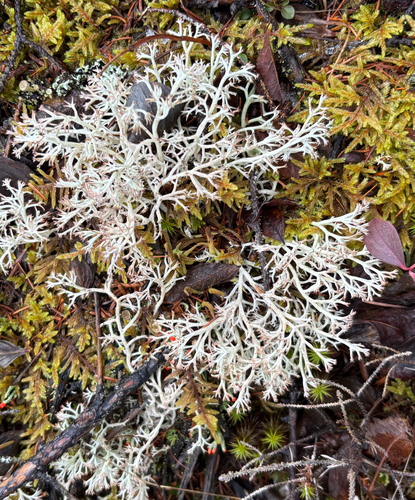
Reindeer Moss
Cladonia rangiferina
Edibility unknown — do not eat -
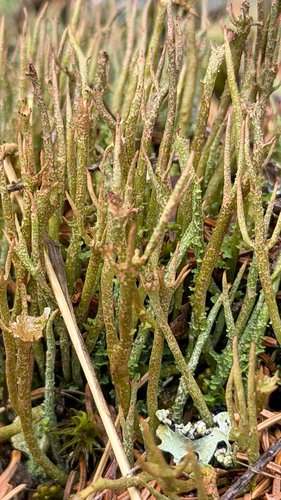
Smooth Cladonia
Cladonia gracilis
Edibility unknown — do not eat -
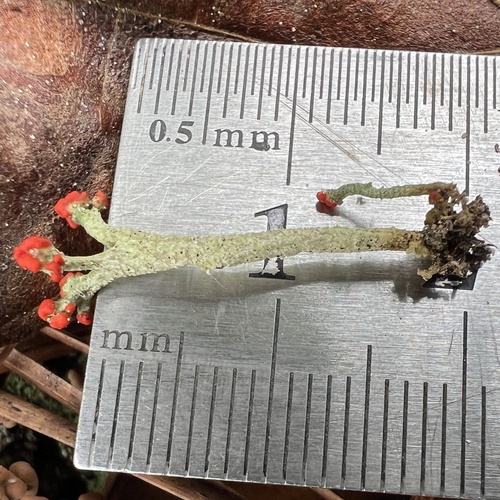
British soldier lichen
Cladonia cristatella
Edibility unknown — do not eat -
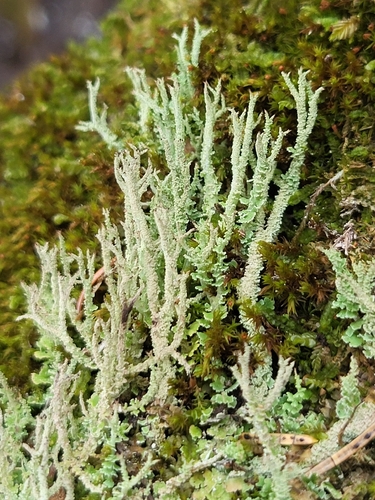
Dragon Horn
Cladonia squamosa
Edibility unknown — do not eat -
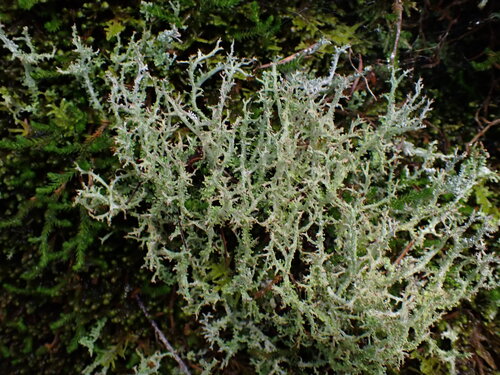
Many-forked Cladonia
Cladonia furcata
Edibility unknown — do not eat -
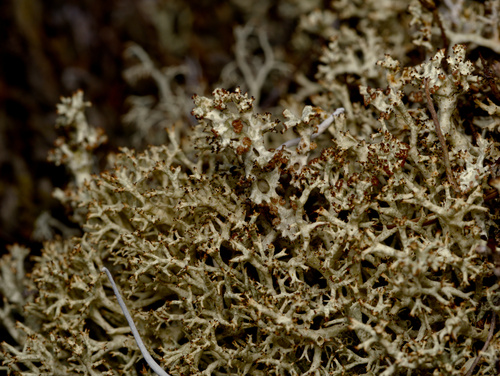
Thorn Lichen
Cladonia uncialis
Edibility unknown — do not eat -
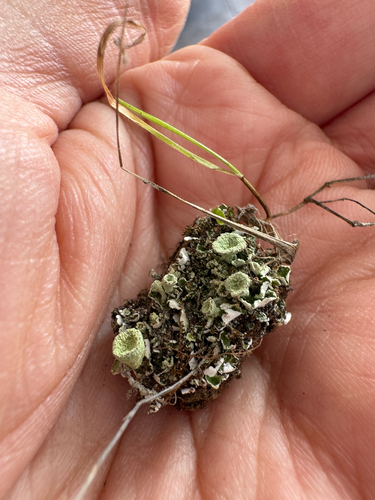
Mealy Pixie-cup
Cladonia chlorophaea
Edibility unknown — do not eat -
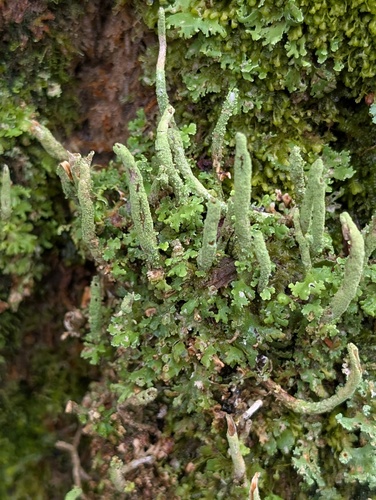
Common Powderhorn
Cladonia coniocraea
Edibility unknown — do not eat
Never eat a wild mushroom based on this site or any app. See safety basics and the disclaimer.