

Barometer Earthstar
Astraeus hygrometricus (Pers.) Morgan
Also called: Hygroscopic Earthstar, False Earthstar
Safety first
Many edible mushrooms have toxic lookalikes, and some of those can be fatal. Have any mushroom identified in person by a local expert before you eat it.
If someone may have eaten a wild mushroom, call US Poison Control at 1-800-222-1222 or 911 right away. In Canada, call your provincial poison centre or 911.
Edibility
Inedible Source: Wikipedia: Astraeus hygrometricus
Classification from Wikipedia: Astraeus hygrometricus. Sources can be wrong or incomplete, and people react differently.
Never eat a wild mushroom based on this site or any app.
Photos
-
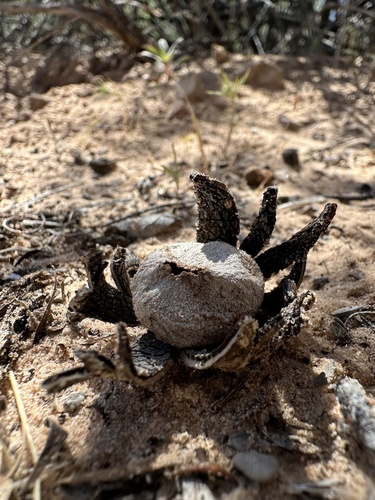
Photo: Katrina Smith. CC-BY. Source (inaturalist) -
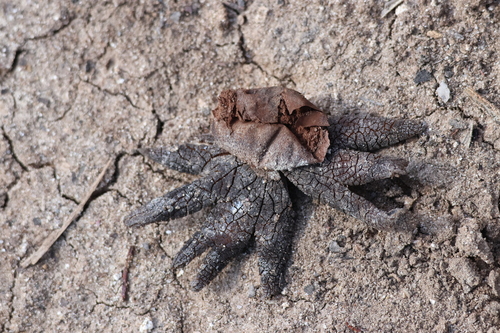
Photo: Millie Basden. CC-BY. Source (inaturalist) -

Photo: mel letterman. CC-BY. Source (inaturalist) -
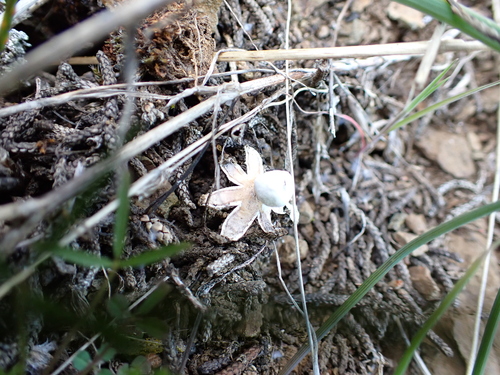
Photo: Neal Kelso. CC-BY. Source (inaturalist)
Lookalikes
No lookalikes are recorded for this species yet. That does not mean there are none. Many mushrooms look alike, so never rely on appearance alone.
Season
When this species has been recorded, by month, from open-licensed US and Canada observations. It shows when people report it, not a guarantee it is fruiting.
The highlighted bar is the current month.
View season data as a table
| Month | Records |
|---|---|
| January | 87 |
| February | 68 |
| March | 95 |
| April | 116 |
| May | 128 |
| June | 138 |
| July | 165 |
| August | 222 |
| September | 156 |
| October | 169 |
| November | 91 |
| December | 64 |
Where it is found
States and provinces with the most records. Check the foraging rules for the place you plan to visit.
- California 188 records · Foraging rules
- Florida 170 records · Foraging rules
- Wisconsin 78 records · Foraging rules
- Michigan 75 records · Foraging rules
- Massachusetts 74 records · Foraging rules
- New York 68 records · Foraging rules
- Pennsylvania 64 records · Foraging rules
- North Carolina 55 records · Foraging rules
- Colorado 55 records · Foraging rules
- New Mexico 53 records · Foraging rules
- Arizona 50 records · Foraging rules
- New Jersey 49 records · Foraging rules
- Utah 45 records · Foraging rules
- Texas 39 records · Foraging rules
- Ontario 34 records · Foraging rules
Show 43 more
- Virginia33 records
- Tennessee30 records
- Oregon30 records
- Minnesota27 records
- Illinois26 records
- Georgia26 records
- Connecticut25 records
- South Carolina24 records
- Ohio23 records
- Indiana23 records
- Maryland22 records
- Alabama22 records
- Delaware17 records
- West Virginia14 records
- British Columbia14 records
- Quebec13 records
- New Brunswick10 records
- District of Columbia9 records
- Washington8 records
- Manitoba8 records
- Kansas7 records
- Maine7 records
- Mississippi7 records
- Iowa5 records
- Kentucky5 records
- Louisiana4 records
- Nevada3 records
- Oklahoma3 records
- Vermont3 records
- Missouri3 records
- New Hampshire2 records
- Nova Scotia2 records
- Rhode Island2 records
- Idaho2 records
- Alberta2 records
- Alaska1 records
- Hawaii1 records
- North Dakota1 records
- Prince Edward Island1 records
- Saskatchewan1 records
- Wyoming1 records
- Yukon1 records
- Arkansas1 records
Identification traits
| Underside (gills, pores or teeth) | gleba |
|---|---|
| Ecology | mycorrhizal |
| Spore print color | brown |
Traits vary. Use them to ask better questions of an expert, not to make a final call.
About
Astraeus hygrometricus, commonly known as the hygroscopic earthstar, the barometer earthstar, or the false earthstar, is a species of fungus in the family Diplocystaceae. Despite a similar overall appearance, A. hygrometricus is not related to the true earthstars of genus Geastrum, although historically, they have been taxonomically confused. The species was first described by Christiaan Hendrik Persoon in 1801 as Geastrum hygrometricus. In 1885, Andrew P. Morgan proposed that differences in microscopic characteristics warranted the creation of a new genus Astraeus distinct from Geastrum; this opinion was not universally accepted by later authorities. Several Asian populations formerly thought to be A. hygrometricus were renamed in the 2000s once phylogenetic analyses revealed they were unique Astraeus species, including A. asiaticus and A. odoratus. Similarly, in 2013, North American populations were divided into A. pteridis, A. morganii, and A. smithii on the basis of molecular phylogenetics. Young specimens resemble a puffball when unopened. In maturity, the mushroom displays the characteristic earthstar shape that is a result of the outer layer of fruit body tissue splitting open in a star-like manner. The false earthstar is an ectomycorrhizal species that grows in association with various trees, especially in sandy soils. A. hygrometricus was previously thought to have a cosmopolitan distribution, though it is now thought to be restricted to Southern Europe, and Astraeus are common in temperate and tropical regions. Its common names refer to the fact that it is hygroscopic (water-absorbing) and can open up its rays to expose the spore sac in response to increased humidity, then close them up again in drier conditions. The rays have an irregularly cracked surface, while the spore case is pale brown and smooth with an irregular slit or tear at the top. The gleba is white initially, but turns brown and powdery when the spores mature. The spores are reddish-brown and roughly spherical with minute warts, measuring 7.5–11 micrometers in diameter. Research has revealed the presence of several bioactive chemical compounds in Astraeus fruit bodies. North American field guides typically rate A. hygrometricus as inedible; while this may be accurate for the now-separate North American species, A. hygrometricus is commonly consumed in South and Southeast Asia.
From Wikipedia, CC BY-SA 4.0. Read the original article.
Never eat a wild mushroom based on this site or any app. See safety basics and the disclaimer.