

Aspicilia phaea
Aspicilia phaea Owe-Larss. & A.Nordin
Edibility
Edibility unknown — do not eat
Never eat a wild mushroom based on this site or any app.
Lookalikes
No lookalikes are recorded for this species yet. That does not mean there are none. Many mushrooms look alike, so never rely on appearance alone.
Season
When this species has been recorded, by month, from open-licensed US and Canada observations. It shows when people report it, not a guarantee it is fruiting.
The highlighted bar is the current month.
View season data as a table
| Month | Records |
|---|---|
| January | 0 |
| February | 0 |
| March | 3 |
| April | 3 |
| May | 2 |
| June | 5 |
| July | 0 |
| August | 4 |
| September | 2 |
| October | 11 |
| November | 1 |
| December | 2 |
Where it is found
States and provinces with the most records. Check the foraging rules for the place you plan to visit.
- California 32 records · Foraging rules
- North Carolina 1 records · Foraging rules
About
Aspicilia phaea (dusky sunken disk lichen) is a grayish brown to tan areolate crustose lichen commonly found on rock in coastal to inland parts of central and southern California. Described as new to science in 2007, it is endemic to (only found in) California. It grows on exposed or partially shaded siliceous rock, with a few known occurrences on serpentine rock. In rare cases full areolas do not form, and it appears as being cracked (rimose). There are often grayish or whitish spots on the areolas. The thallus is 2–8 cm in diameter, and 0.1– 1.2 mm thick. The areolas are irregularly sized and angular, giving the lichen body (thallus) the appearance of a mosaic of small polygons. A rim of dark tissue (prothallus) may surround the edges of the lichen. The fruiting body parts (apothecia) are flat to concave (especially in the thallus center), and slightly immersed in the thallus, appearing as sunken round to polygonal discs, often with a grey or white rim of thalline tissue. Lichen spot tests are all negative (K−, C−, KC−, P−). The photobiont is a chlorococcoid. In Joshua Tree National Park, it is commonly found to be infected with Lichenostigma, a genus or lichenicolous fungi (fungi that are parasitic on lichens).
From Wikipedia, CC BY-SA 4.0. Read the original article.
Recent finds
No community finds tagged with this species yet. Log a find.
More in the genus Aspicilia
-
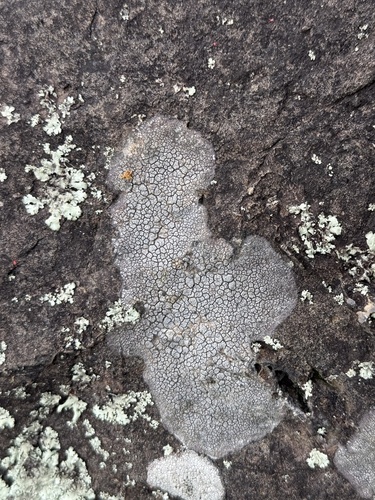
Cinder Lichen
Aspicilia cinerea
Edibility unknown — do not eat -
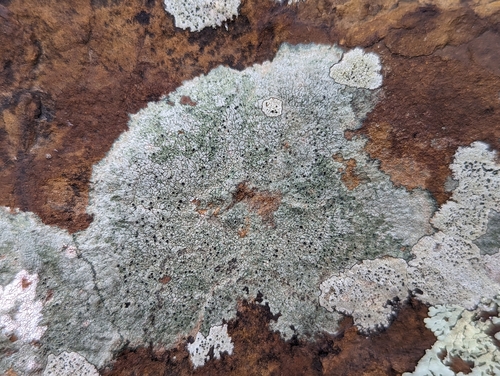
Smooth Sunken Disc Lichen
Aspicilia laevata
Edibility unknown — do not eat - No photo yet
American aspicilia
Aspicilia americana
Edibility unknown — do not eat - No photo yet
Warty Sunken Disk Lichen
Aspicilia verrucigera
Edibility unknown — do not eat - No photo yet
Aspicilia filiformis
Edibility unknown — do not eat - No photo yet
Rimmed Lichen
Aspicilia reptans
Edibility unknown — do not eat - No photo yet
desert aspicilia
Aspicilia desertorum
Edibility unknown — do not eat - No photo yet
Chalky Sunken Disk Lichen
Aspicilia candida
Edibility unknown — do not eat
Never eat a wild mushroom based on this site or any app. See safety basics and the disclaimer.